

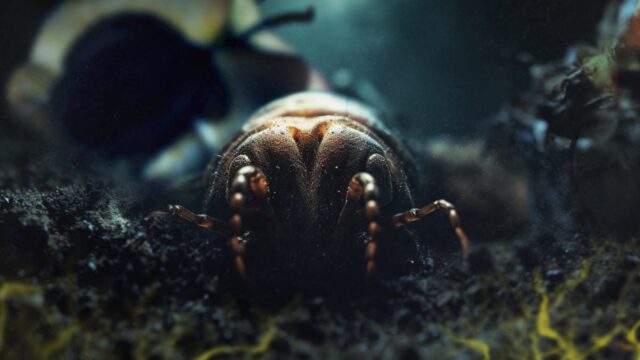
“Are you sure about this, who’s going to want to watch a film about leftovers and creepy crawlies? It’s gross!” exclaims producer Sally Blake (Films a Cinq).
“Mais non, Sally, nothing can be further from the truth. This is a film packed with intriguing and surprising behaviour where life and death duels play out in miniature in a fascinating Miyazaki-like universe, with gorgeous macrophotography. Your rotten kiwis never looked so good,” replies fellow producer Julien Adam (Capa Presse).
Adam and Blake invited the professional audience at Sunny Side of the Doc into their loamy world of the compost bin during their Science Pitch of Compost, The Hidden Treasure of our Waste, directed by Guilhem Touzery.
‘Discover a gangrenous landscape of rot inhabited by giant, nightmarish monsters. Woodlice, centipedes, earwigs, pseudo scorpions, spiders, ants, slugs and vast armies of bacteria and fungi, multiplying at frenetic speeds, devouring everything in their path. But this repugnant, rancid world is also the scene of a fascinating transformation,’ reads the project logline.
The film is at early stage, but plans are afoot to take viewers through the four phases of the decomposition cycle, asking us to consider what happens after they throw out their leftovers and hastily close the lid to our bin. It’s a subject close to many viewers’ hearts, the team suggest, and the film is part-funded by an environmental initiative of the French government.
“Recently there has been a push to make composting more widespread in France because, of course, composting is a very cheap and easy environmental gesture. By keeping organic matter out of the garbage, you reduce greenhouse gases…and it helps the world’s soil,” explains Blake.
The subject is a very universal one, and can easily be adapted for international audiences, she further suggests. “In the French version, which is 90 minutes, we have a little bit more of that human story around the actual compost, where we’re following a family who will interact with scientists. The 52-minute could be a more straightforward [version], which is with wildlife and scientists, an immersive experience into what happens in the box.”
That immersive experience is key to the overall cinematic approach, according to Julien Adam. “There’s room for an essay film for sure, but I think we really wanted to go for a primetime audience, and it was the creepy joy and cool images and beauty of this rotting world that we wanted people to experience,’ he says.
“Compost is an immersive experience into a world you simply didn’t know about before – perhaps you thought you didn’t want to know about…Our story begins where you think everything ends, in a world of surprising beauty…where the oldest of miracles unfolds, a story where nothing is lost and everything transforms,” Blake adds.
The team plans to start shooting in March 2026, with estimated completion in March 2027. The project is already set for broadcast on France Télévisions, and is currently looking for sales agents, co-producers, foreign TV channels, and further funding.





