One of the Seven Wonders of the World is revisited using latest technology, with a promise to unravel the final secrets of the iconic Lighthouse of Alexandria. Gedeon Programmes’ The Lighthouse of Alexandria Decoded, directed by Laurence Thiriat, will be, producer Coraline Roch suggests, “a cinematic journey that will captivate global audiences and let them witness the reverse of the Wonder thought lost forever.”
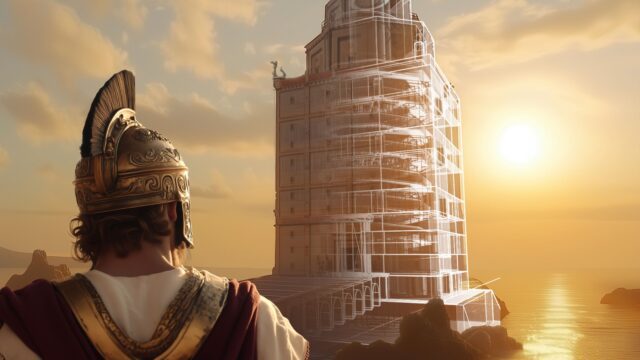
AI-powered technology will use 3D modelling to create the most accurate reconstruction of the lighthouse and ancient city ever achieved, with the help of Dassault Systèmes Foundation. According to the filmmakers, the Dassault Systèmes digital tool will help scientists around the world to explore its construction and collapse, revealing the truth behind the myth.
The remains of the lighthouse, which guided sailors and symbolized the city’s power, lies at the tip of the Pharos peninsula of Alexandria’s coast and was built in the 4th century BC by Pharaoh Ptolemy I. “For nearly 17 centuries, it stood as mankind’s first skyscraper until its mysterious disappearance. Now, 30 years after the first archaeological excavation by Jean-Yves Empereur, the Pharos project has a new start,” the film notes elucidate.
The film will see the most accurate 3D reconstruction of the lighthouse to-date and will gather scientists, archaeologists and researchers in the harbour of Alexandria to reconstruct the rise and fall of the monument.
The day after the SSD pitch, Gedeon Programmes published news of a long-awaited engineering and archaeological feat: 19 of the lighthouse’s largest stone blocks were successfully lifted out of the water, overseen by archaeologist Isabelle Hairy’s team – a remarkable achievement that will catapult the project to its next stage.
The blocks include monumental door lintels and jambs weighing 70 to 80 tons; large base slabs which form parts of the sunken monument, and a pylon with an Egyptian-style door crafted from the Hellenistic period. Like pieces of a giant archaeological puzzle, each newly excavated architectural element block will be analyzed and repositioned virtually alongside a collection of over one hundred blocks that have already been digitized underwater over the past decade. Then, using scientific simulations and virtual worlds, the team of engineers will test hypotheses about the lighthouse’s construction and collapse, and create a digital twin of this lost wonder.
Gedeon Programmes supported the mission by funding the barge and crane to lift the lighthouse blocks, and the director Laurence Thiriat captured the iconic spectacle of the ancient blocks emerging from the water and will have incredible access to the subsequent work to reconstruct the history of the lighthouse.
The team are in the final stages of writing the script for a 90-minute version, and there will also be a 52-minute cut for the international TV market.
“We have gathered approximately 40% [of the budget]. The lifting operations, all the authorizations in Egypt are very costly. So this is a project that stands at 732,000 euros. And we are ready to discuss where we should put the cursor on the 52-minute version because obviously this is a mix of science and history, and I’m sure this question will be raised at the market,” Isabelle Graziadey, Head of Coproduction and Distribution told the professional audience at Sunny Side of the Doc.
Current partners are France Télévisions (France) and SBS (Australia), and project team is seeking co-producers, private finding, broadcasters, regional funds and support from cultural institutions.
Feedback from the Science Pitch panel at Sunny Side was enthusiastic, with interest from multiple broadcasters from around the world in recognition of the project’s incredible access, international appeal, and ability to bring fresh perspectives to ancient history.
As producer Caroline Roch concluded, “This is something that appeals to every audience. Everybody knows about the Seven Wonders of the World… or if they don’t, they need to.”