

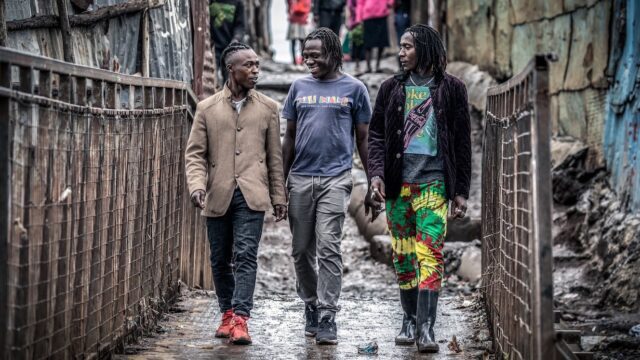
“As a single father, I know the fear of not being enough. Mathare Fathers is not just their story. It’s a story of all of us,” says co-director Mattias Grosin (Stockholm) of his latest project. It’s a sentiment that Iyanu Omoboye, the Nairobi-based co-director entirely agrees with. “Mathare Fathers is such an amazing project and one that touches on the subject that not a lot of conversation has been had around, about single fathers, and especially single fathers in the slums of Africa,” he adds.
Omoboye has a deep connection with the project, living as he does in an apartment that overlooks the Mathare slum (Nairobi, Kenya) featured in the film, which stretches away from his home as far as the eye can see.
Mathare Fathers spotlights the lives of three single fathers from the slum who have left behind a life of crime to start a new one as single fathers. The film notes tell us that the participants were former street children who broke free from the cycle of drug addiction and gang violence to establish a tour guide company, and their new-born children proved to be their guardian angels, inspiring them to transform their childhood traumas into a successful business. Now, they share their life stories with curious tourists in Nairobi’s backstreets, all the while saving money for their children’s education. Their ultimate aspiration is to escape the slums and provide their children with opportunities they never had—but obstacles abound.
The film is a co-production between Sweden, France and Kenya. Producers Lisa Wahlbom (Nordic Eye Productions) & Sophie Parrault (Morgane Productions) outlined the project at the Sunny Side of the Doc Current Affairs and Investigation slot.
For Parrault, whose last project was on the subject of Viking women, Mathare Fathers represents a complete change of direction. “I find it very interesting now to change perspective and question paternity. I admire the strength and determination of these guys and I’m sure we’ll make a wonderful film. Our plans in France are to welcome the directors in the editing room to have them work with our French editors,” she says.
Swedish producer Wahlbom told us: “We had some early development funding from SVT, but also from Swedish cultural funds and the film funds. We have a budget of around 500,000 euros. And we are hoping to find broadcasters here, but we are also in talks with Media Pros Africa who think this will be a very important story to tell, not least in Africa.”
The film will begin shooting in September 2025, with an estimated completion date of January 2027. Much of the budget is secured, but the team are still looking for further funds for completion.
The panel at Sunny Side had questions around what happened to the mothers, the upbeat nature of the preview clip that the audience were shown, the general context of the society they live in, as well as how the fathers got into criminality, and subsequently left it behind.
Lisa Wahlbom explained. “We have both the context, and the background of what’s happening with the fathers. Now they have a guiding company in Nairobi, in the townships where they have their company together, where they’re trying to be good fathers and good providers. And there are different stories [for each of them], but the mothers were forced to leave the children with these then-criminal fathers. One is living in Australia, but one has taken back her child, and she and the father have a good relationship now. So, we do have the mothers’ stories, but they are not the main characters,” she told the panel.
In response to questions about the seemingly upbeat nature of the clip, that is only a part of the story, said Wahlbom. “It’s a strong story but there will also be calmer, more intimate elements to the film. There are times when everything is happy, and the clip reflects that, but of course it’s not easy. The fathers have ups and downs and some of them go back to their criminal life for a while, and one father has maybe to realise that the best fatherhood is to leave the child with someone else.”
The Mathare Fathers story aims to speak to wide audiences, exploring themes of parenthood and what masculinity means in contemporary society. “Today, masculinity is at the crossroads,” Mattias Grosin suggests. ‘But these guys, they’re building something so strong and beautiful together with the kids in one of the world’s most harsh places. Love has become a lifeline.”





