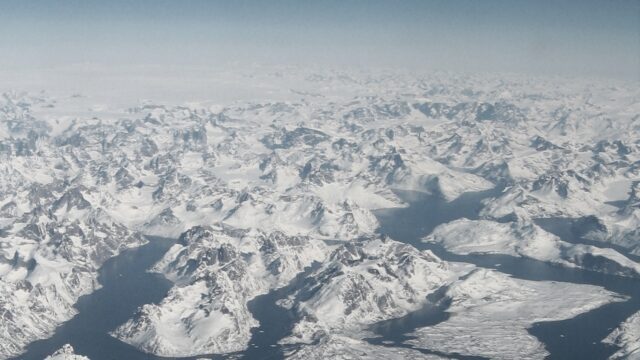
After showing the stunning vista backdrop of Greenland’s frozen landscapes, Jean-Yves Cauchard, co-director of Greenland, The Icy Eldorado addressed the audience at Sunny Side. “We are very, very lucky to be here in this amazing place, but it’s not the beauty of the landscapes which interests Donald Trump.”
Co-director Vivien Meltz agreed. “Yes, because what’s also amazing here is that we are really at the heart of the challenges of our global future climate change, international trade defence strategy, and of course the rising tensions in the race to secure the resources that are critical for both the energy transition and the military industry.”
And therein lies the story. Greenland is the land of all paradoxes, say the filmmakers. The largest island in the world, with its 2.2 million square kilometres covered 80% by ice, is also one of the least densely populated territories on Earth, with barely 57,000 inhabitants. Mainly living off fishing, tourism and Danish subsidies, yet sitting on a potential treasure of approximately 25% of the world’s hydrocarbon reserves, the third-largest uranium reserves, and 20% of rare earths, it is an icy Eldorado that today sparks all sorts of ambitions, says the synopsis.
The island has been much in the news, focussing particularly on how foreign powers want to exploit it, but this project aims to focus on the Greenlandic point of view.
“We don’t want this film to be the story of the little pawn in the big chess world of superpowers,” said Meltz. “We want it to be the story of people with their own agency trying to find their place in the international jungle in a post-colonial context, which is also a major issue of our time.”
Producers Song Pham and Serge Gordey (Temps Noir) outlined the challenges of a production which is being created in the context of a continually developing news story.
“Shooting in Greenland has already started. We have expanded our team to be as effective as possible to directors, to producers. This will give us the best chance not to lose the momentum, which is not self-evident when faced with the US President, who has his own sense of time, as we discover every day,” said Song Pham.
Serge Gordey expanded further. “Although we acknowledge that time is a key factor, this is not a news programme, it’s a geopolitical film focused on the agency of the Greenland people. They will speak in their language or in English when they feel like it. It will be a mix of verité sequences, interviews and archives, featuring people who have power-making positions in Greenland, Denmark, the US and Europe, as well as ordinary citizens, so that we capture what’s happening in all walks of life.”
The producers went on to explain that a 52-minute version will be created, with the aim to deliver by the end of December 2025. All rights are available, except for the German and French territories.
“We still need to raise 30% of the budget,” continued Gordey, “but I’m sure it will be OK with your help. Our sales agent is Arte Distribution who we know will be happy to meet with you.”
At this point in the process, the team are mainly seeking pre-sales, but would consider co-production if it’s a good fit for all parties involved.
Greenland is representative of the many wider issues facing us, and whilst applauding the filmmakers on being amongst the first documentarians to tackle the subject, the panel asked how the team intend to deal with this broader context.
“In a way, it’s a very classical issue of post-colonialism – on the one hand you’re thinking of the environment, but on the other hand you need resources. There are a lot of issues, and that complexity is what we’re going to tackle,” Gordey stated.
Greenland has been catapulted onto the world stage because of what it means to us in terms of resources, and climate change, and therefore is of universal interest, but the filmmakers’ angle is always to bring our perspective back to a Greenlandic one, they stress. As the logline concludes, “its geopolitical destiny will have significant ecological consequences for the entire planet. What choice will the people of Greenland make?”