“Baseball Island is a feel-good documentary about the tiny island-state of Curaçao that spawns an astounding amount of world-class professional baseball players,” says Thomas den Drijver, who is producing the doc alongside Sander Verdonk of New Amsterdam Film Company. “It tells a heart-warming story about a devoted community determined to win the prestigious Little League world championship in the US.”
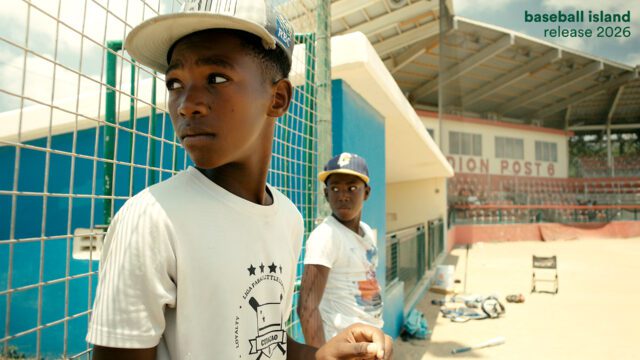
The film follows the young players of Liga Pabou, a local team of eleven- and twelve-year-olds chasing their dream of competing in the Little League World Series. Set against a landscape of limestone rock, dry fields, and sun-washed ballparks, Baseball Island reveals Curaçao as a place where baseball isn’t just a pastime, but a metaphor for ambition, and resilience.
Curaçao, a former Dutch colony, gained independence from the Netherlands in 2010. Though small in size, the island has produced an extraordinary number of Major League Baseball players — an outcome rooted in both talent and a deep cultural connection to the sport.
Through Vasquez’s approach, Baseball Island becomes both a sports film and a social portrait. The film eschews traditional interviews and narration, instead allowing life in the community to unfold naturally. “This film does not rely on interviews or talking heads. Through interactions and moments within the community of Liga Pabou — both big and small — we get closer to the Curaçaoan psyche and its themes: self-fulfilment, the importance of community, pressure, expectations, and resilience,” den Drijver explains.
This perspective creates a rare level of authenticity. “This is certainly not a fly-on-the-wall documentary,” Vasquez tells BDE. “As filmmakers, we are acknowledged by the characters as members of the community. Our camera is embraced by them as part of their – and our – everyday reality. They may put on a little performance or strike a pose — with joy or awkwardness — but the experience is genuine.”
By allowing the camera to be seen and accepted by its subjects, Baseball Island breaks the invisible barrier between audience and community. “That safe distance between viewer and subject is intentionally broken,” adds Vasquez. “When they look into the camera, it feels as if they are addressing the viewer directly. Our perspective and experience are emphasized in this way, even though we ourselves remain invisible and unheard to the audience.”
For Vasquez, who was born on Curaçao and raised in the Netherlands, the project carries deep personal meaning. After two decades of working across interactive media, art, and history, Baseball Island marks his feature-length documentary debut. The story emerged from his return to the island during the pandemic — a homecoming that deepened his connection to Curaçao’s culture and identity.
“When I returned to the island, I felt the urgent need to tell stories from within, without the filter of an outside gaze,” Vasquez writes in his director’s statement. His goal, he adds, is not to document sport but to immerse viewers in “the rhythm of Curaçaoan life: the heat shimmering above dry fields, the slap of dominoes on a veranda table, the laughter of children playing by the sea.”
For New Amsterdam Film Company, Baseball Island represents a continuation of its commitment to bold, cross-cultural storytelling. The Amsterdam-based outfit has a strong record of auteur-driven, socially relevant films, from Jim Taihuttu’s The East to Baloji’s Augure and Michiel ten Horn’s Fabula.
“This is our third collaboration with Lyangelo,” says den Drijver, “and his first feature documentary.” The partnership, he reveals, stems from a shared desire to tell meaningful stories rooted in identity and culture but accessible to a broad international audience.
The project has already secured support from NTR, the Netherlands Film Fund, CoBO Fund, Film Harbour and The Searchers, with confirmed financing of €479,875 out of a total budget of €599,844. “We’re at MIA looking for ways to reach an audience as big as possible for this uplifting and relevant story,” says den Drijver. “Possible reps from festivals, broadcasters, streamers, distributors — and whoever else may be taken by the heartfelt story.”
The film’s central characters — including Tyrus, learning to temper his emotions, L’Viandro, carrying the burden of star expectations, and Gordon and Ellis, two friends whose bond mirrors their families’ hopes — embody the island’s collective journey. Through their triumphs and setbacks, the documentary captures a community’s resilience and tenderness.
Each game and training session become a microcosm of Curaçao itself: its struggles, its laughter, and its undying optimism. As Vasquez’s camera moves from dusty fields to tropical beaches, from practice sessions to family dinners, Baseball Island turns sport into poetry — a mirror reflecting what it means to grow up Curaçaoan, or as locals say, “Yu di Korsou.”
Den Drijver and Verdonk’s outfit has made a name for itself by backing films that challenge traditional genres and embrace cultural specificity while appealing to a global audience. “New Amsterdam Film Company is an experienced production company,” den Drijver points out. “Our films have been shown at festivals such as Berlinale, Tribeca, and Cannes, and have been sold to broadcasters worldwide.”
That international track record is essential for a project like Baseball Island, which tells a story deeply rooted in local reality, but is resonant well beyond Curaçao’s shores. The film’s use of Papiamento — the island’s creole language — and its refusal to rely on conventional documentary tropes create a sense of immersion rarely seen in sports or cultural films.