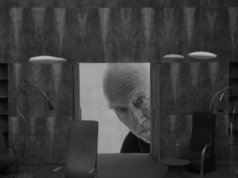
In his new feature documentary, selected for IDFA Competition and produced by Dutch outfit Cobos Films, Diego Gutierrez assumes the role of a world-weary filmmaker who returns to his homeland of Mexico to create what may be his final film. “To live is to find oneself lost. Accepting this is part way to recovery,” he quotes Spanish philosopher José Ortega y Gasset at the beginning of the film. The quote also serves to describe the filmmaker’s very specific mind-set.
Twenty-seven years ago, Gutierrez fled the “sadness and emptiness” he felt In Mexico in order to start a new life in The Netherlands.
But now, nearly three decades later, there are fundamental questions which he needs to find answers to, such as how to cope with loneliness and grief, how to maintain a grip on life when all may seem lost, and how to heal a broken world.
In seeking these answers, he turns to a selection of Mexican folk, all of whom offer him a modicum of solace. Werner, in his twenties, is the product of a bourgeois upbringing, but he now finds salvation in the natural world, telling how “the quality of life depends on the quality of the relationships we establish with all living things.” Frida is an art restorer who is working on a statue of the Redeemer for presentation once more to Catholic devotees. When she suffered a bout of memory lost, she felt blessed by the greater sense of clarity she experienced, a feeling akin to “removing the noise.” What’s more, she has a firm belief in the “here and now,” rather than worrying about future concerns.
Florencio may be a peasant farmer, but he lives a happily Epicurean existence. He also feels that those born with a “silver spoon in their mouth” are “useless,” which also means director Gutierrez, although Florencio doesn’t apply that adjective to his films. Ecologists Fer and Mayra, meanwhile, are as devoted to each other as they are to the bats they study relentlessly. Gutierrez comes to feel a “bond of protection’ in their presence, although they feel his confidence in them as guardians of the planet is a little overstated.
Further counterpoint in the documentary is provided with the mythical story of a president who inherits from his corrupt predecessors a colossal eagle made of pure gold, that he naively feels can be deployed to heal his wounded nation.
Mexico may be the location of Gutierrez’s odyssey, but the themes are universal. ‘The sinking boat is the planet,” he says. “Mexico, I think, is more of a metaphor for the world.”
He further clarifies the role of the ‘filmmaker’ in the film, a character that embodies the concerns of Gutierrez and editor Albert Markus. It specifically articulates “our doubts, our ideas, our worries, our thoughts of what it is to be, and to use also the film as a tool to cling to something… to give meaning to what the hell we’re doing,” he says, suggesting that it is the filmmaking process itself that can provide clarity and understanding. As he says in the film, “doubt only disappeared when it was replaced by an image.”
Editor Markus invokes the great Danish editor, Niels Pagh Andersen, and takes a slightly tack. “Like Pagh Andersen said, people are telling stories to create order out of chaos. But I learned at the Art Academy that the other side is true as well, that we also create chaos from order. And if you create chaos, sometimes it becomes doubt.”
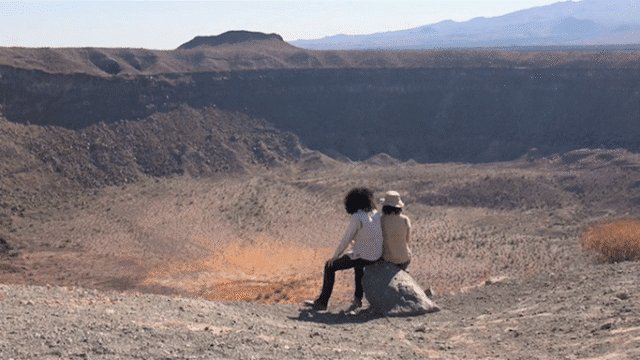
In among all these doubts, there were also surprises, the filmmakers note. When Gutierrez slept in the desert after a day in the baking sun, the experience was close to transcendental. “It is very strange to lay there and to hear nothing, and to not understand the space that you are in,” he says. “Because there’s no echo, there’s no air, there was no wind, there was nothing. When I closed my eyes, I couldn’t really be sure where I was. I could have been inside a closet, or in a room. There was no space, even in the middle of this immense space.”
Likewise, Markus was delighted by the footage he edited of a family (mother, father, small daughter) venerating the newly installed statue of Christ in the hushed church. “We were thinking about this personification, or this projection by people of their own worries, their own dreams, onto an animal or onto a statue,” he says. “Suddenly the two parents and the daughter were there, singing to Christ. That’s something you can’t prepare up front.”
Gutierrez further tells how financing a film about Mexico, or one shot there, can lead to demands to make it a narcos-themed work, or about poverty, or about Trump’s wall. An existential documentary such as this, therefore, required a leap of faith on the part of funders. “From the business perspective, I think we were lucky to have somebody at the Film Fund, and in VPRO [Dutch broadcaster], who believed in the film,” he says. “It was not easy, but fortunately we came across the right persons along the way.”
A version of this article was first published in SEE NL, a collaboration between Eye Filmmuseum and NFF.