Flemming Fynsk’s intimate portrait of Ginny Williams (1927-2019) brings to life the story of a photographer from Denver, Colorado, who seemed to have an instinct for artists who were destined to take the art world by storm.
Though Ginny professed not to have seen her collecting as a feminist pursuit, her greatest successes involved female artists, helping to “elevate and legitimize” the work of female artists such as Louise Bourgeois, Yayoi Kusama, Joan Mitchell, Ann Hamilton, Lee Krasner, Agnes Martin, Roni Horn, and many others both within abstract expressionism and contemporary art.’
The feature documentary draws on incredible access to Ginny herself, and her family, to bring us an insider’s eye into her thought processes, her relationship to the business side of the art world, and the connections with the artists themselves which all contributed to making Ginny Williams such a remarkable talent as an art collector.
We also hear from prominent figures within the art world, who attempt to analyse what it was that gave Ginny the Midas touch when it came to spotting talent. ‘Her eye is like a divining rod,’ says Amy Cappellazzo, former Chair of the Global Arts Division at Sotheby’s.
Director Flemming Fynsk never really set out to make a film about Ginny Williams, he tells BDE. Like all the best projects, it came about through a series of serendipitous events. After meeting Ginny’s daughter, the film’s producer Elle Williams, he was offered a place to stay in New York, at Ginny’s apartment.
“It just sort of happened when I when I first met Ginny years ago now, and I saw her interact with art. I’m all about character and heart and originality and I just had this feeling that it’s rare to meet a character like her, somebody who’s so confident in who she is, and how she interacts with the world. And I had a great desire to capture it,” says Fynsk.
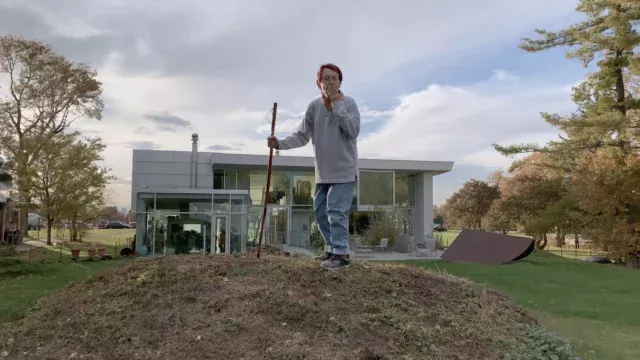
It’s amusing to watch as Ginny throws a million-dollar painting loosely wrapped in bubble wrap into the boot of her car, or tuck a Georgia O’Keefe under her arm in order to hang it in a different part of her house, then casually chop a tree around a priceless sculpture that is haphazardly placed in a scrubby part of her garden.
“I like to collect what I feel,” says Ginny, as the camera follows her around the multi-million dollar private collection crammed onto the walls of her home. “I just bought what I damn-well pleased and I lucked out.”
These casual asides captured on camera are the result of a special friendship that sprung up between Fynsk and Ginny. She was a very private person, says Fynsk, but their connection really comes across in the film. We see her playing with her dog, working in the garden, wandering around her light-filled, art-filled home, full of playfulness and bon-mots. What strikes us is that, as well as her love of art, she is full of wonder for the beauty of every-day objects. In one incident, we observe as she turns a pair of nail-clippers over in her hand. ‘It’s a really beautiful thing,’ she says as she studies them closely, leaning on the kitchen sink.
Fynsk explains how much of the footage was shot on a mobile so as not to be too intrusive, and to capture those unstudied moments. “I’ve never made a film like this before. I’m very much into framing and I like visuals very much… I really had to just trust that whatever I filmed was going to be usable.
“And I didn’t even think it was going to be usable in a film. It was just like as a notebook and as a record of what I was experiencing. So it was a very unusual project.”
For Fynsk, the project unfolded organically. “It was sort of magical… we all met and it just worked out perfectly. It was kind of a beautiful experience.”
The “we” also refers to Ginny’s daughter Elle Williams. “It was initiated by Elle in the first place, and she is so close to her mother as well. She’s the one really who then also ended up producing it, and financed me to go through the editing process.”
Ginny Williams may well have approved of Fynsk’s instinctive process during the edit. “I go into the editing suite without a plan… I have a sense of what I have and then I kind of just start putting things together. I never think about what I’m doing. Whatever feels right, feels right,” Fynsk reveals.
“I wanted to capture her character more than anything, the way I saw her. She wasn’t defined by anything. She even says in the film that ‘I’m not a collector.’ She didn’t limit herself like that. She was all over the place and that’s how I approached the edit.”
That is communicated in The Art Whisperer loud and clear. Relaxing on her sofa, Ginny mischievously tells us how her exasperated accountants asked her every year, ‘are you a collector or a dealer?’ She refuses to be pigeonholed. ‘My accountants have a terrible time with this [in the end] they just take the one with the most advantage,’ she says.
“It’s been kind of a wild journey,” says Fynsk. “And now we’re in the Oscar race.”
Ginny Williams died at the age of 92, in 2019, but her legacy is captured beautifully in Fynsk’s film. Such was the relationship they developed, he was even there at her side in her final days.
“What is magical for me as a filmmaker is how people respond to it [The Art Whisperer]…it’s young women that really respond well to it, and it’s delightful,” he tells BDE. “In a way without any particular agenda – she obviously was just such an instinctive collector – but she did end up collecting women, and also really promoting them and supporting them.”
In fact, Fynsk tells BDE, the upcoming screening at Hauser and Wirth in New York is a revelation in itself for the gallery’s Director of Public Programs who had never heard of Ginny Williams. Fynsk hopes that his film will have a long life in such galleries internationally, ensuring that Ginny Williams’ particular brand of art appreciation and collecting – loving it for what it is, rather than seeing it as a commodity – is equally enjoyed and appreciated by art practitioners and audiences across the globe.