

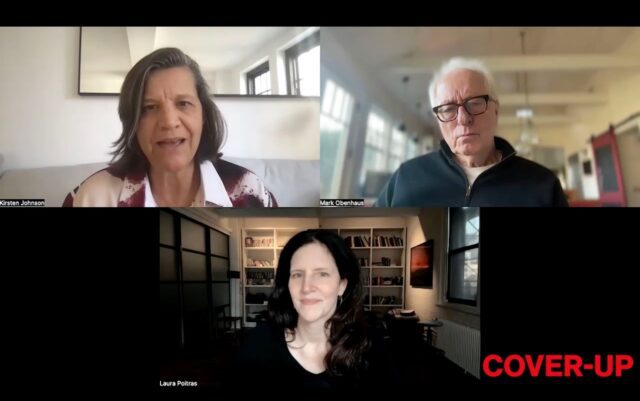
Multi award-winning US filmmaker Kirsten Johnson talks to Mark Obenhaus and Laura Poitras about their feature documentary Cover-up, which world-premiered at Venice and which explores the investigative journalism career of Seymour (Sy) Hersh, a Pulitzer Prize-winning journalist who covered the My Lai massacre during the Vietnam War and the Abu Ghraib torture scandal during the Iraq War.
Johnson opens the conversation with a question about the gathering, uncovering and use of evidence, and how we “make meaning of the scope of evidence.”
“Some of the guiding principles that we went into in approaching the material and approaching the story is this notion that history is not inevitable, but history is created,” Poitras responds. “And it’s created in the moment we’re creating it now, the history that is going to be carried forward to future generations. And we wanted to draw connections across time in Sy’s reporting, using [it] as a portal or a lens to understand this country over half a century. And then we’re working with materials. We had Sy’s notebooks. We thought of them as sort of portals into that history, sort of the things [that] could take us into the past. And then with the archival materials, we’re building a case in this film. We’re building a case against ideas of impunity, executive power, lies, coverups.”
“The material we feel is very alive because it hasn’t been resolved, because there is no resolution for these atrocities,” she continues. “No-one in power was ever held accountable, or at higher levels of power, for the atrocities and massacre at My Lai. Similarly, with Abu Ghraib, no one was held accountable. And so we are really like building a case that this country has a problem. It has a problem with impunity, lies and covering up its wrongdoing and atrocities, and has a problem with being extremely violent. And there’s also another theme that we were really looking at that also relates to evidence, [which] is what is Sy’s relationship to the legacy media, to the press, and how does the press sometimes work as a sort of counterbalance to state power?
Click on the link above to watch the entire interview.





