

Tel Aviv-based filmmaker Hilla Medalia jokes that, in her neighbourhood, everybody gets in on the Oscars action. She has two films on the Academy Award shortlist, Children No More: Were and are Gone, which she produced and directed, and Holding Liat, which she co-produced. Across the street is producer Rachel Leah Jones whose Coexistence My Ass! is also in the running.
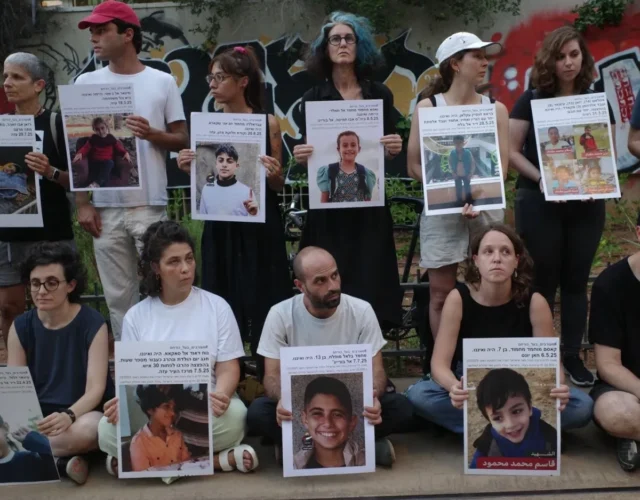
Medalia’s short Children No More, follows the silent vigil being held in Tel Aviv by a small group of Israeli activists who stand in a public square holding photos of Palestinian children killed in Gaza by Israel.
The vigil began in March 2025 after the ceasefire in Gaza collapsed. It continues to this day. Each image has the child’s name, the date he or she died, their age, and the poignant phrases “involved against their will” and “were and are no more.”
Every piece of information is rigorously checked. “They’re not just relying on the Ministry of Health of Gaza but they’re actually looking into many sources,” the director explains.
These photographs represent only a small proportion of the many thousands of murdered children in Gaza – most didn’t leave a picture behind. Activists hope that their images will move and startle onlookers, and that this could be at least a small step toward change and reconciliation.
The documentary has its roots in the director’s friendship with revered former HBO and MTV documentary exec, Sheila Nevins (who was herself in the Oscar race last year with her short, The ABCs Of Book Banning). “My very first film, made over 20 years ago, my student film, Sheila bought,” Medalia remembers. Medalia’s Peabody and Emmy winner, To Die in Jerusalem (2007), about the mothers of two young women, one Palestinian, one Israeli, experiencing the same horrific grief and loss, was also broadcast on HBO.
Last year, Nevins had discovered the story of the silent vigil in Tel Aviv and encouraged Medalia to make a documentary about it. The director, who had already been planning a documentary about Agi Agrov, an activist who has been painstakingly collecting details of Palestinian casualties since 2020, leapt into action.
“We did this film very quickly. We started in June and it was already in theatres in LA at the end of September,” Medalia says. “And we did it with no money…it felt urgent and we needed it out.”
Early support came from Vesna Cudic, Head of Documentary Partnerships at Full Story Films Sky in the UK. “They came on board before we finished…I am very grateful to them because I don’t know if any American broadcasters would be showing the film. Sky standing behind the film was a big and important step.” Albi Film and Television Fund, the first-ever independent moving image fund for productions by or about Israelis and Palestinians, also backed the film.
There is something heart-rending and haunting about the experience of looking at these images of smiling, happy kids in the knowledge that they’ve all been killed. Their deaths are ‘ethically, religiously and morally wrong,” as Medalia puts it. Nonetheless, the vigil has proved highly contentious. As the documentary makes clear, many Israelis were furious to see activists commemorating the young Palestinians when some of their own fellow citizens were still being held hostage by Hamas.
“First of all, it is really important to say that we in Israel don’t see the images and stories that you see internationally,” Medalia suggests that many Israelis simply aren’t aware of the extent of the death and destruction in Palestine. She believes that self-censorship is also often to blame. Journalists and broadcasters shy away from reporting the full details. This, in turn, “creates this real denial…it is so painful what is happening and people are very emotional about what they feel. It’s incredible and also extremely sad to see. I want to believe that if people see a picture of a child that was killed, they can feel empathy…[but] this empathy is seen really as a betrayal by some people.”
In the documentary, passers-by harangue the activists and tell them they should feel ashamed of themselves when all they are doing is holding up photographs of murdered children. The fact that these are silent protests, and that the activists never say anything, seems to antagonise the critics even more.
“That has really taught me a lot about the strength and the power in silence – that you don’t necessarily need to scream, but that the silence can be stronger than any scream.”
Medalia and her team have been submitting the documentary to Jewish festivals but “getting a lot of rejections.” One Jewish community centre scheduled a screening and then cancelled at short notice. It has also been a struggle to get people on “the pro-Palestinian side to watch the film and not boycott it.” The director has made it very clear that the film was made without state funding. She accepts, though, that it will “create a lot of fire in Israel once it goes wider.” She and her team are planning a grassroots campaign, “from the ground up.”
Whatever the controversy, AMPAS (Academy of Motion Picture Arts and Sciences) members have given the documentary “an incredible response” at screenings everywhere from London to New York and Copenhagen.
Through her company Medalia Productions, Medalia has made a wide range of films, everything from The Go Go Boys, telling the inside story of maverick film hucksters Menahem Golan and Yoram Globus, to Wanted: Ronni Kalderon, about a brilliant young footballer from Tel Aviv who became a drug baron.
“But I do focus most of my work on social issues…being an Israeli and living in Tel Aviv, I feel really obligated to make films about the conflict and about the occupation – and to try to stop that…,” her voice tails off.





