With this well-crafted film, in which his elderly father and uncle are seeking information on their long-ago departed father, Dutch director Tom Fassaert raises questions about the personal and private aspects of filming your own family affairs.
The main characters, two brothers in their seventies, are endearing. Their story, searching for information about the father who abandoned them when they were young, is engaging and touching – at times very touching. The music highlights the emotions, adding a little tension but in a playful and adventurous way. The use of archival materials (old film and video recordings and black-and-white photography) adds depth to their story. And the film’s arc is brought satisfyingly to a close.
For a work of fiction, these would all make great recommendations, and indeed I wouldn’t be surprised if Between Brothers turned out to be a general crowd-pleaser, doing well in the ranking for the IFFR Audience Award. As a documentary, however, there are aspects of its storytelling which I find troubling.
It’s a very personal story, which is fine, of course – many stories are personal, especially documentaries. The two elderly brothers are called Rob and René Fassaert; the director is Rob’s son and Rene’s nephew, Tom Fassaert.
The story is also very private, which is different from being merely ‘personal’. When things are private, they require extraordinary care – the documentary must convince its audience that the sacrifice of privacy was worth it, either for the subjects themselves or for the common good, and the director must demonstrate their awareness of the power imbalance between filmmaker and subject.
Here, certain things about the film bother me. First of all, Tom (I will use first names for clarity) mostly stays behind his camera. There is a moment when he’s filming his dad Rob entering René’s house, and his dad remarks, half kidding: “Hey Tommy boy! There’s my son again, who I only see with a camera in front of his face. I think it’s more a kind of… fetish?” There’s a kind of postmodern self-conscious honesty in keeping that criticism – because it does feel like criticism – in the film, but that doesn’t diminish the truth of it.
René’s small apartment is crammed with boxes and piles of books and papers, in which he himself can’t find anything, doors can only open halfway and there’s only one usable chair available. In his voice-over, Tom notes that René doesn’t like anyone entering his house except Rob, who faithfully visits him once a week. But he doesn’t say anything about how René feels about Tom being there or about being filmed – for public viewing, no less. This gives me, as a viewer, the feeling of intruding without René’s clear consent. After all, this film is being made for an audience, thus on my behalf.
To be clear, it may well be that both Rob and René are completely happy with the finished film – I do not know. Let’s simply assume that they are. Then there is still a difference between the external and internal ethics of a documentary. Without receiving affirmation of René’s consent within the documentary, I have no way of knowing whether I’m watching the infliction of psychological harm for the benefit of cinematic impact.
The fact that Tom generally stays behind the camera and mostly communicates through a detached, retrospective voice-over, also gives me unease. Although he is evidently personally involved in the story, Tom is not meeting his father and uncle on an equal footing. He is using the power imbalance to control the narrative, and the fact that his voice-over expresses his uncertainties doesn’t really change that. They are still his uncertainties, he is still coming from a position of control, keeping himself at a distance from the psychological and emotional vulnerabilities he is asking of his father and uncle.
It’s worth quoting René in full, when he reacts to Rob’s idea of writing a fictionalised novel about him: “Well, if you write a story about someone, you should be careful about making things up. You can’t make up someone’s history. Then you could end up far from the truth. And you can’t play games with that. Then you document something and others read it, so you can’t correct it anymore. You can’t tamper with that, or tell half-truths. Or suggest things that aren’t true, that you can’t prove. You can’t do that.”
Again, it’s honest, in a postmodern kind of way, that this critique of crafted storylines is included in the film, as it also reflects on the documentary itself, with Tom’s voice-over at one point actually starting with “So I picture them, the two brothers…,” as he suggests how things could have gone. But again, admitting to steering a storyline – which is what the chosen narrative structure feels like – doesn’t absolve you from the fact.
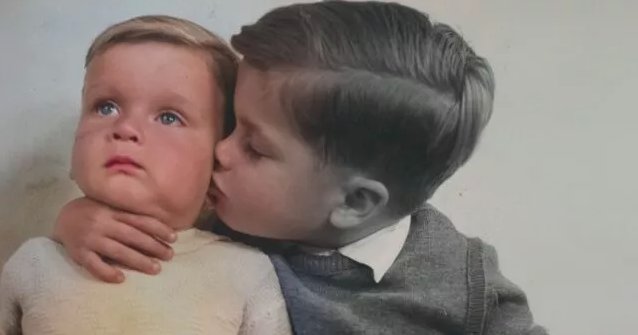
There is actually a moment in one of the old family videos where René explicitly states that he’s feeling uncomfortable being filmed, which strongly suggests there was social pressure involved. In that situation, he was being filmed by Rob, who was also an avid recorder of his own family, just as Tom would turn out to be (his previous documentary A Family Affair was the 2015 IDFA opener), and just as Tom’s grandfather apparently was before he took off, leaving Rob and René behind and taking all his filmed material with him.
These facts are mentioned early on, by Tom himself, but it still takes him the full length of the film to arrive at the conclusion that making this documentary also has something to do with himself. Which is not only disappointing by being so painfully obvious, but also another sign that he kept himself far too removed during the filming process.
The few moments when you do hear him talking directly to Rob and René, even if it’s still from behind the camera, immediately create a greater sense of shared vulnerability. And although I know people have differing views on the privacy of new-borns, to me it feels inappropriate – especially in a film which, I think, tries to deconstruct the obsessive need for filming your family as an ineffective substitute for true emotional connection – that Tom ends Between Brothersby filming his own baby.
Netherlands/Belgium, 2026, 106 minutes
Director Tom Fassaert
Production Een van de Jongens, Clin d’Oeil Films
Producers Renko Douze, Hasse van Nunen, Hanne Phlypo
International sales Een van de Jongens
Script Tom Fassaert
Cinematography Tom Fassaert, Mick van Dantzig
Editing Thabi Mooi, Dieter Diependaele, Tom Fassaert
Sound design Marc Lizier, Paul Gies
Sound Tom Fassaert
Music Tobias Borkert
With Rob Fassaert, René Fassaert