At this year’s CPH:DOX Roughcut showcase, Moroccan filmmaker Asmae El Moudir presented her new hybrid documentary titled Don’t Let the Sun Go Up on Me, a poetic and deeply personal project currently in production.
Introducing the session, Dani Carlaw, Head of Unscripted at Screen Scotland, highlighted the strong industry backing already surrounding the film. “This is an incredibly exciting project that already has Autlook attached as sales agent, and a variety of prestigious backers,” she told the audience, adding that “there is still plenty of room for partners to come on board.”
The project marks El Moudir’s follow-up to her internationally acclaimed debut The Mother of All Lies, which premiered at the Cannes Film Festival in 2023, winning the Un Certain Regard Best Director prize and the Golden Eye for Best Documentary, while also earning a place on the Oscars shortlist.
El Moudir explained that the origins of the project date back to a seemingly trivial moment in 2017. “This story began with a very simple event,” she said. “I lost my ID and went to a photo lab in Rabat to take a new picture. In the shop stood Habib, surrounded by many VHS tapes. He had filmed his daughter, Fatima Zahra, a girl who could only live at night because the sun could kill her.”
Fatimazahra suffered from xeroderma pigmentosum (XP), a rare genetic condition that makes exposure to sunlight potentially fatal. Through Habib’s extensive home-video archive, which documented his daughter’s life from birth, the filmmaker discovered a wider community of young people living with the same condition — known locally as the ‘Children of the Moon.’
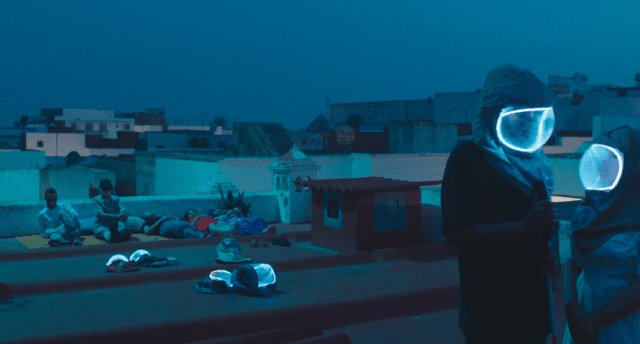
El Moudir began filming Fatimazahra and her family, following their nocturnal routines and their fragile attempts to build a social life in a world designed for daylight.
The film took on a new dimension after Fatimazahra passed away in 2023. Her younger sister Meriem now carries forward her dream of travelling to Norway’s Lofoten Islands, where the polar night allows for months without sunlight.
In the film, Merem gathers six of Fatimazahra’s online friends — fellow “Children of the Moon” she had previously only known through social media — and brings them together in Morocco before embarking on the journey north.
“For Meriem, it became a way of transforming grief into action,” El Moudir explained. Having shared the same bedroom and nocturnal life as her sister for years, Meriem finds herself unable to return to a conventional daytime routine after her death.
The gatherings captured in the film often mark first-time experiences for the group. “What you see here is the first time after 17 years of social media that they meet together,” the director said. “For some of them it’s the first time going to a bar. Travelling to Norway will also be the first time they travel abroad.”
Because many XP patients have a reduced life expectancy, El Moudir intentionally avoids sensationalising the story. “I’m not looking to add more drama,” she said. “The drama is already there. Instead, I try to bring joy into their lives. It’s a dark but colourful world.”
Stylistically, Don’t Let the Sun Go Up on Me blends multiple layers of material, including Habib’s family VHS recordings, El Moudir’s observational footage and videos recorded by Fatimazahra herself, who had built a strong presence on TikTok. “I’m looking for ways to keep her alive,” the filmmaker explained. “Through her voice, through her own images — creating a dialogue between the living and the absent.”
The director describes the film as a hybrid documentary, combining documentary realism with elements of fantasy and even vampire mythology. “It’s part documentary, part science fiction, part vampire tale,” she said. “A contemporary fable about memory and the power of a dream.”
The film is being produced by Haut et Court Doc and Insight Films, with Emma Lepers serving as co-producer alongside Monica Hellström, whose previous credits include Oscar-nominated documentaries Flee and A House Made of Splinters.
The project is a 5-country co-production between Morocco, France, Denmark, Norway and Chile, with co-production partners including Ström Pictures, Lofoten Film Collective and Quijote Films.
With an estimated €991,420 total budget, the production has already secured significant support from institutions such as Atlas Workshops, CCM (Centre Cinématographique Marocain), Al Jazeera Documentary Channel, Red Sea Fund, Hot Docs Blue Ice Fund, Vision du Sud-Est, International Media Support, IMS, OIF, Institut Français du Maroc, AFAC, Catapult Film Fund, Arte France and Arctic Film Norway, among others.
According to the team, roughly 80% of the film has already been shot, with additional sequences scheduled in Morocco and the Lofoten Islands during the polar night. The team is currently seeking additional pre-sales, distribution partners and foundations support.
Editing is already underway as the filmmakers prepare the next stage of the project. “We have so much material,” producer Lepers explained during the presentation.
The team hinted at ambitions for El Moudir to return to Cannes, or to premiere the finished film at another major European festival. Expected to run approximately 90 minutes, Don’t Let the Sun Go Up On Me is currently slated for completion by March-April 2027.