Chronicling one person’s experience of travelling across continents to escape a North African prostitution ring, Coming From the Sea follows a young Nigerian woman (Tina) who embarks on a perilous odyssey across Europe to rebuild her life and protect her child – but the ghosts of her past are never far behind.
BDE catches up with the film’s producer, Emmanuel Gras, ahead of the team’s pitch and screening at ParisDOC Work-in-Progress sessions.
The documentary film is ambitious in scale, following the protagonist over a period of four years. Director Ioanis Nuguet first met Tina when she was on a boat making the crossing to France. After that he documented her entire journey, from crossing the Alps, through to her discovery that she was pregnant. We see her gain asylum in France and attempt to make a life for her and her baby, constantly dogged by the shadow of the men who hurt her.
The film that the director set out to make differs from the one now being screened at ParisDOC, however. “At that time, he [Ioanis Nuguet] wanted to show the perspective of the people who come across the Mediterranean….he really wanted to talk about different destinies and to show the idea that they are not victims – they are subject of their own destiny. What they are doing, it’s like an odyssey, it’s an adventure.”
The logistics of such an undertaking, however, were not practical. His characters scattered across Europe, and it was not possible to follow all of them in any meaningful depth or for any length of time. The way forward presented itself when, during his research on the Sea-Watch 4 in the summer of 2021, he met Tina. ‘As we talked, Tina emerged as the heart of the film,’ Nuguet tells us in his director’s notes.
So Nuguet was able to be there right from the very beginning, or at least the beginning of her quest to make a new life for herself, producer Gras explains.
“He was there when she asked for the papers from the French administration, he was there when she crossed the Alps, when she was in Calais and in Italy, and even when she gave birth to her child. So, after four years of filming, he felt that it was possible to make a film around her.”
Nuguet’s work with Tina allowed him to bring a new perspective to the now all-too-familiar migrant stories we have almost become numb to, Gras suggests.
“I would say that the ambition of the film is to go deeper in the experience, in the intimate experience, because the film is also from the perspective of Tina…so it tries to capture her way of thinking. For example, Tina has many philosophical questions, and she also thinks about magic – her life is connected to notions that we don’t get as Europeans.”
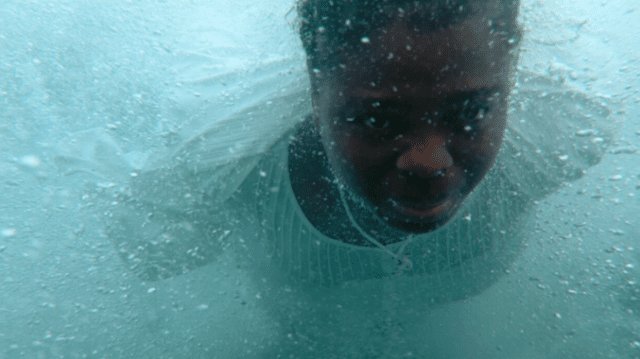
The cinematic approach used to convey Tina’s world view is outlined in the director’s notes. ‘The staging focuses on the fluid nature of time and water: the sea, voices, shifting light, memories. The film weaves together three intertwining themes—rescue, motherhood and welcoming, therapy—like waves of the same inner sea. The camera remains at Tina’s height, in her breathing, in her silences, in her sometimes hesitant speech. Her voice, written with her, extends her therapeutic work: fragments of thoughts, prayers, or visions addressed to Mother Sea, like so many attempts to reinvent herself.’
Indeed, the film’s title comes from Tina’s confession to a psychotherapist that, ‘I come from the sea.’ A sea which is for her, ‘at once a goddess, a refuge, and a witness: a Mother Sea to whom she confides her doubts and wounds.’
“It’s not a descriptive camera,” Gras says of the director’s unique style. “It’s like a dance around her, always moving. And also, the narration of the film is not linear; the past, the present, and sometimes the future are mixed. The film plays with the fact with that we don’t know where we are all the time, or what’s happening. So, it’s an equilibrium of understanding, and also being kind of lost,” he says.
At ParisDOC Gras and his team are looking for distribution and an international sales agent, with an initial view to securing a presentation for Cannes.
“The ambition is really artistic, and to think that the cinema allows us to feel a different life experience, and the art is important in that it’s not just a description of something… it’s not information, it’s really about how art can allow us to be connected to the people and to the experience,” he says.
“I don’t like this word migrants we use in France. I prefer exiled people. I want us to see them not as just figures of people who come, but as human beings, and above all as adventurers and explorers. Maybe it can change some minds. That’s what we hope for,” Gras concludes.