

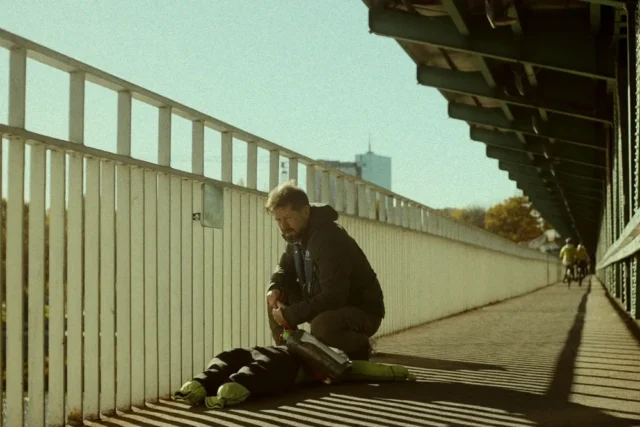
The Polish feature documentary Closure (sold by Autlook and produced by Braidmade Films) tells the most desperate of personal stories, that of a dad searching for his lost son. As we see, there are no lengths to which Daniel will not go to find Chris (16) who was last seen on a bridge over Warsaw’s Vistula River. One moment Chris was there, captured on CCTV, but when the rotational camera turned again to where the boy was standing, he had disappeared.
For two years, Daniel dedicated his every waking moment to the search for his boy. A successful and resourceful businessman, he built a custom-made boat fitted out with cameras, drones and tracking devices. He furthermore designed and created a threshing machine that could cut through the tangled flotsam on the river surface in search of evidence. He would throw dummies the same weight and size as Chris from the bridge, and determine their trajectory down river, before commencing a new search. “Who doesn’t search, doesn’t find,” he says in the film.
At times he would navigate the river with helpers, at other times solo, such as on the day that he encountered director Michał Marczak.
Marczak, himself the father of a young son, was scouting the river for locations in a sailboat, together with his family. It was getting dark, and he was struggling to dock at one of the islands, at which point he was guided to shore by a man who appeared from out of the darkness. That man was Daniel.
The following day, Daniel explained why he was on the river. Marczak was profoundly moved by the story and later joined Daniel on his search. “I found myself thinking about my own choices as a father, and about the world my children are growing up in, with all the risks, pressures, and unspoken fears that come with it,” the director writes. “At that moment, I began to understand what this film could be: not a documentary that arrives with conclusions, but one that opens doors. A film that asks more questions than it answers.”
Not that Marczak suggested immediately the idea of a film to Daniel and his wife Agnieszka, who were going through turmoil since the disappearance of their boy. “I didn’t have the courage to, even though I had his number, to call them,” he tells Business Doc Europe. He was intensely wary of intruding on their lives at such a difficult time, he underlines.
“But when I later did research, found that that Daniel and Agnieszka had kind of opened up their lives already to media. They went out into the public when they were searching for Chris and they did a lot of interviews [that] were aired on television and on social media. They let reporters into their house. There were shots from Chris’s room already in the media. So that gave me the courage …They’ve already expressed this story out in the open.”
As we see, Marczak tells the story through observation of Daniel’s own modus operandi, in the minutest of detail. “For the audience to enter that reflective, meditative space, I felt I had to convey the world Daniel inhabits from the inside. That is why I chose to use every cinematic tool available to place the audience directly into the search, not as observers, but as participants,” the director says.
“This film became one of the most challenging I’ve made on every level, because it required holding two impulses at once. On the one hand, I wanted to keep the crew minimal and intimate. On the other hand, I wanted the film to carry an epic scope, to convey emotion through images and atmosphere, through showing rather than telling. I don’t believe films, on their own, change the world. But I do believe in the power of small moments, moments that quietly shift something inside us and ripple outward in ways we cannot measure.”
Toward the film’s conclusion, two landmark occasions appear on the horizon; what would have been Chris’s 18th birthday and Daniel’s own 50th birthday. These offer the opportunity for Daniel and Agnieszka to reflect, and to find potential ‘closure.’ Prior to this, we have seen how Daniel’s skills and efforts have not gone unnoticed, and that he has helped in locating other missing people along the river, which make for tragic and heart-breaking scenes depicting bereaved family members who are themselves experiencing ‘closure,’ welcome or otherwise.
A core feature of this documentary, as well as other such excellent pieces of work, is that it serves as a corrective. Daniel may note in the film that “nobody teaches families how to live,” but Marczak’s documentary serves as a powerful reminder for us all to take stock of, celebrate, but also work to maintain the most important aspects of life, such as family. This became equally pertinent for new dad Marczak as he got to know his protagonist, for whom he gained an enormous admiration.
“I have a six-year-old and now a two-month-old, and…my wife and I were thinking a lot about how to navigate the challenges that kids face in today’s world,” he tells BDE. “Where as a society have we failed? It’s not just individual, but there’s a collective moment in time that just seems to be very difficult for young people. And it’s the fault of all of us, I feel. It’s a collective fault. And so trying to understand what that fault is, and how to navigate past it, and how to help children navigate that world, but also to let them make mistakes and so on… So, yeah, of course, it’s been going through my mind a lot.”
“And a lot of times that’s what we were thinking when we were out on those islands with Daniel. What should I do, Daniel? You know, like what the hell do you think I should do? What are your tips for me? And I was thinking a lot, and I’m just looking at Daniel thinking about his life. You know, it just made me think about my life three times more.”
“If Closure leads even one person to call someone they love, to ask how they truly are, to stay a little longer in a conversation instead of rushing past it, then the film has already done more than I could have hoped for,” Marczak ends.





