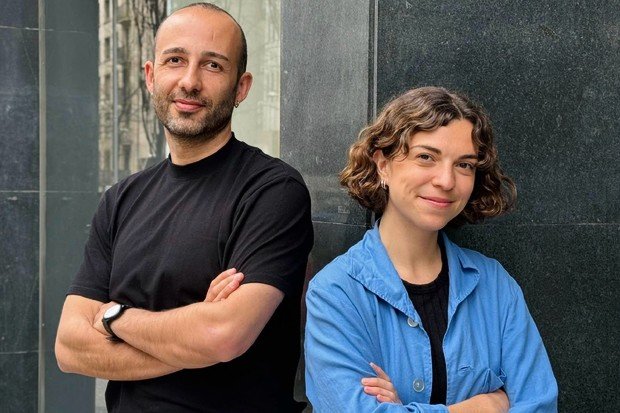
For DocsBarcelona, this past year has been one of reflection, co-Artistic Directors Maria Colomer & Èric Motjer (also Head of Pro) tell Business Doc Europe on the eve of the 29th edition. The festival opens May 7 with A Fox Under a Pink Moon, co-directed by Mehrdad Oskouei and Soraya Akhalaghi, in which sixteen-year-old artist Soraya documents her attempts to escape Iran, where she lives with her abusive husband, and reunite with her mother in Austria.
“This year we had a new international committee, so part of the process was actually taking time to explain who our audience is, but also where Barcelona sits culturally. What kinds of themes resonate here, what cinemas we have, and what kind of viewing habits exist,” Colomer and Motjer together stress of the festival’s endeavour to take stock, and to both evaluate and articulate the requirements of its cineaste public. “So yes, we think about our audience, but not really in terms of entertainment, education, or information. For us, these elements are not separate, and we think more about the context we exist in.”
“For example, we talked quite a lot about how certain documentaries, that follow what you could call a more American model, with big production value and more interview-based, don’t always fit so well with our audience,” they elaborate.
“In the north of Europe, American culture has a stronger impact, but in Barcelona, and in a film festival like ours, audiences expect to see another type of cinema… So probably, if we think about needs, the criteria we use could be summed up as: the overall interest of the film, how engaging and appealing the story is, its formal quality, and whether it has an original cinematic language, so not just a copy of a previous film but adding something new.”
“At the same time, we don’t separate cinematic quality from impact. We value both. We look for films that connect with the world we live in and that have cinematic value. I would say that giving value to the collective cinematic experience is central to how we think about the programme,” Motjer underlines.
The pair furthermore stress the necessity for dialogue within both the global and the local context. “This year, with the geopolitical world conflicts we’re living in, we felt it was important to give space to films that go beyond the headlines and focus on human stories, films that allow us to understand the world from a more empathetic perspective, such as A Fox Under a Pink Moon, The Travelers, Mailin or The Woman Who Poked the Leopard,” says Colomer.
I ask what the role of the festival, and docmakers in general, is in these politically worrying times, and if there Is a requirement, or even a sense of imperative, to voice the concerns felt by many.
“Cultural institutions can help us have a broader understanding and a more critical perspective. We take that role with a lot of responsibility. What are we bringing to the city, which narratives, which ideas, which realities. We take up space, so yes, there is a sense of responsibility to reflect on all of this,” Motjer responds.
“At the same time, we are also living a moment of increasing standardization of culture, and for us it is important to resist that. We take very seriously how to give space to diversity within cinema, to different voices, forms, and ways of thinking, and to create a programme that is enriching rather than homogeneous,” he adds.
“So it’s not so much about adopting a particular political line, but about creating a space where complexity, plurality, and critical thinking can exist. In that sense, festivals have a role in opening up perspectives, rather than simplifying them. Prominent cultural organisations have a duty here, to give filmmakers space to think out loud, even when it might be uncomfortable for some. Our stand is with plurality, rigour, and courage.”
The yearly calendar for doc festivals, markets and events is getting ever fuller. The first week of May sees DocsBarcelona, DOK.fest Munich and MDAG starting with two days of each other, with Hot Docs just finished and Cannes around the corner, very soon to be followed by the likes of Krakow, Sheffield and a newly resurgent Sunny Side. While all this has no effect on local audiences, industry folk are forced to choose carefully. Is this a particular issue for DocsBarcelona, or is it easy to navigate within these waters?
“Barcelona is a very active city with many film festival and cultural activities all year around. Cinema numbers show that autumn and the beginning of spring are the time of the year when people go more the cinema, however. As I was mentioning, we are lucky to be in a city with a big engagement in cultural activities,” Colomer responds.
“From the industry side, I guess there’s no such a ‘good moment’ when it comes to finding great dates: the market is oversaturated with multiple events overlapping over the year but we are the last major European appointment before the Cannes,” Motjer adds of his Pro dates which run 11 to 13 May. “We’d like to keep DocsBarcelona Pro as a human-size market where decision-makers can have meaningful one-to-one conversations away from the noise, and where filmmakers and producers feel their value among the ones attending and don’t feel lost among thousands.”
“Our 650+ project applications this year, the highest in our 29-year history tell us the industry has stopped seeing us as competing with anyone – we are a necessary stop on the route,” he counters. “And we realise this as we’ve become a relevant hub for those who understand DocsBarcelona Pro as meeting point for filmmakers and producers from Latin-American countries and also Mediterranean countries, both North and South. The scale of Barcelona, the editorial focus of our forum, and the size of the event make us complementary. We hear from commissioning editors all the time that they come to us because DocsBarcelona allows them to actually sit down with a producer or a filmmaker for thirty minutes and look at footage. That’s the role we want to keep.”
The Catalan doc industry is again in the spotlight this year, with 28 Catalan films out of a 57-film programme, and with local films selected within all sections of the festival. “That’s very exciting, also because it happened quite organically, as the level this year was very good,” says Colomer.
On the DocsBarcelona Pro side, out of the 63 projects selected in DocsBarcelona Pro 2026, 14 are Catalan productions or co-productions. “That’s not a quota, that’s gravity,” says Motjer.
He adds: “DocsBarcelona Pro is, in practice, the place where Catalan and Spanish documentary meets the world: where a first-time director finds the right commissioner, or where a producer designs a co-production with any European country, or even where rough cut film is being picked by a major film festival.”
“Beyond the projects themselves, we’ve programmed activities such as ‘Reactivar lo Real: Hacia un nuevo impulso del documental en España,’ a frank, honest conversation about what Spanish non-fiction needs from public broadcasters, public funds and private platforms to promote a momentum,” Motjer continues. “Spanish cinema right now is producing some of the most distinctive work in Europe, but the non-fiction production ecosystem around it is fragile. We’re not here just to celebrate Catalan and Spanish documentary scene, we’re here to convene the industry in a serious way and give that work the structural conditions to keep growing.”
In closing, Colomer returns to the theme of responsibility, and the wider role both of the filmmaker and the festival in today’s oppressive climate. “We like to remember that non-fiction cinema is the archive and the memory of the future, and that has to be guarded very well, not to erase collective and historical memory, [to stand] against intolerance, and against the erosion of political freedoms,” she signs off.