Polish director Marcin Borchardt has spent his entire career engaging with the avant-garde in its various forms, whether cinema, literature, experimental music, visual art or counterculture.
“Because of this, the Themersons always felt extraordinarily close to me. My ambition was never simply to ‘make a film about them.’ What truly mattered to me was trying, in some small way, to help restore their work to the place in twentieth-century art history that I believe rightfully belongs to them,” Borchardt explains what led him to make his new feature documentary My Themersons, about the life and work of artists and filmmakers Franciszka and Stefan Themerson.
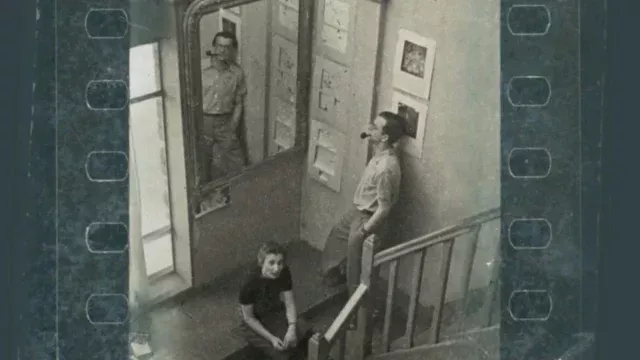
The film (which premiered in Millennium Docs Against Gravity this week) looks at the Themersons from the perspective of their niece, Jasia Reichardt, the British-based art critic and curator now in her 90s – but who knew the Themersons in Warsaw and in Paris when she was a girl in the 1930s.
“During the making of my film, one of their long-lost early works, Europa, was rediscovered after eighty years. When I finally saw it, I was absolutely stunned by how extraordinary it was. I have no hesitation in calling it a masterpiece. Its place is among the great works of the historical avant-garde — alongside Un Chien Andalou by Buñuel and Dalí, the films of Man Ray, Hans Richter or Jean Cocteau,” the director observes.
“But Europa possesses something else that makes it especially haunting today. Watching it now, one experiences an almost unbearable sense of contemporaneity. What the Themersons capture in that film is an emotional state of instability just before catastrophe arrives — a civilisation losing its ethical foundations, language beginning to disintegrate, people overwhelmed by anxiety without fully understanding what exactly is approaching.”
Borchardt argues that the Themersons’ work has a new contemporary resonance as Europe is again roiled by war. “We live, materially speaking, perhaps better than any previous civilisation, and yet at the same time many people experience profound disorientation and collapse of meaning. Shortly afterwards, the war in Ukraine began, and suddenly this story about violence, displacement and dehumanisation ceased to feel historical at all,” he says.
To make the documentary, the filmmaker steeped himself in his subjects’ archives. “Thousands of letters, diaries, drawings, photographs, films and unrealised projects — I gradually understood that hidden inside this enormous body of material was not only the story of two extraordinary avant-garde artists, but also an intensely human story about love, survival, imagination and moral endurance during one of the darkest periods of the twentieth century.”
Jasia Reichardt, he suggests, was crucial to unlocking the story. “She was not simply a witness or commentator. She became the heart of the film. Her childhood story — surviving the Warsaw Ghetto, hiding in multiple places during the occupation, and eventually being reunited with the Themersons after the war — gave the film its emotional gravity. At some point I realised I was no longer making a film ‘about avant-garde art.’ I was making a film about people trying to preserve humanity, imagination and love while the world around them was collapsing.”
It took a while to prise Jasia out of her shell. She wanted to keep the past at bay. After the war she had spent years trying not to remember events that were obviously painful and traumatic.
“At the beginning Jasia was extremely reluctant to be recorded at all, and even more reluctant to be filmed. Our relationship therefore developed very gradually and was based above all on trust, patience and delicacy. Initially we simply talked. Later I began recording some of our conversations in audio form. Jasia would sometimes read fragments of her memoirs, and these readings became an important emotional entry point into the material.”
Only during one of the director’s later visits to London did she finally agree to let him film their conversation with a camera. That became the one and only moment when we were able to do it properly. The actual filming therefore lasted only two days, but the emotional and intellectual preparation for those two days was extremely long and complex.”
The film was supported by the Polish Film Institute, the National Film Archive–Audiovisual Institute and the Mazovian Regional Film Fund, and it received some private support as well.
“Remaining independent was extremely important to me because it allowed complete artistic freedom and gave me the possibility to tell this story in a rather unconventional cinematic form,” Borchardt says of his own highly stylised approach, heavy on montage and elliptical editing, and also with snippets of animation.
“I never wanted simply to imitate the aesthetic of the Themersons or reconstruct the avant-garde as a museum exercise. What interested me was entering into a dialogue with their way of thinking about cinema, language and perception. The montage structure of the film became connected not only to the Themersons’ cinematic language, but also to the experience of rupture itself. War destroys continuity — of memory, identity, language and everyday life. I wanted the editing to carry traces of that fragmentation, while still preserving emotional continuity through letters, drawings, diaries and above all through Jasia Reichardt’s testimony.”
“The archive itself was overwhelming,” Borchardt continues. “The Themerson archive is gigantic — thousands of documents, sketches, manuscripts, photographs, films and recordings. In many ways the editing process became an act of excavation. But I did not want to use the archive merely illustratively. I wanted documents, drawings and fragments of texts to become active cinematic matter.”
He talks of constructing the film “not only linearly, but also “in depth”, closer to the logic of avant-garde art itself…I embedded the film with various signals and hidden pathways for attentive viewers who may wish to go further beyond the immediate narrative. In the film, practically nothing is accidental. For example, at the beginning we encounter Jasia as a young curator connected to the exhibition Cybernetic Serendipity. A viewer who becomes curious about those robots and machines may discover that this exhibition was one of the defining moments in the history of cybernetic and computer art internationally.”
The documentary took five years to complete and was, its director acknowledges, “filled with creative, logistical and emotional difficulties.”
Nonetheless, this was clearly a fulfilling venture. Borchardt rhapsodises about every aspect of his subjects’ lives and art. He has huge admiration for Franciszka’s drawings, especially the wartime series known as ‘Unposted Letters.’
“Those drawings are emotionally devastating. They were created in London while she was separated from Stefan and desperately trying to save both him and her family trapped in occupied Poland. What is extraordinary is that they are at the same time intimate, tender, terrified and formally sophisticated. They function almost like emotional transmissions sent into darkness.”
He also admires her theatre work and illustrations while marvelling at Stefan’s chameleon-like ability to reinvent himself.
“What moves me most about the Themersons generally is their refusal to separate intellectual life from emotional life. Stefan could write highly sophisticated philosophical texts and at the same time produce works full of absurd humour, tenderness and vulnerability. They were both profoundly serious and profoundly playful at once,” the director states. “That combination is extremely rare.”
“And perhaps that is what I admire most about them overall: their absolute artistic freedom. They moved between disciplines without asking permission from categories or institutions,” Borchardt continues.
“Film, literature, drawing, philosophy, typography, music, children’s books, experimental publishing — for them all these forms were interconnected ways of exploring reality and human consciousness…I also deeply admire the ethical dimension of their work. Even in the darkest wartime circumstances they continued creating. Not out of escapism, but almost as a form of resistance against intellectual and moral collapse. In a strange way, I think they understood that imagination itself could become a form of defiance. And perhaps that idea feels especially important today…”