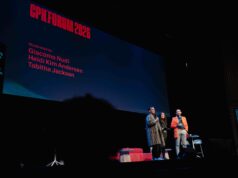
During her Cannes Docs’ Doc Day keynote, titled The Edit Is The Film, Japanese-British filmmaker and editor Ema Ryan Yamazaki offered a candid and highly personal reflection on the role of editing in documentary cinema, drawing on her work on the Oscar- and BAFTA-nominated Black Box Diaries (2024) and the more recent American Doctor (2026).
Opening with a joke aimed at the room’s directors and producers, Yamazaki reassured the audience that her talk was “not a coup,” nor an attempt to claim editors truly make films — “although if there are any editors, maybe we are.” Instead, she framed her keynote as an attempt to explain how filmmakers can better collaborate with editors and get the most out of the process.
Yamazaki, who also directs and produces, positioned herself as someone speaking from both sides of the equation. Having directed three feature documentaries and earning an Oscar nomination for her short Instruments of a Beating Heart, she explained that editing remains the place where she first learned storytelling. After growing up in Japan with a British father and training in New York under editor and filmmaker Sam Pollard, she eventually returned to Tokyo to pursue stories rooted in Japan while maintaining what she described as an “inside and outside” perspective.
Throughout the keynote, Yamazaki repeatedly returned to one central idea: editing is fundamentally about confronting reality rather than preserving intention.
“What do we actually have versus what you thought you had on set?” she asked.
For her, editors possess a necessary distance. They can acknowledge that an expensive scene or emotionally loaded sequence may simply not belong in the finished work. She also defended uncertainty during production, recalling an anonymous editor’s mantra she has adopted: “Don’t be God, I’m God.”
The point, she explained, is not creative dominance but accepting that documentaries reveal themselves over time. Directors and cinematographers should “shoot for the editor” rather than predetermine meaning too early because “only the documentary gods know what’s to come.”
Her first case study focused on Black Box Diaries, directed by journalist Shiori Ito, who documented her own investigation into sexual assault.
The project unfolded over four years and originated from material never intended as a film: iPhone recordings made for personal protection, audio notes, footage captured by friends and later professional shoots. Yamazaki inherited approximately 450 hours of mixed-media material and described the experience of watching it as emotionally overwhelming.
One of the most difficult aspects was that Ito herself was both director and subject.
Yamazaki recalled discovering footage that Ito no longer remembered recording, including highly intimate moments. Presenting these discoveries became an ethical challenge as much as an editorial one.
“How do you present that to the director who’s also her?” she asked.
The edit evolved through multiple conceptual phases. At different moments, Ito considered removing herself from the film entirely, incorporating stop-motion animation, or relying on metaphorical visual devices. Yet Yamazaki remained convinced that the raw footage captured in real time carried the emotional truth of the project.
Eventually, the team discovered the breakthrough that would define the finished film: the idea of diaries.
Remarkably, the title Black Box Diaries only emerged shortly before submission to Sundance Film Festival. Diary entries and reconstructed memories became tools to fill narrative gaps while maintaining the immersive first-person experience the team wanted to preserve without relying heavily on voiceover or explanatory text cards.
Moreover, Yamazaki emphasised that emotional sustainability became as important as creative decision-making.
The team took extended pauses from editing, embraced humour and created space for informal moments together. “We had so much fun,” she said, arguing that joy and recovery were necessary even on a film dealing with sexual violence.
She also reflected on the limits of editorial care. Initially, she found herself occupying multiple roles — editor, emotional support and confidante — but eventually recognised the importance of separating responsibilities so that dedicated team members could support the director emotionally while she focused on shaping the film.
Her second case study, American Doctor, presented almost the opposite conditions.
The documentary follows three US doctors working in Gaza and moved from production to world premiere in less than a year. Editing began while filming was still ongoing, leaving little opportunity to pause and discover structure over time.
Unlike Black Box Diaries, the problem here was scarcity of material.
Director Poh Si Teng wanted to build a vérité film despite having limited access to footage. Yamazaki admitted she actually finds too little material harder to edit than hundreds of hours.
At one point she had to tell the director that production could not stop. “We only have a short film,” she remembered saying.
Despite funding difficulties, filming resumed and the eventual structure became simpler than earlier versions, reducing multiple shifts between Gaza and the United States into a more focused rhythm. The lesson, she argued, was that experimentation often leads to simplification rather than complexity.
Concluding the session, Yamazaki rejected fears that artificial intelligence could replace documentary editors. For her, editing remains inseparable from human relationships.
“The film belongs to the director,” she said, but the editor’s responsibility is to understand that person deeply enough to help uncover the strongest version of the story.
“The editor has to really understand the director as a person,” she concluded. “This is the key ingredient to a successful editing process.”
She closed by pointing to a growing documentary ecosystem in Japan, mentioning the new called J-Doc Hub initiative and her own involvement in launching a documentary film school aimed at building community and reducing isolation among filmmakers.