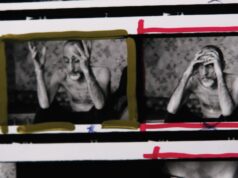
In Irvine Welsh: Reality Is Not Enough, Paul Sng follows the Trainspotting author through a moment of transition. The film, which screened at MDAG presents Welsh as an artist looking back at fame, excess, class, music, sport, drugs and mortality, while still searching for new creative directions.
Speaking to Business Doc Europe in Warsaw, Welsh explained that the project began informally, through his friendship with Sng. “Paul’s an old pal, basically. We’ve been mates for a while,” he said. “He just said to me in the pub one night, ‘I’d like to make a documentary about you at some point.’ And I thought, ‘No, I’m not really interested.’”
Welsh had turned down similar approaches for years, partly because he considers himself “quite a private person.” But Sng’s proximity changed the equation. “Because Paul knows me, I would be less guarded around him. I’d be more open,” he said. The director then spent about a year following him, in a process Welsh describes less as a conventional biography than a search for a particular thematic line.
“I always thought documentaries were about telling the story of someone’s life,” Welsh reflected. “But it’s not. It’s actually telling a particular story, a particular aspect that you decide is interesting.” For him, one of the surprises was seeing how the same material could yield “completely different documentaries” depending on the edit. “It interests me as a fiction writer, how you can actually make something out of the same material.”
According to Welsh, the film was initially more focused on creativity, but its centre of gravity shifted. “Because of the 30 years of Trainspotting and all this kind of stuff, it became about the relationship with time,” he said. “Everybody’s got a different relationship with time. And then, from there, I think that’s when the mortality thing kicked in.”
The trust between subject and filmmaker was crucial. Welsh said he would not have been as comfortable with someone he did not know. “There was a lot of trust. I just felt very comfortable,” he said, adding that this helped produce “a much better documentary.”
Asked whether the filming process made him feel exposed, Welsh connected vulnerability to artistic work more broadly. “Everything that I do creatively, I feel quite vulnerable,” he said. “I feel quite vulnerable sometimes when I write and when I publish, and I quite enjoy that feeling. That’s where things get good, if you allow for that feeling.”
For him, the film benefits from a degree of candour. “I was quite happy to be in a position where I could be a bit of an asshole as well as a very sage and together person too,” he said. “I think most of us are. So I think the candour helped the film.”
Welsh also sees documentary as one of the few remaining spaces where counter-cultural work can still breathe. Referring to Sng’s previous films, including Poly Styrene: I Am a Cliché and Tish, he said the director is drawn to figures “who are a bit out there and aren’t really going to be covered by mainstream things.”
“I think documentaries in some ways are probably the most counter-cultural,” Welsh argued, “because they’re generally independently produced. And that lends itself to a kind of freedom that a lot of filmmakers in fictional cinema don’t really have.” With fiction films, he added, the pressure to raise money can bring compromise. “Who pays the piper calls the tune. The more finance you have, the more you become compromised.”
Documentary, he continued, can still speak powerfully about class, race, gender and power structures because it can take viewers into lives and perspectives often ignored by dominant culture. “If I’m watching a documentary, I don’t want to watch a documentary on Elon Musk or Jeff Bezos or somebody born into money and power and privilege, with a silver spoon in their mouth, because they’re all exactly the same kind of asshole,” he said. “You want a different kind of story.”
The film also touches on drugs, altered consciousness and Welsh’s long-standing interest in transcendence. He described his relationship with drugs as complex, combining education, culture, exploration, hedonism and release. “As well as wanting to have a good time, I was always probably searching for some kind of transcendence with drugs,” he said.
That aspect has shaped audience responses, particularly around the film’s DMT (hallucinogenic) sequences. Welsh said viewers have been curious about the subject because contemporary life feels increasingly confined. “The Internet is very confining,” he said. “It was supposed to be about freedom, but it’s become these kind of manacles.”
He expanded the idea further, describing people as “caged,” despite the illusion of connection. “We have become a reduced version of our algorithms, and we’re constantly being milked and farmed for our experiences, which are then diluted and fed back to us,” he said. “We’re connected more with other people, and we’re lonelier than ever. We have less human contact than ever.”
That, he suggested, is precisely why independent documentary matters. “Any cultural space for independent art forms is going to shrink in no time,” he said. “But I think it still exists to an extent, probably more in documentary than most other things.”
Looking at younger artists, including docmakers, Welsh sounded pessimistic. He believes they may be “more caged” than previous generations because there is no longer a strong street or underground culture to nourish them. “It’s all a media culture. It’s all top-down,” he said. “It’s very hard for any artist now to come out with something that is genuinely interesting and provocative.” Technology, in his view, has not solved this. “It gives more people the ability to do polished but not very interesting stuff.”
As for the film’s title, Welsh said it captures the basic impulse behind art. “The reality of life is too confining and constraining,” he said. “People want to break out and see another dimension of humanity. I think they get that from art. I don’t think reality is enough for any artist.”
Welsh did not involve himself heavily in the edit, although Sng showed him different cuts. “I was content just to let him get on with it,” he said. “I think you have to let people make what they want to make. I write the books that I want to write. I write the songs that I want to write. You have to give other people that respect.”
For Welsh, the key was not self-protection but artistic independence. “To me, it’s more important that he makes a film that he wants to make rather than a film that I want to see. I don’t really care what people think about me. If I did, I wouldn’t write what I write,” he signed off.