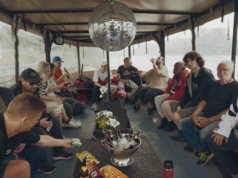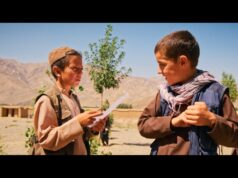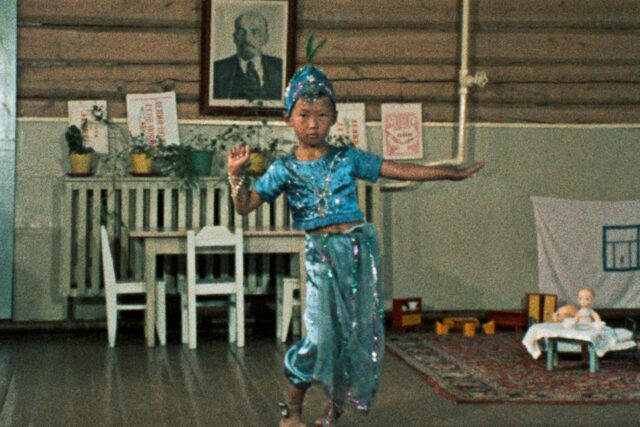
The Soviet Union is revealed in all its contradictions in Ukrainian director Sergei Loznitsa’s sprawling new archive-based documentary Imperium (screening this week in Venice Open – Out of Competition). The footage he uses was shot by Italian filmmakers in the early 1970s. They travelled to every corner of the Soviet empire, from major cities like Moscow and St Petersburg to far flung towns in central Asia; from Ukraine to the Baltics, from Azerbaijan and Kazakhstan to Uzbekistan.
One key point, the director explains, is just how little these communities have in common with each other. Twenty years after all this material was shot, the Soviet Union was to break up.
“We have from that time this image that the Soviet Union was Slavic people, all Russian ‘kalinka malinka’ and some gypsy songs,’” Loznitsa sums up the long-persisting cultural stereotypes. In fact, he points out, the USSR was made up of a huge number of different peoples and communities, “of different ethnicities and different cultures – and sometimes these were cultures that could not exist together in one country.”
In other words, the Soviet Union was always an experiment destined to fail. It simply contained too many incompatible ingredients. “The reason why the Soviet Union collapsed was absolutely logical. If you travel through the Soviet Union and you observe all of that, the first impression that comes to your mind is, how is it possible that this is one country?”
Loznitsa begins his film in Moscow and then heads out into the hinterland before eventually ending up back in Leningrad/St Petersburg (both cities where empires fell, Moscow in 1991 and St Petersburg in 1917).
To his surprise, some journalists in Venice talking to him about his documentary have continued to “mention Russia” as if that country and the Soviet Union were one and the same. “This film is against that!”
The Italian filmmakers were working on a TV series which they called ‘Mirror of Russia.’ Loznitsa was intrigued by the way in which they shot it. As westerners, they had few of the inhibitions that paralysed Soviet cinematographers. They weren’t worried about censorship or arrest.
“I feel it. When I watch this, I feel this is not Russian,” the director says of the archive footage. “It is beautifully shot. It is shot by people from a free country. The position of the camera, the composition and how they shoot is done without any respect of Soviet symbols or Soviet authorities.”
Loznitsa points out that Soviet cinematographers would have made sure to show fawning images of the Soviet leaders, for example the leader Leonid Brezhnev, but there is little sign of him here.
“Also, they mention things that no Soviet cameraman would ever mention,” the director notes, referring to ethnic tensions that Soviet filmmakers would have ignored.
Loznitsa is one of the most prolific major directors currently working. Almost every year, he has a new feature or documentary in a major festival. Last year, his drama Two Prosecutors, based on a novella by Georgy Demidov and set during the Stalin terror of the 1930s, was in competition in Cannes. That was how he started to work with Philippe Bober, whose company Coproduction Office was in charge of international sales on the movie. Bober was recommended to him by maverick ex-patriate Russian director Ilya Khrzhanovsky (whose new feature Dau is in Venice competition).
Now, Coproduction Office is selling Imperium – and Bober has also produced through his sister company, Essential Filmproduktion. The project also has extensive Italian backing.
Loznitsa studied at film school in Moscow in the early 1990s, just after the collapse of the Soviet Union. He wasn’t able to travel widely. He was in Vladivostok and Turkmenistan but hasn’t been much further afield.
“For me, it was very new,” he says of the many far flung parts of the Soviet Union that are included in Imperium. “It was surprising, very surprising.”
He hadn’t realised, for example, just what a big part religion played across the Soviet Union,
or the tradition of sacrificing animals. “That connection between the pagan religion and the Christian religion, I didn’t know about that.”
The outspoken Vilnius-based director has been back in the media spotlight in advance of Venice for remarks he made (and quoted in The Guardian) describing the European Commission’s decision to remove funding for the Biennale because of the opening of the Russian pavilion as “a punishment in kindergarten.”
He elaborates on his remarks to Business Doc Europe, pointing out that European countries continue to collaborate with Russia, even four years after the full-scale invasion of Ukraine.
“This is huge hypocrisy. They [the EU] just punish the Biennale [by taking away €2 million] which was money for a programme which connects different countries. It makes no sense. The Biennale presents culture and art from all over the world. Even now, this Russian pavilion is closed. I think the politicians just switch on to arts to avoid problems which they have to solve themselves but can’t. They have to find a way to press Russia and stop this horror which Russia produced,” he laughs ruefully.
Loznitsa is already busy plotting a new fiction project, another adaptation of a Demidov book, An Orange Lampshade. “It’s about the 1930s and Stalin’s purges. It’s the story of a family that also finds itself consumed, destroyed, by the regime. It’s also about making a wrong decision – a decision that is caused by great love and a desire to protect and save the protagonist’s family…but nothing good came out of it.”
Imperium is a Loznitsa that doesn’t have any Dutch involvement, and that wasn’t made through Atoms & Void, the Hague-based company that he runs. The key partners this time round were Essential Filmproduktion, Société Parisienne de Production, Kino Produzioni and Studio Uljana Kim.