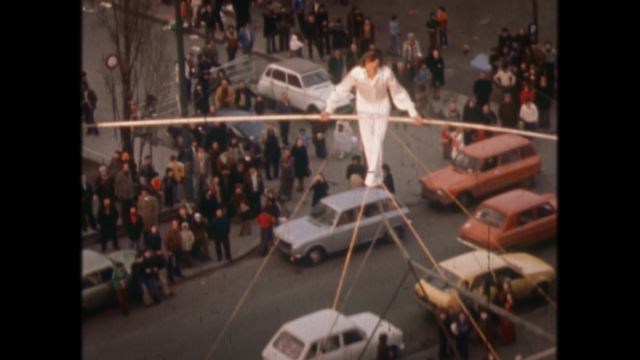
For a short period in the 1980s, the Aubervilliers housing estate in Paris seemed a bastion of hope, optimism and community. It was a run-down, working class neighbourhood with a high immigrant population, but a locally-funded programme of urban renewal planted seeds of pride and togetherness within its residents who could imagine a rosier future within their immediate environs.
The estate was built in the post-WW11 era, and almost immediately locals thought of it as a paradise, in that it offered properties with full amenities including bathrooms. Immigrants came in from Mali, Spain, Portugal and Vietnam. The Algerians arrived with olive oil. “We all lived well, all together,” one resident says.
But the area saw a slow decline over the next 30 years which determined the local Communist town hall to instigate its progressive programme of rehabilitation. Folk cleaned the place up en masse, gathered to paint the stairwells, and little by little deep neighbourhood bonds were formed.
What’s more, the whole thing was filmed on the emerging medium of video, and broadcast on a local TV station by a certain Alain Quiquenpoix with his Télé Alphonse Jouis – a name taken from the street it was on. A camera crew would go into the Aubervilliers flats and apartments to interview residents to record their views and opinions and, at times, to hear their gripes. The practice of urban rehabilitation led to a glorious spike in community empowerment and connection.
Italian director Giuseppe Schillaci, whose Auber 89, sold by Lightdox, is selected for Giornate degli autori at Venice 2026, grew up on a similar estate in Palermo, Sicily. When, in 2022, he was invited to take part in an artistic residency in the area, his initial belief was that the Aubervilliers of the 1980s would be something akin to a ghetto. “I had this stereotypical view that the banlieue was always like this,” he confirms to BDE.
But when he was given access to hundreds of hours of archive material that was shot in the 1980s, he was astonished by what he saw. “I [had] always associated [Aubervilliers] with the clichés of violence and marginalisation from the 1995 film La Haine,” he says, referencing Mathieu Kassovitz’s classic film about urban street life in the French capital. What he encountered instead within the archive was “an intimate yet collective moment of solidarity and social transformation – before the banlieues went up in flames.”
One of the teenage kids seen in the 1980s footage was comedy writer and actor Fatsah Bouyahmed. But when Schillaci asked Bouyahmed to participate in the project he needed a lot of persuading, at least initially.
“I contacted him to show him some of the sequences, but he told me he no longer wanted anything to do with Auber, and that, moreover, he had recently lost his memory following an accident,” Schillaci writes in his notes for the film.
But the director wasn’t to be so easily deflected. He needed a red line within his film to connect all aspects of the story, and knew that Fatsah Bouyahmed was the perfect person to perform that function. When he finally sat the actor down for a five-hour viewing (which he recorded so that all responses were spontaneous), Bouyahmed reacted with unbridled enthusiasm, laughing, crying and shouting in recognition of the faces on screen that he hadn’t see in near-50 years. “The film thus became a healing ritual, in which Fatsah rediscovers his past,” says Schillaci. “He came alive…By the end of the process, we see him going through this whole range of emotions.”
However, the optimism we see in the film, and which Bouyahmed was, in great part, responding to, was not to last. While we see “the old political ideology of the France Communists and the leftist working class” working for the betterment of the community, elsewhere the world was in transition.
The Berlin Wall was coming down, and the Soviet bloc began to dismantle, ushering in a period of capitalism which eroded the sense of societal cohesion within the banlieues, even the “consciousness that they were working class,” Schillaci laments.
The character of Quiquenpoix, who used to broadcast his Alphonse Jouy News show from the estate, is intriguing. He made the transition from a distributor of porn on VHS into a seemingly more enlightened proprietor of a news/information outlet (although he still showed adult content on the channel after the 10pm watershed).
Now living in the South of France, Quiquenpoix retains a great deal of nostalgia for the times. “He was one of the avant-gardist technicians,” says Schillaci. “And he is a technician, not an intellectual or an artist. He was an innovator of all this. He tried to, with his own hands, make television for the city, for the people within the social housing. “
Schillaci’s Auber 89 is not just a reminder of a more collegial and socially progressive era, it also recalls a more innocent time when audiovisual technology was still in its relative infancy.
“This film is also a love letter to the 1980s: the golden age of television and VHS,” agrees the director. “The saturated colours, the pixelated typography of early title sequences, the clumsy video overlays, the handcrafted cross-fades: all of this visual language infuses the film’s aesthetic, its titles, transitions, and colour palette.”
“This isn’t mere decorative nostalgia: it’s a way of remaining faithful to the world these images created. Their roughness is a deliberate artistic choice: it reminds us that memory is not restored – it is reconstructed,” Schillaci ends.