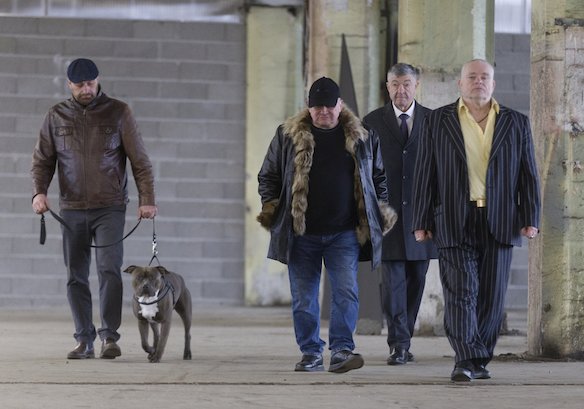
In Ieva Ozoliņa’s feature doc project Wise Guys, currently in early post-production ahead of delivery in 2027, two former gangsters decide to go legit and start a debt collection agency, all the time relying on the skills they learned during their criminal past.
“Director Ieva Ozoliņa is an established documentary filmmaker in Latvia, and her greatest strength is her ability to get extremely close to her characters without forcing intimacy,” producer Madara Melberga (FA Filma) tells Business Doc Europe. “She is a genuine documentary ‘digger’: curious, persistent and interested in what lies beneath the first answer.”
“But the foundation of her relationship with her protagonists is very simple – she genuinely likes people. Her characters sense that she is not approaching them as specimens or stereotypes. They trust her, and that trust gives her access to moments that would otherwise remain hidden from the camera.”
Melberga adds how another of the 52/90-minute film’s strengths is how “beneath its humour and larger-than-life characters lies a very serious question. The film looks at what happens when ordinary people find themselves in situations where state institutions, legal mechanisms or other formal structures cannot – or are perceived as unable to – solve their problems. This makes the protagonists more complicated than conventional ‘gangsters.’ They occupy a grey zone between criminality, mediation and a parallel form of justice.”
She points out to BDE that her goals for Baltic Sea Docs 2026 are very “concrete.” She is looking to identify one or two broadcasting partners who can join the film at the final stage, as well as lure an international sales agent who can promote its cinematic qualities and convince industry players of its wider audience potential. “At the same time, we are very interested in hearing how international decision-makers perceive the balance at the centre of the film – between humour and seriousness, and whether its distinctive quality as a kind of ‘real-life Sopranos’ resonates with international audiences,” Melberga tells BDE.
All international territories are currently available, giving potential partners “considerable flexibility” at this stage, she adds. “We also believe the film has unusually broad audience potential for a creative documentary. Despite dealing with crime, debt, justice and moral ambiguity, it is accessible, character-driven and often genuinely funny. We have repeatedly heard from industry colleagues that this combination – a serious documentary with strong cinematic characters that is also highly watchable and entertaining – is comparatively rare.”
Wise Guys has particularly personal resonance for director Ozoliņa “In the 90s, when Latvia broke free from the Soviet Union, my father became a self-made banker, and he had what was called a mob protection— a criminal gang that protected him from similar guys from other gangs,” she confides. “I was always interested in them, but my father didn’t allow me to be around when they came. Later, I made a film about my father and how he disappeared with an enormous amount of money, leaving the bank bankrupt. Interpol was searching for him, and so was I.”
“Years later, I discovered that people from the same gang had set up a legal debt collection agency, and I really wanted to make a documentary about them,” she adds. “To my surprise, they agreed — maybe because some of them had seen the film about my father, or maybe because they saw themselves as people serving society – of course, for money, not for free!”
Producer Melberga further tells BDE how, during the film’s participation in dok.incubator, tutors and colleagues repeatedly remarked on how unnervingly close Wise Guys feels to fictional gangster worlds as depicted in series such as The Sopranos. “The crucial difference, of course, is that everything we see is real. Nothing is reconstructed or staged: events unfold in front of the camera as they happen,” she says.
“For audiences, this creates the unusual experience of watching something that is humorous, charismatic and entertaining, but morally complex and sometimes deeply uncomfortable. For film partners, the project combines rare access, memorable characters and strong entertainment value with a larger social question: what happens when ordinary people no longer believe that formal institutions can provide justice?”