While the famously fine red wines and vineyards of Burgundy provide both the context and the setting for this beautifully made film, co-directors Michael Dweck and Gregory Kershaw astutely deploy their vérité gaze to dwell on love in all its forms, both within and beyond the vines, focussing on the estates, their wealthy owners, as well as the workers and critics whose lives are so deeply invested within the region’s fabled reds.
In Burgundy, the world’s most celebrated wines are only one part of the story, with ritual, inheritance, romance and appreciation of ‘terroir’ all combining to define why this famed red wine (the whites are hardly drunk here) carries such deep-rooted resonance. Dweck and Kershaw have previously documented traditional practices in films such as The Truffle Hunters (in which man and dog search for aromatic tubers in Piedmont) and Gaucho Gaucho (Argentinian cowboys wrangle herds in the Salta region of the country), so delving into the lives of folk engaged with the vines of Burgundy seems a perfect next move.
Perfect use of crafted cinematography and a delightful (and oh so French) soundtrack helps bring the filmmakers’ central characters to life. Each is identified by their profession on screen, and while some of them interact, each helps reveal a different aspect to the wine and the region.
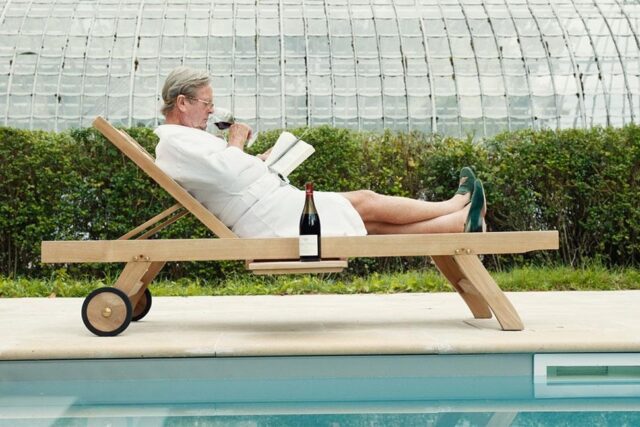
The film opens with Bertrand, the Domaine owner, seen shooting outside his ‘modest’ chateau that has been in the family for 160 years, and then sipping fine wine beside a swimming pool. Other characters we are introduced to are Guillaume, the wine critic at a blind tasting; Enzo, ‘the boy’ who we see shirtless washing a car before heading for his job at the vineyard; Patrick, the maître d’ of three-star Michelin restaurant Maison Lameloise who is approaching retirement, and Céleste who is training under renowned French sommelier Eric, but who is unsure whether it is the job for her.
Young Enzo is ruggedly old-fashioned (he loves French actor/icon Jean Gabin) and when he eventually takes Céleste on a date he is dressed in suit and tie and wants to talk about wine for his own future vineyard. Dweck and Kershaw rather sweetly step away from traditional documentary style and feature home movie-style 8mm vignettes representing the aspirations of Enzo and Céleste, including one in which they are dressed as Bonnie and Clyde outfits to rob an armoured car (this after he has been turn down for funding for his grand plans).
The film veers between the various ‘leads’ as they try and find a way through life. Bertrand is trying to convince his grandson Melchior (who jokes about his life in Paris within the world of finance) to take over the vineyard; Enzo wants to develop from the status of hard worker in the fields, to running his own business; Guillaume is freshly separated and heads out on a series of dates where wine is the centre of discussion, while also filmed seeing his therapist; Céleste struggles to see if the work suits her, and Patrick gently scolds his restaurant staff as he strives for perfection on the table and on the plate.
All want to move forward in some way, but all are driven by a love for wine and the region they inhabit, and while they are very different in terms of social standing they are united in a sense of place. Even as Enzo and Céleste seem to part ways, the film ends with them drawn back to the place they feel happiest. Desire for change and deep-rooted heritage intertwine in this generous and beautifully presented portrait of a place where history and tradition are of real value.
Naturally enough, wine quaffing is central to the film, but Burgundy is neither heavy-handed nor elitist about the importance and value of wine. The filmmakers shot for two years and admit they were drawn to the rituals of life there. As they write: “Then we stayed. Long enough to understand that pleasure in Bourgogne is not a hobby but a discipline, practiced daily, with the gravity other people reserve for religion. Stay that long and you stop observing. We began dreaming stories onto the lives we were following, until the film became what it is: a portrait of a magical community, rendered through drunken eyes.”
France, 2026, 90mins
Dirs: Michael Dweck, Gregory Kershaw
Production: Beautiful Development Company
International sales: Charades
Producers: Michael Dweck, Gregory Kershaw, Cameron O’Reilly
Cinematography: Michael Dweck, Gregory Kershaw
Editor: Pauline Gaillard
With: Enzo Ferraroli, Céleste Kalis, Eric Goettelmann, Patrick Maniere, Guillaume Baroin, Bertrand Devillard, Matteo Berny, Noelles Kermany, Melchior Monot