A handful of documentary projects were awarded at the close of the 83rd Venice Film Festival, which ran September 2 to 12 2027.
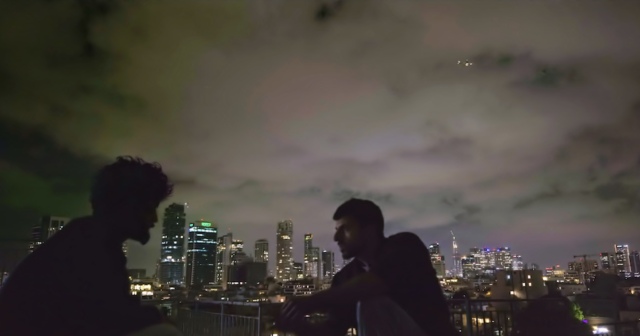
The major doc winner was NAZA by Yuval Abraham and Rachel Szor (UK), which won the OFFICIAL SPECIAL JURY PRIZE, as well as the independent EDIPO RE STUDENT AWARD and the GREEN DROP AWARD. It further received a Mention Cinema for UNICEF as part of the Leoncino d’Oro Award. Synopsis: Shot at night on the rooftops of Tel Aviv, Nazareveals in detail the systems behind Israel’s calculated mass killing of Palestinian civilians in Gaza. “We made this film out of a sense of obligation to use our position as Israelis to examine the systems behind the mass killing of Palestinian civilians for which our country is responsible,” the directors noted pre-festival.
The IMPACT GOLDEN GLOBES PRIZE went to LETTERS FROM THE SILENCED COUNTRY (LISTY) by Andrei Kutsila (Poland). The film is a portrait of contemporary Belarus told through stories of individuals who have endured imprisonment, repression, and exile – voices silenced by an autocratic regime. “This is not a story of the past. The repression continues. Almost every day, someone is arrested, someone is sentenced – often without public knowledge. Through my film, I want to give voice to those who cannot speak – Belarusians living in a silenced country,” says Kutsila.
One of the festival’s QUEER LION AWARDs went to Theo Rollason (UK) for QUEER EDWARD II. Synopsis: Spring 1991: queer life is under renewed attack in Britain, and filmmaker Derek Jarman is adapting Christopher Marlowe’s Edward II into a radical protest film. Drawing on never-before-seen footage shot by Seamus McGarvey on Jarman’s set, Queer Edward II is about the refusal to separate art from life, politics from pleasure. Comments Rollason: “As a queer filmmaker born just after Jarman’s death, I saw a clear opportunity to use the Edward II set as a springboard to discuss what I wish I’d known: just how high the stakes were for the community at this historical moment (UK in the 1990s), and Jarman’s centrality to the struggle that followed.”
The CINEMA & ARTS BEST FILM AWARD was won by Takashi Miike (Japan) for SHUMEI: THE LIVING LEGACY OF KABUKI, shared with the fiction Look Back by Hirokazu Koreeda. Shumei – The Living Legacy of Kabuki follows the 2022 succession ceremony of Ichikawa Danjūrō XIII Hakuen. In his first documentary feature, director Takashi Miike offers an intimate portrait of Danjūrō and his son, Shinnosuke, capturing both the grandeur of the Shūmei ceremonies and the personal responsibilities, pressures and sacrifices involved in carrying forward one of Japan’s oldest performing traditions.
The MARIO SERANDREI – HOTEL SATURNIA AWARD FOR BEST TECHNICAL CONTRIBUTION was won by Bibiana Rojas Gómez and Juan David Cárdenas (Colombia) for THE END OF TIMES, selected for Critics Week. In the film, Salomé reviews decades of family videos to understand her mother’s sadness. In this search, she uncovers a past marked by exploitation and historical violence in Colombia and Latin America. By using artificial intelligence to imagine a less terrible world, she discovers that it is easier for us to conceive the end of the world than the end of capitalism.