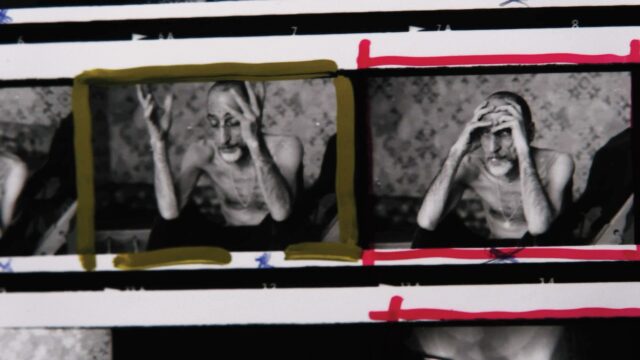
During the mid 1990s, the brilliant Portuguese photographer Mariana Viegas spent several years taking pictures on the sets of films by some illustrious auteurs, Šarūnas Bartas, Pedro Costa, Manoel De Oliveira and João César Monteiro among them.
As the stills photographer, Viegas had an ambivalent status. She was both part of the filmmaking team and an outsider, “like a vampire” as one interviewee calls her in Inês Oliveira’s new feature doc, Visits From A Distant Relative, screening as a world premiere in the Portuguese Competition at Doclisboa.
Oliveira is a teacher as well as a director. She had a strong interest in “how directors move on set…their energy, how they relate to the crew, to the actors and so on.” That made her especially curious about Viegas’ stills.
“I have known Mariana for a long time,” the director says of her subject. Both were part of the same artistic milieu in Lisbon and they had several friends in common. They had lost “a bit of contact” when Viegas went abroad, but Oliveira remembered that seven-year period when her friend had been working “very intensely” as a photographer on movie sets. She contacted Viegas and told her she would be fascinated to see her archive.
The director spent an initial three-day stint with her subject, assessing the archive and shooting a little early footage and interviewing her. Then she began to pitch the project and apply for funding.
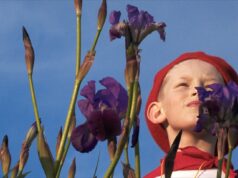
Some of Viegas’ assignments were daunting. On Bartas’ Few of Us (1996), she accompanied the crew to a remote Siberian village. She tells a story of how the helicopter she arrived on was also carrying a cargo of vodka. For the next three days, all the adults in the village got blind drunk and their children were left to fend for themselves. “It was tough to watch, people falling over in the streets,” she remembers of the binge drinking. School stopped and there wasn’t any bread “because the baker was drunk.” The photographer was observing all this and taking some very poignant pictures of the abandoned kids.
Oliveira was keen to hear about how, as a young woman, Viegas navigated the world of these movies, most of which were directed by high-profile men. She was often there during the developing, casting and pre-production as well as during the shooting itself. She was working in a period before smartphones, when photography, with all its photo-chemical processes, still retained an air of mystery and magic. On certain Costa films, some of the actors were non-professionals. Being around Viegas became a way for them “to get used to camera and to being photographed – she could be very helpful in helping them to build up a relationship with a camera.”
The features on which she was working were among the most important art house pictures of their era, titles like A Few of Us by Bartas, Pedro Costa’s Ossos, Manoel De Oliveira’s Party Inquietude, and Le Bassin de J.W. from Joao Cesar Monteiro, all movies which retain their cult appeal today.
“These were films that marked me, they are still important films for me,” Oliveira observes She describes Viegas’ photos as “somehow like a time machine,” giving viewers new perspectives on the important work of these major auteurs.
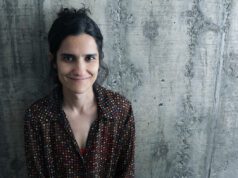
“In a way, it is a bit obvious to have these filmmakers, but also I think it is interesting to have this other perspective of this woman at two stages of her life, when she was 26 and now when she is 56,” Oliveira suggests.
Some of Viegas’ on-set photographs have had long after-lives. For example, images she took during the making of the Pedro Costa’s movies have been used in DVDs and books. Certain other images have featured in exhibitions of Viegas’ work. “But some of the photographs have been very little seen.”
Viegas is currently editing a new book of her work. Several of the pictures used in the documentary are also likely to feature in this publication. “The archive is rich and interesting, with a lot of artistic value and a lot of information that can be very useful for the study of cinemas.”
Veteran Portuguese producer Paulo Branco, who was involved on most of the movies on which Viegas worked, appears in the documentary. “He was very happy to focus on the pictures, observe them in detail and access memories. He mentions Bartas and Pedro Costa as filmmakers who create worlds, and live these worlds much more intensely than the worlds that they were born into – what we call reality. It’s interesting to see how he still romanticises the putative of ‘authorship.’”
Other characters who appear in the documentary include renowned costume designer Isabel Favila, director João Botelho and actor Francisco Nascimento.
The director expresses her main gratitude to Viegas herself “for trusting me…she exposed herself very much because the film lives so much off her voice, her thoughts, her work…the flow of her storytelling – it was very demanding work for her.”
This wasn’t a big budget project. “I made the film with 50K,” Oliveira says. The aim now is to secure world sales representation and to explore further festival and distribution opportunities.
The director herself recently completed a fictional project, Neko (2025), about a group of teenagers roaming through Lisbon. “It was a short film in 16mm. I went back to basics.” Throughout her career, she has combined fictional and non-fiction work. She currently has two fictional features in development.
Nonetheless, she expresses a certain frustration with the gender imbalance within Portuguese cinema. This, she points out, is more than just an opinion. She is involved with MUTIM – Women Workers of Moving Images, an organisation for women working in the film and audiovisual industry that was founded in 2022. MUTIM has already carried out its own statistical research – and the data conclusively proves that it’s the men who still earn more, and consistently get the better opportunities. “Let’s say I would like to do more fiction, but unfortunately fiction is a luxury of men,” she signs off.