Several years ago, Berlin-based filmmaker Janis Westphal heard from a friend about a very unusual housing project in the heart of Berlin Kreuzberg whose residents are homeless alcoholics. More than 40 men live here and they are all considered beyond the reach of conventional therapy. They’re allowed to drink but they are treated with kindness and respect.
“This was in December. 2019. I just went there. I was like ’yeah, I’m Janis. I want to maybe have a closer look at your house, maybe start some filming for research…’”
This set in motion the process that has now led to his new feature documentary Haus der Trinker (Last Round] which receives its world premiere in DOK Leipzig’s German Competition this week.
The main shooting period was in 2025 with a few finishing touched applied this year, and small snippets of footage from his earlier visits to the facility. “There is not a single social worker working there who has been there before me,” the director points out that he has now spent several years on the project.
Among the alcoholics are a few residents in their mid 80s. Sadly, most do not live nearly that long. “With alcoholism, people over 60 are quite rare…but there are some.” At first, the facility was only for alcoholics, but it now also hosts heroin and crack addicts.
No females are there. “When there are mixed genders, there is more conflict. It is as simple as that,” Westphal notes. He adds that, in Germany, “75% of addicted people are men and 95% of prisoners are men.” This, he believes, is no accident but reflects an ongoing crisis in masculinity – and the way so many men are still unable to ask for help but will “compensate” for problems in their lives with drugs and alcohol.
Biographies of the residents at the shelter are very different. Axel Garbrecht used to be a gaffer in TV for many years. “But then he started cocaine and his life went down the toilet at some point.” Some of the other residents have been living on the streets almost their entire lives. Others tell tall stories about their past lives. One claims that he served with the French Foreign Legion.
The shelter was originally founded by a priest. It was one of the first facilities of its kind – a place which followed a radical policy of ‘acceptance.’ Staff treat the residents as adults. They’re allowed to drink in moderation. They are treated as human beings, not as pariahs.
“Men, alcoholics, homeless – it is three stigmas in one,” the director says of his protagonists, most of whom feel utterly marginalised within mainstream society. They’re blamed for their situation and are often told that their problems are self-inflicted. Death is ever-present. (The film begins and ends with funerals). All the men have suffered more than their share of misery and bad luck. Often, one misfortune will lead to another. Whether it’s because of broken relationships or ill health, they will turn back to alcohol and spiral downwards very quickly. They give in to pity and anger.
“They are all so vulnerable,” the director says of his subjects.
So far, so grim, but Westphal’s film also shows the humour and the camaraderie between the residents. There are success stories too. Hille, one of the residents, has now moved into his own flat and has stopped drinking.
Over his many years visiting the facility, Westphal developed close relationships with various residents. He admits it was hard to see some of them in such a dire situation.
One challenge was how to find a narrative line through these characters’ lives. He knew he was making a group portrait and that it wouldn’t work to focus on an individual. “I wanted to make a film about a community from the start. Filming was very complicated. There is a lot of boredom and everyday life,” he observes.
He was working closely with his “super good editor,” Marisol Barrientos Lima. “We had these sessions every week, twice a week. It is so much about how it feels – it is more feeling than story.”
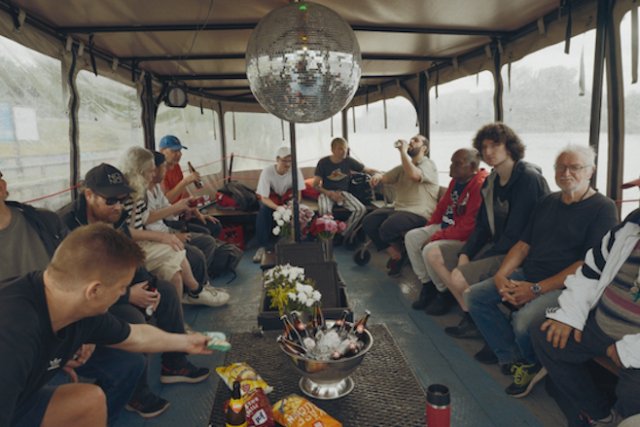
One solution was to concentrate on special occasions, for instance Christmas or a boat trip down the river, or the annual chess tournament. Another was to follow Uli the senior staff member and former city official. “He is like a legend somehow,” the director says of this idealistic but tough-minded man who quit local politics because his work “was compromised by budget.” When he took over at the facility, it was in a chaotic state but he restored order.
No-one is pretending that the facility fixes every problem but most of the residents are clearly happy to be there. “First, you give somebody a safe environment to live in. From then, you do everything else,” the director says of the ‘housing first’ policy it pursues.
Westphal has already organised a screening for the men at the facility. “That was probably the most interesting film screening I have ever had. I was super nervous. I couldn’t sleep the night before. Some of the men are shown in a very bad state and I didn’t know how they were going to like it.”
In the event, 13 o4 14 of the men turned up for the screening. “People were laughing and commenting…but after 10 minutes, everybody was silent and they really got into the film. Everybody was happy afterwards and were quite touched.”
German distributor Real Fiction is already aboard. Westphal made the film through his own production company, Seven Peaks Film, with support from Impact Produktion. “On our first meeting, our distributor said that with topics like homelessness in cinema, it’s the same as on the streets – people like to look away, so it is going to be a challenge [to release]. But I really think we have made something special because it is so full of humour and warmth. It’s not bleak!”