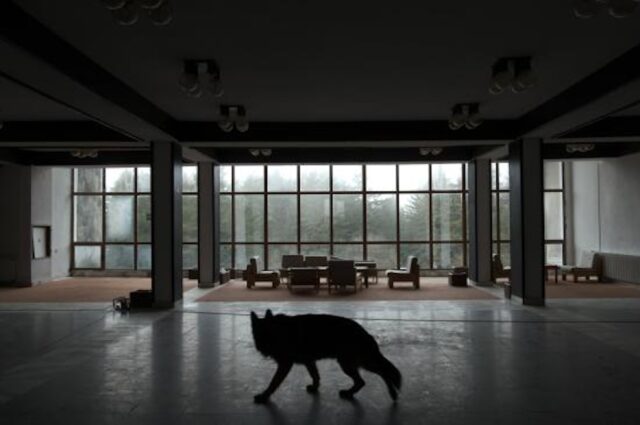
Welcome to Co-Living Semokovo, a sprawling facility in the mountains of Bulgaria whose guests used to be high ranking communists. The place, which is less than three hours drive from Sofia, has fallen into disrepair, but Munich-based property developer, Mathias Zeitler, a ‘long-term residential place builder,’ saw an opportunity to turn it into a perfect stop-off for Europe’s ever-increasing tribes of ‘digital nomads.’
In her new film Hotel Utopia (a world premiere in German Competition at DOK Leipzig), director Julia Groteclaes chronicles Zeitler’s attempts to transform what one observer calls “a failed communist project into a communal capitalist project.”
Groteclaes had heard Matthias on the radio and had been intrigued. He was a larger than life figure – a master salesman with a lot of spiel and an obvious flair for marketing.
“Everyone in the digital nomad world knew him. I was never interested in the digital nomads, but Matthias himself was the character who was interesting to me.”
Perhaps predictably, Matthias welcomed the idea of a documentary being made about his Bulgarian venture. The director admits that when she first started shooting, she “fell a little bit myself for the selling strategy from Matthias. It was quite a process to emancipate myself from that.”
It took a while for Matthias to understand that Groteclaes wasn’t just there to make a promotional film on his behalf, and that she might have an agenda of her own. She explained to him that she was more “interested in power structures” and how communities evolve than in helping him with his sales drive.
The film’s tone sometimes verges on the satirical. In the opening scenes, Matthias is seen confidently driving through the snow, disregarding warnings that his car may become stranded – which, sure enough, it soon does, just a few minutes from his destination. He is left on his own and suddenly seems strangely vulnerable.
“It is the film in a nutshell, Matthias having a vision, driving his car. He has power and is motivated by his own vision,” the director suggests. “On the one hand, he is the character who maybe seems a bit arrogant, privileged and has no boundaries – and on the other side, he is this man we feel a bit sorry for probably.”
There is an obvious mismatch between what Matthias is promising and the actual reality of the Bulgarian hotel which had been abandoned several decades before and is going to cost a small fortune to refurbish. The rooms may look “Instagrammable,” but the electricity doesn’t yet work and the swimming pool isn’t heated (although the WiFi is at least fast).
“Of course, digital nomads as a name or lifestyle brings an idea which many people do not like and do not find very attractive. They are a bit like capitalistic hippies. It’s a very western privilege to have enough money to go to places where you become a rich person because you don’t have to pay for food and living,” the director observes.
In the course of the film, audiences are likely to develop more sympathy for these nomads as they learn about them and the challenges they face. Some seem lonely, uprooted and a very long way from home.
Once the units have been sold and the building is up and running, Matthias plans to move on somewhere else. He is selling Semkovo as a utopia but it’s not one he wants to stay in himself.
As viewers are bound to notice, the building bears a passing similarity to the Overlook Hotel in Stanley Kubrick’s The Shining. It’s the kind of place where, in the dead of winter, you can easily imagine the digital nomads going a little bit crazy.
The facility was built in 1981. Guests were privileged members of the Party. After the Wall came down, it operated as an ordinary hotel but had been empty for 20 years by the time Mathias found it. It had broken windows and had been vandalised and broken into.
The majority of the digital nomads are men. They’re the ones who seem to have the means and the opportunity to take off round the world with their laptops in their rucksacks.
“I always wanted to make a film that makes power structures and power dynamics visible by cinema, following the questions: who holds power, who can challenge power and who follows power,” Groteclaes defines her own position. Early on, she questioned whether she should be working on a documentary whose main protagonists were men.
However, renowned Georgian director Salomé Jashi gave her some useful advice. “She said, ‘Julia, men have been looking at us women from the very beginning of cinema and we have to look back now. That really helped me, and underlined the feeling that I can still make a feminist film by watching men.”
Alongside Matthias and the digital nomads, the director also focuses on the lives of some of the local people including the caretaker of the building. She expected him to be very critical of these foreign interlopers who had turned up uninvited in his neighbourhood. Instead, he was nostalgic and seemed to hope that the nomads would succeed in bringing the old hotel back to life.
Several of the characters involved have seen the film in advance of the premiere. “The protagonists liked the film. Also, they recognised themselves in it…I am very relieved that they all like it!”
This may be Groteclaes’ diploma film but the director, a graduate of Film Academy Baden-Württemberg, already has plenty of experience. Other documentaries she has made include Hinter den Farben (2024) and Heimspiel (2021).
And, yes, she will be going back to Bulgaria to see what is happening in Semkovo. “But for a holiday, without a camera,” she adds. “There are people I would like to meet again. I would like to see Semkovo from a perspective not led by whether this is important or interesting for the film. That is something we sometimes lose when we are doing films, this fresh eye…”