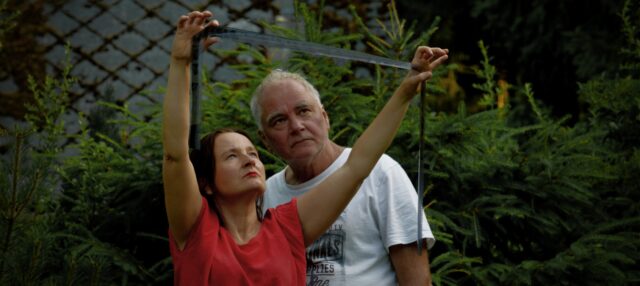
Czech filmmaker Filip Remunda has known Blanka Kulová since they were teenagers. Both went to FAMU the celebrated film school. She studied editing and he took the documentary directing course. Now, they have collaborated on Love Exposed, a “tragicomic documentary” that explores Blanka’s relationship with her father, Vlastimil Kula, the maverick photographer most renowned for his nude and erotic photography. The film, backed by HBO and sold by Andana Films receives its world premiere this week at Ji.hlava.
In the second year of film school, one of Blanca’s assignments was to make a short documentary portrait of someone ”interesting.” She chose her father.
“She asked me to be her cinematographer. That’s how I met her father for the first time,” Remunda recalls. “When I saw the dynamics between them, I was amazed. It was a very short experience but very intense.”
The short was well received at the film school but Remunda felt that “the father took over and directed the film instead of Blanka.”
The father was a domineering and successful figure. Remunda thought even then that he would be worth revisiting in another film. He liked Kula’s non-conformism and artistic independence, traits which his daughter shares. “He is not a typical person. He is so honest and frank in communication. He is not hiding much.”
Nonetheless, as the new documentary (which Blanks herself has edited) makes very clear, Kula was a long way short of being a perfectly family man. He was driven and self-obsessed. Remunda likens the household over which he presided to a wasp’s nest.
“The wasp is a very beautiful creature but it is also dangerous. They [wasps] are beautiful but they are dangerous to each other. This is also for me what the film is about.”
Remunda took steps to protect the family members involved in the project. “We worked with psychological advisors [to make sure] not to step beyond boundaries.”
In the film, daughter and father rake over certain painful incidents in her childhood. For example, she talks about one traumatic moment when she spilled shampoo in the car and he had a violent tantrum. Remunda cites this as “a scene we can see from two completely different points of view.” From the father’s perspective, it is a minor, easily forgotten incident from long, long ago. For Blanka, it’s still something to talk about today.
This is one of many moments of misunderstanding between father and daughter that the film examines. It prompts Kula to talk about his own father. The loving grand-dad Blanka remembers was, in fact, according to his son, a womanising and highly manipulative figure who also treated his family very badly.
When Remunda started working on Love Exposed, which also screens in the International Competition at the Tallinn Black Nights Film Festival next month, he had “no clue” about how deeply affected Blanka had been by her childhood experiences. Now, by participating in the documentary, through her art and through therapy, she is trying to break a long-lasting cycle of family misery and misunderstanding. “She is fragile but also powerful,” the director says of his collaborator.
Kula lives with his second wife in a house in the woods near the border with Germany. This was an area that, during the communist era, was heavily protected. That’s why it remains so unspoiled and beautiful. In his workshop here, Kula is always working away on his new constructions. Remunda compares him to a “steam punk” inventor or a character in a Jules Verne novel, a “do it yourself engineer/artist constantly building some part of his never finished studio.” At various points, we see him or others in a bath which he has set up amid all the other clutter.
These days, the ageing photographer’s celebrity is on the wane. In a post #MeToo era, his nude photography inevitably seems voyeuristic and creepy to many critics. Nonetheless, he continues to make images of naked women – and Remunda films him doing so.
The filmmakers were very conscious of the complexities involved in showing Kula at work. “It was obvious that we could not really avoid it as an important part of the story, but we were looking for a camera style that would not objectify female bodies. For me, it was very important that females have a strong voice in the film and that this is actually the POV of Blanka, a strong female and my friend, and that she will tell a story that is important for her.”
In one scene that wasn’t used in the film, Blanka challenged her father about how it was possible for him to be so efficient when he was organising his photography sessions with the models and yet often so lax when it came to looking after his own family. “It was powerful but sometimes you have to kill powerful scenes.”
Remunda, though, is wary about “cancellation” of artists like Kula. “I’d rather talk about difficult topics than cancel them.”
As a filmmaker and artist himself, he knows the pressures and challenges that Blanka’s father may have faced while trying to meet deadlines and balance professional and personal commitments.
“I must confess that, in order to survive economically, I sometimes behaved in a way that is not very polite to my family,” Remunda acknowledges. He insists, though, that he puts the children first. He also doesn’t accept the notion that “every artist must be as egoistic as Picasso” to do exceptional work.
“The lesson for me is that relationships within the family are the most important even if, sometimes, we don’t have enough time or concentration for them,” he says.
The participants have confirmed that making the film has had “a therapeutic impact.”
Love Exposed has a very distinctive shooting style. This is not grungy, fly on the wall, observational documentary. Instead, scenes are carefully and very artfully composed. Remunda praises his cinematographer Jakub Halousek for his work on the project. Despite the considered camera work, the film is still capturing moments of angst and chaos in its subjects’ lives.
“This is my method. I can prepare the scene, working slowly with our heavy camera on a heavy tripod, being patient…and the dialogue can [still] be very realistic and spontaneous.”
Non-profit organisation The League of Open Me is helping the filmmakers develop an impact campaign. Remunda has already noticed how much dialogue and debate the film has provoked at test screenings. He hopes it will “open up” extended discussions between parents and adult children about ‘family patterns and mental health.”