FAMU (Film and TV School of the Academy of Performing Arts in Prague), one of the most respected film schools in the world, is celebrating its 80th anniversary this year. This is the school whose graduates include such luminaries as Miloš Forman, Jiří Menzel, Věra Chytilová, Jan Sverak and Agnieszka Holland, as well as stalwarts of the documentary field like Filip Remunda and Helena Třeštíková.
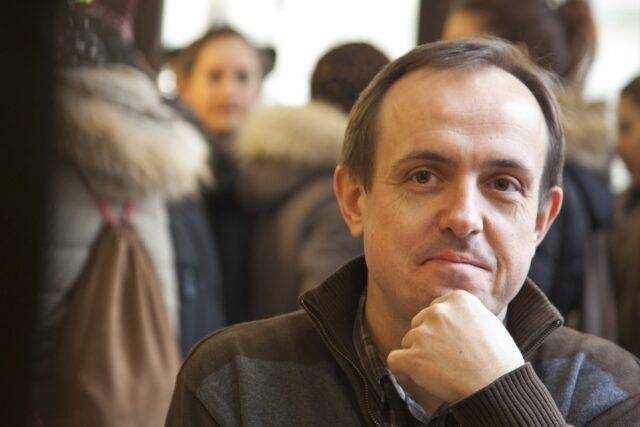
David Čeněk has been Dean since May 2024 – having also served as Vice Dean for International Affairs since 2020. As he tells Business Doc Europe, the celebrations for the 80th anniversary have been extensive and have taken place throughout the year, with screenings at festivals, special programmes in cinemas, and discussions and exhibitions.
“An important part of the anniversary is our collaboration with the National Film Archive, particularly through screenings at its Ponrepo cinema, where we are presenting films representing different periods, departments and artistic traditions of FAMU. We have also prepared special curated distribution programmes under the title Best of FAMU 80, intended for both Czech and international audiences. These programmes allow viewers to discover the remarkable diversity of films created at the school over eight decades, rather than concentrating exclusively on its most famous graduates.”
Čeněk cautions, though, that he doesn’t want the anniversary to be an excuse for nostalgia. “Of course, we are proud of the school’s history and of the extraordinary filmmakers who studied here. But FAMU is not a museum, and its reputation cannot depend indefinitely on the achievements of previous generations.”
As the Dean points out, FAMU has undergone enormous change since it was founded in 1946 but certain key principles remain exactly the same now as they were then. One mantra is that filmmaking must be learned through practice, experimentation and critical reflection.
Historically, FAMU was organised around individual artistic disciplines, such as directing, cinematography, editing, screenwriting and documentary filmmaking. “This structure remains important, but contemporary filmmaking requires collaboration across disciplines, new technologies and different forms of audiovisual expression,” Čeněk says. “But what distinguishes FAMU is perhaps less a particular aesthetic style than its understanding of film education. We do not want to produce filmmakers who all think or work in the same way. We want students to develop their own artistic language, while learning to work collectively and to defend their creative decisions.”
At FAMU, intellectual inquiry and experimentation are always encouraged and there is a “strong tradition of artistic autonomy.”
Documentary, the Dean says, is “central” to the school’s identity. FAMU is well known for “encouraging personal, essayistic, experimental and politically engaged approaches.” Students in the department are never simply taught to regard documentary as the ‘recording of reality.’
“It is also a way of thinking about reality, questioning images and examining the relationship between filmmakers and the world around them,” the Dean insists.
Čeněk himself comes from an academic background and has written extensively about such adventurous and radical figures as Chris Marker, Jean-Luc Godard and Robert Bresson. And, yes, it is important for him that students are exposed to such directors’ work and ideas.
“I strongly believe that filmmakers need to understand the history of their medium. Not because they should imitate the great filmmakers of the past, but because cinema has a memory, and that memory offers an extraordinary range of possibilities,” he says. Godard, Marker or Bresson are “important because they challenge our assumptions about what cinema can be. Godard questions the relationship between images and language; Marker explores memory, politics and the essayistic possibilities of cinema; Bresson forces us to reconsider the relationship between performance, sound, gesture and cinematic form.”
At the same time, Čeněk always looks forward, not back, and he certainly doesn’t like the idea of film history as “a museum of masterpieces.” He therefore encourages students to discover “forgotten filmmakers, marginal traditions, experimental cinema and works from outside the dominant European and American canon.” He doesn’t want them to genuflect at the reputations of big-name figures but instead always to think independently.
FAMU may be a Czech public university, but it has always had an international dimension. “Even during the socialist period, international students studied here, and the school developed important relationships beyond Czechoslovakia,” the Dean notes.
These days, there are programmes in English and the School has partnerships with other film schools and cultural organisations around the world.
“For me, internationalisation is not simply a matter of increasing the number of foreign students. It means creating an environment in which different cultural experiences, artistic traditions and ways of thinking can genuinely interact. At the same time, we must preserve our responsibility towards Czech film culture and Czech-language education. I do not see these two ambitions as contradictory.”
This isn’t an easy school to get into. Admission remains “highly selective” and is based on artistic potential, creativity and an ability to develop an individual approach to filmmaking. The school pays close attention to gender balance, diversity and equal opportunities.
Čeněk says the school’s financial situation is currently stable thanks to public funding and support from the Czech state. However, FAMU still needs to generate extra resources for the production of student films (the money for this comes from “the school’s operating surplus rather than directly from its regular state funding.”)
As Čeněk also notes, film education is expensive, “particularly because of the technological infrastructure, equipment and production facilities it requires.”
The challenge, the Dean believes, is in ensuring the school remains publicly funded. That, Čeněk suggests, is not only “a financial necessity” but “a guarantee of accessibility, artistic freedom and institutional independence.”
Internationally known filmmakers continue to come to FAMU to give masterclasses and share expertise. Sergei Loznitsa, who recently won Best Film Award in Official Competition at the BFI London Film Festival for his documentary about the Soviet Union, Imperium, is among the big names expected in Prague soon.
Čeněk is involved in festival programming, including for documentaries at Ji.hlava, and says that the big Czech festivals are important platforms not only for showcasing student films but also for “professional encounters.” However, he adds that these events should never “become the sole measure of artistic success. A film school must also defend forms of cinema that do not necessarily correspond to current festival expectations.”
Being Dean comes with plenty of challenges – and paperwork. Čeněk talks of the administration, difficult decisions, negotiations and institutional responsibilities of his job and says “there are certainly days when cinema seems rather far away.” Nonetheless, there are obvious rewards, for example when he sees “students discovering something genuinely their own, something that cannot simply be taught or prescribed.”
“What I value most is the possibility of creating conditions in which other people can develop their talent and intellectual independence. A Dean should not decide what the cinema of the future will look like. The responsibility is to ensure that students have the freedom, resources and courage to discover it themselves,” he continues.
As for the ongoing 80th anniversary celebrations, he insists they should mark a beginning, not an end point. “Perhaps the best way to celebrate eighty years of FAMU is to make sure that the next eighty years will be just as interesting,” he concludes.