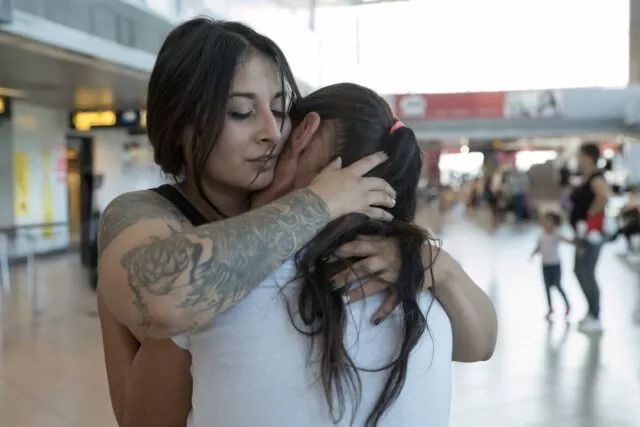
It’s a long and embroiled tale: Jessi Frou, the protagonist in Laurentiu Garofeanu’s feature documentary Lost And Found: Thirty Years, Not Together (a world premiere in Tallinn Black Nights Festival and also available in IDFA Docs For Sale), was sold as a baby in Romania in 1990. She grew up in Canada, believing she had been abandoned at birth. Thirty years later, she discovered a very different story.
Garofeanu began work on the project in 2018 through his Bucharest-based company, Mekanism Media. At that stage, he hadn’t yet met Jessi.
The director is Romanian himself but had lived in London for ten years and for five years after that in New York. He had worked for various different production companies making mainly commercial projects including such titles as Body Bizarre and Preposterous Pets. He worked on documentaries about swimming with polar bears and living with crocodiles and lions.
When he decided to come back to Romania, Garofeanu was determined to “tell the stories I am interested in, and also to have a little bit more creative control of my work…I wanted to do stories that can help society a little bit because I feel that in Romania, we have a shame – a lot of the difficult conversations we tend to sweep under the rug.”
In the 1990s, Romanian babies had been given up for adoption in often murky circumstances. Garofeanu, 48, realised that many of these people, now young adults, were coming back to the country to try to find out more about their roots.
“When I started learning about these adoptees, I was shocked,” he remembers. He himself was struggling with his own identity as a Romanian having been away for so long, but at least he grew up in the country and went to school there. Many of the adoptees had no memory of their homeland whatsoever. They wanted desperately to identify with Romania and its culture but many struggled to establish meaningful links.
“I started researching. I went on a private adoption group where thousands of children were posting. There were a lot of conversations happening and there were so many interesting stories from all over the world – there were children adopted in the UK, Australia, Germany, France but a lot were in Canada and the USA.”
Garofeanu started doing interviews with adoptees. Several expressed the desire to come back to Romania but they weren’t sure when. Others would come for just a day or two to meet their biological parents before returning to their daily lives. That was why Jessi seemed so special. He met her initially through Facebook. She had visited Romania for the first time in 2017. He connected with her in early 2018, just before her second visit.
“That’s one of the things that attracted me to her, she had a drive. She not only wanted to meet the family but she wanted to explore her identity in depth. She wanted to spend time with her family in Obor (in Bucharest) and to give something back to society.”
The contrast between her life in Canada, where she lived in middle-class affluence, and the world she encountered in Romania was glaring. In Obor, not everyone has running water. The roads are not paved. Life is simple and tough. Even so, Jessi seemed to feel at home there and never complained about the conditions. She quickly formed strong bonds with her real mother and her relatives.
“She wanted to become a voice for other adoptees in order for them to understand that it is not as simple as it may seem if you want to reconnect with your birth family. She was very positive, very transparent,” the director recalls. “We continued from there. I decided I wanted to follow the story wherever it leads.”
Jessi realised from the first visit that there would be complications as she tried to re-establish her relationship with her birth mother and family. Sure enough, her eventual meeting with her biological father exposed some deeply uncomfortable family secrets.
At times, her trust in her mother disappeared and she again felt extreme feelings of betrayal and abandonment. She went back to Canada and moved on with her life, studying journalism, marrying, divorcing and having a child of her own.
The pandemic slowed filming down. However, Garofeanu kept on going, working with an investigative journalist to unpick a very complicated story yet further.
As matters progressed, there were some extraordinary revelations – not least the news of a sister Jessi never knew existed and who also been sold for adoption.
This wasn’t an easy documentary to finance. Garofeanu was working as a “self-shooting producer-director.” In other words, he was doing everything himself including the lighting and sound. He owned the equipment. The national film fund gave him a small amount of money and there was also early development funding from HBO.
There was bad luck along the way when companies that had agreed to back the project were either caught up in corporate restructuring or sold – and the money never arrived. Nonetheless, Garofeanu persevered, pumping his own resources into the film and eventually winning the Balkan Watchers Award in 2025 which came with cash attached.
The filmmakers had some good fortune too. After Garofeanu put information about the film and its trailer up on his website, he was approached out of the blue by the woman who turned out to be Jessi’s Spanish sister Paola (who looked uncannily like her and shared her lust for life).
Three decades ago, when the sisters were sold as babies by their family, the adoption system in Romania was like the wild west. Records weren’t kept properly. Documents were forged or lost. This was an era of rampant child trafficking. Nonetheless, through sleuthing and DNA tests, Jessi and the filmmakers were able to uncover the truth. A story that could have been very dark ends in uplifting fashion.
Now, the director is travelling between Tallinn Black Nights and IDFA to launch his long-gestating documentary.
“I’ve already sent the film to another 12 festivals. I would love it to travel around the world…this has happened in so many other areas in the world, from our neighbours in Ukraine to Bulgaria and the Balkans too, and all the way from China to South America,” he says of the worst excesses of the adoption industry. “I would love this film to travel to different areas of the planet to see how people connect to it!”