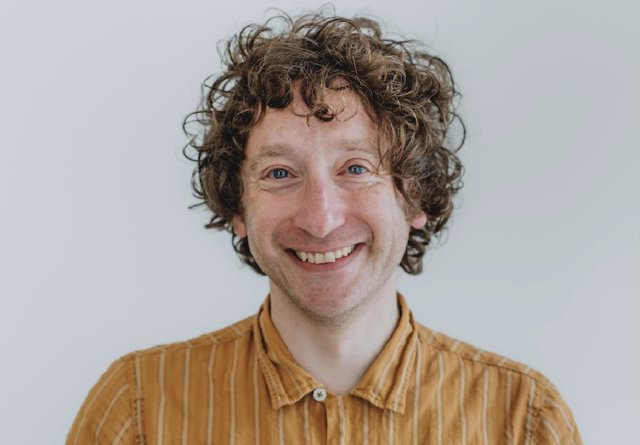
Effervescent Folkestone-based producer and consultant Charlie Philips, former Head of Documentaries at the Guardian, has only been Programme Director (Advocacy and Curation) at the Documentary Association of Europe (DAE) since September, succeeding Brigid O’Shea, but he is already putting his indelible stamp on the organisation.
Above all, Philips wants the sector “to shout from the rooftops” about the public service value of documentaries. That is why he is lobbying so intensively.
“I want to connect more of the big national organisations across Europe, producer-organisations, director-organisations and film institutes – to try to get them to compare notes and speak with one voice so that we can collectively advocate for the public service remit of documentary as an art form which I feel is not being respected enough and is under threat from many directions,” he declares.
DAE has around 850 members, mainly European (although it is open everywhere and has “members from over 50 countries”) “We actually don’t have that many UK members,” he acknowledges – but he hopes that will soon change. Producers and directors make up the bulk of the members but Philips is keen to point out sales agents, distributors and commissioners, among others, are all very welcome to join too.
“There is no limit to how many members we could or should have. I want us to represent as many filmmakers as possible,” Philips continues. “I see us like a trade union, a trade body [that can offer] protection in a very hostile world.”
DAE prides itself on being “a very ethical organisation, a feminist organisation, an intersectional organisation…we are explicitly political. The more members we have, the more power we have.”
Philips and his team are trying to support filmmakers from low income and diverse backgrounds, “really helping beyond throwaway diversity schemes but on an ongoing basis, really supporting new entrants to the industry.”
In the longer term, Philips hopes DAE may be able to establish its own fund – but that is far off. In the shorter term, he believes the organisation will soon be “able to offer members free legal advice, cheaper insurance, cheaper services. I’d love to be able to offer that either pro bono or discount.” Members get reduced prices on market badges at various festivals and markets.
One prospect Philips raises is DAE working together with the UK’s recently launched Documentary Film Council (DFC). After all, Philips is UK-based himself and the two organisations have shared goals. “We haven’t had a meeting yet – but we will.”
Another aspiration is to set up an awards event. “There are some great awards that documentaries win, but there aren’t that many documentary-specific awards. I think there is a space for a global documentary awards that is very much aimed at independent filmmakers, a bit like the BIFAs.”
Philips acknowledges this will take time but sees it as a viable ambition. He is also looking to ramp up funding for DAE. “Big freedom of speech foundations and big documentary funding organisations have, during the Trump era, talked about supporting organisations rather than individual films, supporting the infrastructure of the industry. I think we could and should have a part of that.”
He also believes “there are a lot of organisations making a lot of money from independent doc makers” who should be putting something back, and hopes to touch up some of those too (whether they’re big production companies or distributors).
IDFA is a key event in the DAE calendar – and there will be the usual DAE party on Monday night. “I was at Sheffield Doc Fest when we used to have the best party anywhere, and so I do like organising a good party as well,” Philips promises this will be a rocking affair.
Meanwhile, during daylight hours, Philips will be busy with consultancy sessions, the IDFA Academy and the Forum – as well as moderating an IDFA talk on “is AI stealing my documentary?”
“It’s basically responding to the fact that a lot of people’s films are being used to train AI, either because sales agents and distributors are licensing them or they’re out there being distributed and AI just takes and uses them, whether legally or not,” he says. “A lot of the discussion around AI has been around should you use AI to make your films, and there hasn’t been enough discussion about happens afterwards if they are being used to train AI.”
DAE is also currently championing its members’ work on its own site, for example posting new interviews with filmmakers like Michał Marczak (Closure) and Biljana Tutorov and Petar Glomazić (To Hold A Mountain).
Alongside his activities at DAE, Phillips remains a prolific producer in his own right. Earlier this month, one of his features, All Rivers Spill Their Stories to the Sea, directed by Jeanie Finlay, picked up a BIFA nomination. Philips has several projects in the pipeline (although he is coy about revealing too many details as none have been publicly announced yet).
“The great thing about the DAE role is that I can do it alongside my producing. I love producing and I am really dedicated to it,” he says. “I am always interested in speaking to people looking for producers because I like to have quite a big slate as everything takes so long to make – and it goes in fits and starts as well, because of the funding, and I am very good at multitasking!”
All Rivers Spill Their Stories to the Sea has shown all over the UK, posting “really good audience numbers” and provoking some very emotional reactions from viewers angry about the way the fishing community portrayed in the film risks having its livelihood stolen away because of pollution. The film is being distributed through Glimmerama, the creative distribution company set up by Finlay herself. “The way that we are doing it ourselves means that we are in control of playing it wherever we want, putting it online whenever we want….”