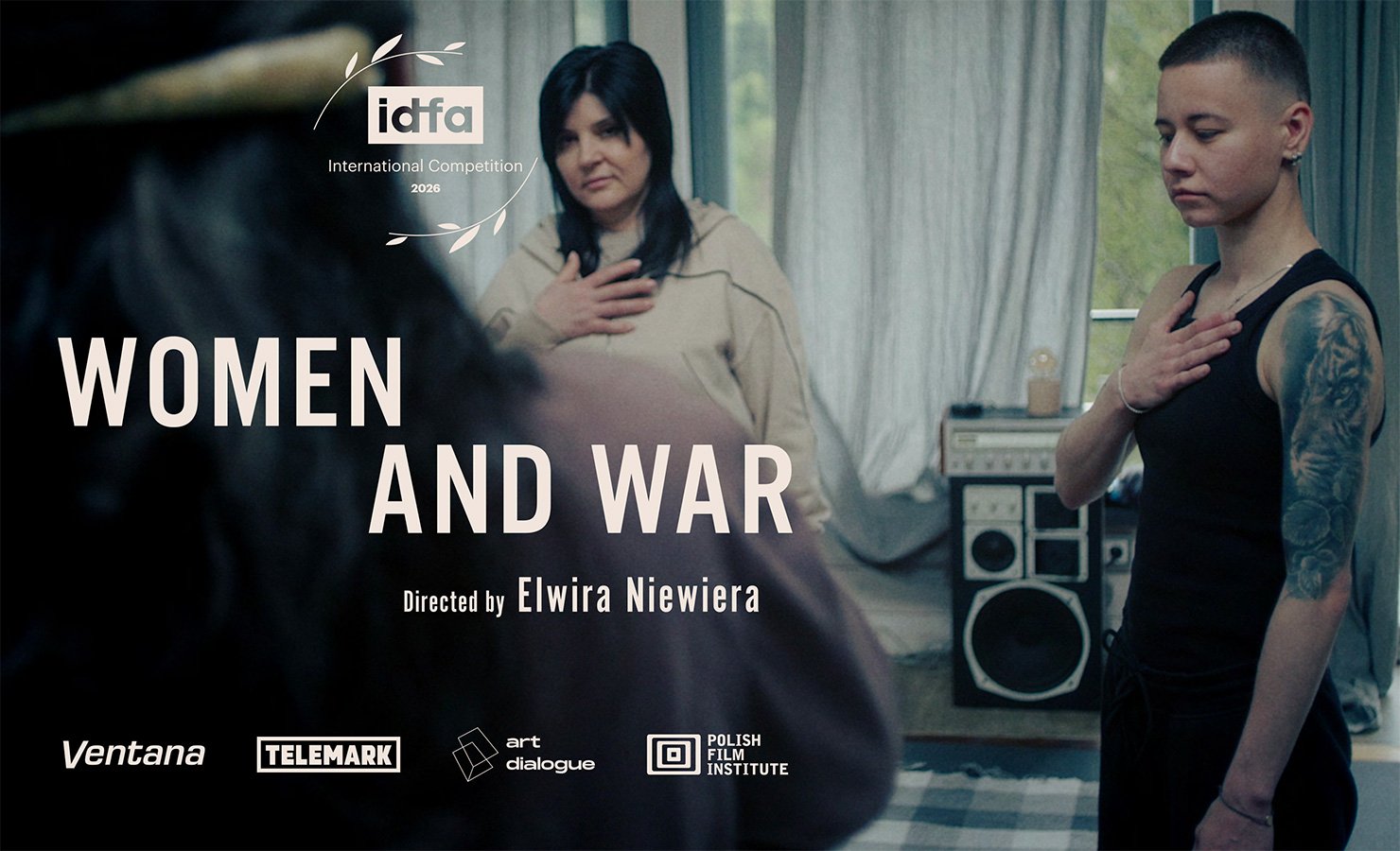
Tomorrow (Sunday, November 15), a public action will take place outside the Eye Filmmuseum before the world premiere of Elwira Niewiera’s new documentary, Women and War, screening in International Competition, and sold by Rise and Shine.
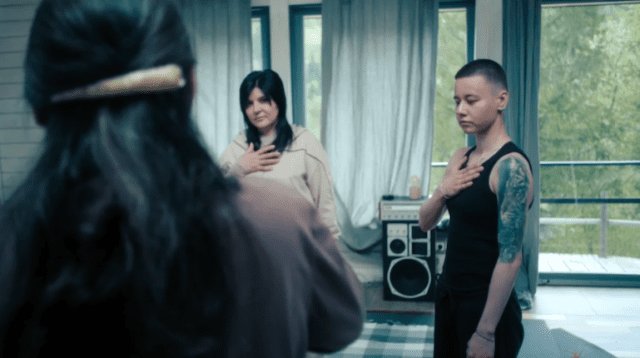
The film follows four Ukrainian women who have endured horrific experiences – torture, sexual violence, long-term imprisonment, terror and bereavement – since the Russian full-scale invasion of 2022. They’re shown attending therapy sessions high in the Carpathian Mountains as they try to come to terms with their memories of loss and trauma.
According to human rights organisations, more than 2000 Ukrainian women remain in capacity. Late in the film, one of the protagonists, Yulia, who was held in captivity for two years, remembers what she was told by the prisoners she left behind when she was finally freed: ‘please don’t leave us alone with Russia.’
The public action is one way of reminding the public of the plight of these female prisoners and is the result of a collaboration between Niewiera and celebrated Polish artist Bartek Kiełbowicz. “I showed him the film, and he was so impressed that we started to think about what we would do.” The public will hold portraits painted by Kiełbowicz of 33 of the women.
“You know you cannot touch a painting in a museum, but in my movie, touch plays a very important role in the therapy helping the women. In the public action, touch also plays an important role. We want people to hold the pictures, pass them from hand to hand, and to be able to touch them, embrace them, spend a moment with them.”
In late 2022, Niewiera had heard about the trauma therapy programme in Ukraine. “I was deeply moved. Eight months after the full scale invasion started, people were thinking about how to help women to heal,” the director remembers.
Her earlier documentary, The Hamlet Syndrome (2022) had used Shakespeare’s tragedy to explore the trauma experienced by young Ukrainians in the wake of the Maidan revolution. A representative from the Ukrainian Women’s Foundation who had admired the film now approached her and invited to see if the trauma programme might also be worth documenting. Niewiera spoke at length to the therapists. She wasn’t sure it would be possible to film their sessions unless both the women and the therapists had complete faith in her motives. “Before filming, I spent several months getting to know the women and building relations with them.”
Since the full-scale invasions, Niewiera has been deeply involved in humanitarian work in Ukraine. This made it easier for the women to trust her. They knew she wasn’t just a filmmaker or journalist who was there as an observer and would soon leave. She had already shown her long-term commitment.
At the outset, the director and the therapists established very clear ground rules. They agreed that there would be no filming of the individual therapy sessions. “These would remain completely private and this was very important for me, that the women would have this private space.”
Instead, the documentary focused on the group sessions and the art therapy.
Niewiera accepted that the women’s welfare must always come first. Nonetheless, she made herself a “meaningful part of the group” by always being helpful, making tea, laying out blankets and trying to create a calm atmosphere. She was determined to make a positive contribution, not just to be a movie director sitting on the side-lines, watching what was going on.
“Of course, it was a very heavy experience. In the movie, I tried not to give space to the perpetrators, but to concentrate on the journey toward healing and what it means for women who are coming out of captivity.”
These women “continue to live in this constant state of fear, of danger, even after being released from capacity, because they completely lose their sense of safety. They can’t trust in other people even if they are back with their families.”
They also often feel “emotionally and physically numb.” For example, Iryna, a ballet dancer from Mariupol, found herself incapable of dancing after her horrific experiences hiding in basements. “The process toward healing is long and it is difficult. I realised that at first they women were not only unable to feel joy but also to feel sadness or anger.”
During the therapy, the director saw the women’s feelings “slowly come back.” For her, too, this was an emotional and gruelling experience. “It was so much determination. I needed to make this movie,” she admits. “Of course, there were so many times when I doubted I could it.”
She therefore developed a novel way for relieving “pain, anger and helplessness.” She would smash plates. “The Ukrainians have been so many years at war that they know how to deal with pain. One of my very close Ukrainian friends recommended this to me.”
The director acknowledges that while making the documentary, and learning “the terrible things people can do to one another, you begin to lose trust in humanity. That was one of my motivations for making this film, also to show the inner strength and resilience the women have to overcome the worst evil.”
Women and War is a Polish-German-Ukrainian production, made through production companies Telemark, Ventana Film and Art Dialogue. “The first year, 2023, I was alone without producers, but I received a great development grant from Chicken & Egg Films at this time.” In late 2023, she applied successfully for German public funding – and the project built support from that point.
Niewiera always shoots her film in an observational style. She wanted the camera to be close to the women and to shoot in an intimate style – but without making the subjects uncomfortable. Her partner Piotr Rosołowski is the DOP. The women knew and trusted him from the start.
“During the filming, the camera often stays still, giving space to silence, gestures, faces and also body language. The changing seasons are also very important because they show us the passing of time and reflect the inner changes of the women.”
There is an obvious contrast between the “peaceful calmness” of the therapy retreat high in the mountains and the turbulence of the women’s lives.
All four subjects are due in Amsterdam for Sunday’s premiere. The film is expected to receive its Ukrainian premiere next summer and then to travel through the country. The German release is being handled by Real Fiction and the Polish premiere will be at Millennium Docs Against Gravity in May. The director, meanwhile, is now busy trying to establish a long-term trauma therapy centre in Ukraine. “We already have the land and an architect is working on the design. With this film, I want to offer the audience a chance to contribute and support us.”