Ruslan Fedotov grew up in Mogilev, a city in eastern Belarus that is on the banks of the Dnieper River. “I spent significant time there and a lot of things happened connected to my childhood with this river,” the director reminisces about the adolescent swimming and boat trips that remain fresh in his mind. Later, when he visited Kyiv for the first time, he saw that the river, which starts in Russia, flowed directly through that city too. He used to joke to his Ukrainian friends that he could send them a message in a bottle and it would actually be delivered to them.
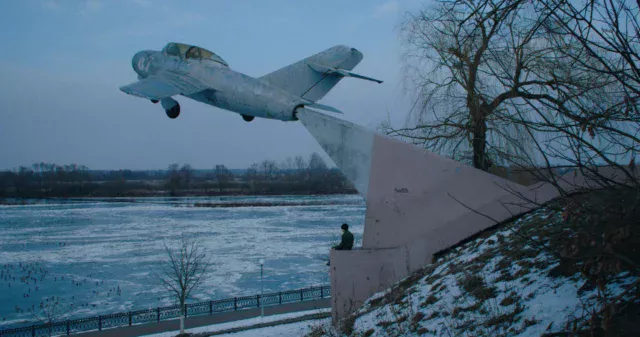
Now, Fedotov has made a film about the Dnieper, Down the River, a world premiere in international competition at IDFA.
His idea, which he first conceived long ago, was to document the lives and experiences of a younger generation in Russia and Belarus. However, as he soon discovered, when you explore the river, you can’t escape traces of the past. “When war started, it [the film] had a completely different meaning.”
Now, since the full-scale invasion, Belarus and Russia are “completely separated” from Ukraine. If you put a message in a bottle in Mogilev, it wouldn’t have much chance of receiving a friendly welcome in Kyiv.
Fedotov, a Doc Nomads graduate, is based in Berlin and Down the River has German funding. However, he still has a Belarusian passport and can travel in the region. He understands “totally” when Ukrainians are critical of his decision to film there, but argues that observational documentaries like this serve an important function. “I didn’t start filming immediately. I just went to scout. I went to the source of this river. I was travelling a long time.”
The director met his German producers, Margarita Amineva-Jester and Kristina Shtubert, in unlikely circumstances. He was riding through Berlin on his bike and bumped into Kristina in a cafe. She was intrigued by the project and brought it to her colleague’s attention.
This isn’t a film with talking heads, interviews or lengthy contextualisation. Instead, the director, who is also the cinematographer, takes a more nuanced and poetic approach, relying on the images he captures while travelling down the river to convey his thoughts and meanings.
He met several of his subjects spontaneously. For example, at one point, he saw teenagers on the shore, dancing wildly to a raucous folk song, and they allowed him to film them.
At the start of the documentary, we see a young man using a special liquid to remove the rust from old bullets he has found in the river and then making keychains out of them. Later in the documentary, he is also shown digging in a graveyard. Another very striking early sequence reveals a group of youngsters pulling an ancient Second World War Russian machine gun from the mud which they then clean up. This happened on the first day of filming, close to the source of the river. Fedotov couldn’t help but see this incident in symbolic terms. As such images attest, wherever you go along the Dnieper, you encounter mementoes of past conflicts.
Religion and militarism are also shown as going hand in hand. An orthodox priest is filmed preaching to young cadets at a military club who then bathe themselves as if being baptised in the freezing waters of the Dnieper.
Fedotov had originally hoped to structure the film chronologically, heading down river, following the currents and the seasons. Ultimately, this wasn’t possible. During editing, he realised he sometimes had to reintroduce characters, mix themes, or simply step back and forward in time.
On his travels, the director often encountered local people staging reconstructions of old battles. At one stage, somewhere in Russia, in one of the film’s strangest, most disturbing scenes, they re-enact incidents from the ongoing conflict with Ukraine.
“That’s the paradox and absurd situation. The war is not even over, but they’ve already made a show.”
The re-enactments are done on a surprisingly lavish scale, complete with weapons and real explosions, and watched by families having picnics in a festive atmosphere. The events are clearly being used as propaganda. “It’s completely free. Kids are going there. It looks attractive but, of course, it is loud and a bit violent.”
At another stage, we see middle-aged characters, mainly women, dancing at a disco on the deck of a big boat to a Tina Turner record. Women are also shown, yelling fiercely in support of their men folk who are grunting their way through a tug of war contest.
“Now, it is hard to film in Russia because people need to be sure who you are and what you are doing,” Fedotov reflects. Nonetheless, as he was just one man with a movie camera, he was generally able to shoot without interference.
A late sequence shows the flags billowing at a snow-covered cemetery where recently fallen soldiers have been buried. “The flags mean soldiers and the different flags mean the divisions where they served,” the director explains.
Down the River, he continues, “is not about the river; it’s not about nature; it is not about the beautiful views…along this river, in Ukraine, Belarus and Russia, there are a lot of graves.”
There were “huge battles and fights” over the Dnieper during the Second World War. Now, such battles are recurring and the gravediggers are busy again. One is shown lying back on the earth, taking a breather and smoking a cigarette as he looks up at the sky.
“I wanted to put everything in one film, the different layers, from the past to what is happening right now,” Fedotov says.
War, then, is always in the background, even if the full-scale invasion isn’t referred to directly. For obvious reasons, the documentary ends at the moment the Dnieper flows into Ukraine and begins to pass through places devastated by the ongoing conflict. “My film and I will stop here, at the limits of my own experience,” the director tells his audiences in the closing intertitles.
Fedotov’s previous films include Where Are We Headed (2021), a poetical, observational “road movie” set in the Moscow Metro. Down the River doesn’t yet have a sales agent but is expected to screen widely on the festival circuit. Mexican activist Elena Fortes, co-founder of Ambulante Documentary Film Festival, is on board as an executive producer.