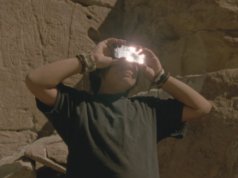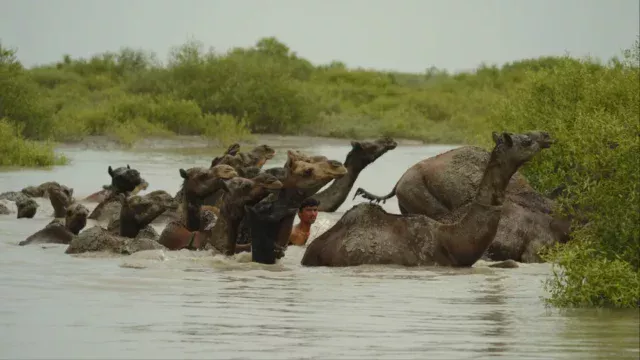
Vikram Singh’s Camels of the Sea, which won the £100,000 Whickers Film & TV Funding Award in 2024, began with a photograph and an unlikely caption: a herder was preparing to take his camels into the water. Nearly six years of filming later, the Indian director has developed an observational documentary about a coastal community whose livelihoods, relationships and animals are threatened by industrial expansion.
Selected for IDFA Forum’s Rough Cut Presentations, the Elefant Films production follows Adam Abdrehman, a Fakirani Jat herder in Kutch, western India, whose Kharai camels swim between mangrove islands to graze. Produced by Mandakini Gahlot, the project is seeking €235,170 towards a €422,670 budget, as well as sales, broadcasting and impact partners.
Singh’s interest extended beyond the animals. He also belongs to the wider Jat pastoralist community, and aspects of Adam’s life echoed his own upbringing, although Singh’s family kept buffaloes rather than camels. His father was a veterinary doctor, and he grew up on a research farm. Earlier films exploring how people and animals share space across the Indian subcontinent provided another connection.
The helmer spent almost two years in development on the project, learning the rhythms of Adam’s life. Initial introductions came through Sahjeevan, an NGO working with pastoralist communities in Gujarat. Those encounters expanded into relationships with community leader Bhikabhai and salt pan owner Umar, whose competing interests shape the documentary.
“With each of them, consent was a conversation rather than a signature, about what they were comfortable with us filming and what they weren’t,” Singh tells Business Doc Europe. Adam initially resisted having his family filmed, particularly its women, concerned about how outsiders might represent them. Showing footage to the family helped build confidence, but those conversations continued throughout production.
In detail, the doc examines how industrial development has restricted the camels’ access to mangroves and disrupted their traditional routes. Herders and activists contend that many salt pans were built illegally, with their legality being challenged in court. Several camels have died during the years Singh has been filming.
Yet the same salt pans provide employment, creating difficult choices for people struggling to earn a living from camel milk. Singh says he had not anticipated the divisions that would emerge within the pastoralist community as the pressures of activism and organising took their toll.
“Some of the film’s strongest human drama comes from the disintegration of those relationships, which in some ways mirrors the disintegration of the landscape around them,” he explains.
Umar’s inclusion broadens the story beyond Adam’s struggle. Both men are Muslims in a Hindu-majority state, of a similar age and determined to improve their children’s prospects, but they understand their surroundings very differently. “Umar sees the landscape as a resource to be relentlessly extracted, while for Adam, the landscape itself is the treasure,” says Singh.
Singh describes an approach that has shifted from a more factual record towards something increasingly stylised and impressionistic, with restrained images and largely diegetic sound. Adam’s dislike of interviews helped push him towards observation. Often working with only a camera assistant, he found the situations unfolding around him more revealing than his prepared questions.
Practical difficulties included moving cameras across remote coastal channels to film the swimming camels. The ethical limits became equally clear when an animal was trapped in a trench and every available person was needed to pull it out. Singh stopped filming to help.
“It would have been a strong scene, but being part of that rescue was a turning point in my relationship with Adam and his family,” he recalls.
Financially, competitive grants have helped preserve the project’s independence. Support through DocEdge Kolkata and DMZ Docs was followed by the £100,000 Whickers Film & TV award. The latter gave the team greater freedom during production, including the possibility of working with Italian editor Valentina Cicogna as the film’s structure began to emerge. Singh is also credited as cinematographer and co-editor.
The financing plan lists €187,500 secured, with backing from The Whickers, Al Jazeera Media Network, DMZ Docs, the Alter-Ciné Foundation and Elefant Films. Gahlot confirms that Al Jazeera is attached for the Middle East and North Africa, with rights elsewhere available.
The team has now completed its final shooting season and is working on an early rough cut. Gahlot gives the intended running time as 92 minutes and says the aim is completion in mid-2027, followed by a release in the final quarter of that year.
At IDFA, priorities include finding finishing funds, broadcasters, a sales agent and impact partners. The filmmakers are also open to a European co-producer and further creative collaborators, particularly a sound designer able to develop the specific textures of coastal Kutch.
For Singh, the eventual audience also includes the people whose lives have shaped the film. “One of my guiding principles has been to make a film that each of these very different people, including those who disagree sharply with one another, could watch and recognise their own reality inside it.”