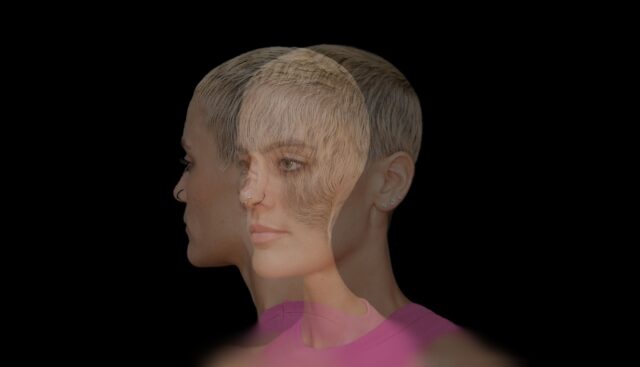
A smile, a breath or a hand touching the floor can become a way of carrying someone else’s memory in Being in You, Michał Stankiewicz’s mixed-reality documentary created with the late American musician and geologist Cat Janice. Following its Venice Immersive premiere, the Polish project competes in IDFA’s DocLab Competition for Immersive Non-Fiction.
Stankiewicz first encountered Janice through TikTok, where she was speaking about her illness. He approached her with an artistic collaboration which he called a “machine of immortality,” exploring how a person might remain present through somebody else’s body and imagination.
The proposal developed through conversations, rehearsals, improvisations and writing. Janice’s memories of family holidays on Topsail Island, North Carolina, and her background in coastal geology helped shape the work, alongside her music and sense of humour.
“What she wanted most was to leave memories that her son could experience, see and hear,” Stankiewicz tells Business Doc Europe. “She also hoped they might help her family understand her more deeply.”
While Janice was alive, the collaborators worked on the script and recorded conversations and gestures, including her hands opening and closing and playing an imaginary piano. She used her phone to scan her home and objects that mattered to her.
After her death in February 2024, those recordings became the basis for the continuing project. Her family provided private videos, principally VHS footage, while the team travelled to Topsail Island to capture places she had described. There were also absences that no further filming could resolve.
“We could no longer ask Cat another question or go back and record something again,” says Stankiewicz. “At some point, we stopped being afraid of those gaps and accepted them as part of the work.”
The current experience runs for approximately 25 minutes, including credits, and uses a standalone Meta Quest 3 with wired headphones. It accommodates one participant at a time and requires one operator. The full installation incorporates sand, plants and lighting within a six-by-four-metre space; a minimal touring version needs a clear area of at least six by three metres.
Beyond IDFA, Stankiewicz is considering longer presentations in cultural venues, a version for use at home and a longer work that several people could experience together.
“I think people underestimate how profoundly the requirement to design an experience for one person at a time shapes the work itself,” he says. “It influences the rhythm, the dramaturgy and the relationship with the audience.”
Stankiewicz’s approach draws on participatory theatre, in which the audience’s body is central. He calls the mechanism “reverse embodiment”: Janice’s recorded voice invites the participant to lend their own movements and senses to the encounter.
“When she asks you to smile, the smile happens in your face, in the present,” he explains. “Her recorded voice becomes connected to a physical event taking place now.”
Spatial scans, volumetric recordings and archival footage overlap with the participant’s surroundings. The headset tracks their hands, and Janice’s recorded hands appear alongside their own. The connection also depends on responding to her voice, giving recorded gestures a continuation in the present. “Memory becomes something you do with your muscles, your attention and your breath,” the director adds.
Creative producer, co-writer and co-dramaturge Ash Eliza Smith helped develop the connections between landscape, geology and personal memory. Her background in dance informed the physical dimension, while lead developer and designer Jakub Oleś’ experience in experimental theatre supported a process in which technical development and writing evolved together.
Some technological elements were initially embraced, then discarded. The team built a digital avatar of Janice but ultimately left it out. Stankiewicz also chose to retain the scans she had made on her phone rather than rebuild her surroundings as polished digital environments.
“We could have made the work look much more spectacular by building the entire environment from scratch in 3D software,” he reveals. “[but] at some point, we realised how much the documentary quality and honesty of the work mattered to us.”
Those imperfect recordings preserve small traces of their creation: Janice’s reflection in a mirror as she scans a room, or part of a slipper on the studio floor.
The use of her voice required similarly specific decisions. Stankiewicz says Janice consented to speech synthesis within the scope of the script, recordings and conversations they had developed together. Synthetic speech fills gaps and accounts for roughly 15% of the voice material; reducing its use occupied much of his final two months before Venice.
“I could have finished much faster by using more voice cloning,” he adds. “But it mattered deeply to me to work as much as possible with Cat’s actual recordings.” He also stresses the limits of the digital materials: “They cannot replace her or restore her ability to make new decisions.”
Produced through Betwixt Foundation, the project was initially financed entirely by Stankiewicz, who says he worked without external support for four years. Subsequent backing came from the Creative Industries Institute’s Development of Creative Sectors programme, the Polish Film Institute and Warsaw’s artistic scholarship programme.
The director further emphasises the importance of funding that allows time for research, software development, testing and revision. “Supporting that process means allowing space for uncertainty and experimentation.”