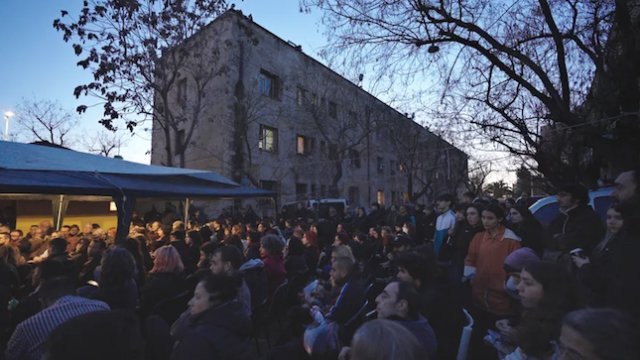
In Athens’ Prosfygika neighbourhood, keeping a bakery running, repairing an apartment and defending a neighbour’s home are parts of the same political struggle. Father-and-daughter filmmakers Nikos Pilos and Arsinoi Pilou explore those connections in Resisting Residents, an observational documentary selected for IDFA Forum’s Rough Cut Presentations.
Produced by Dafni Kalafati through Filmiki, the Greek-Qatari project follows a community of refugees, migrants, activists and Greeks who have lost their homes. Its setting is a complex of eight apartment blocks on Alexandras Avenue, originally built for refugees from Asia Minor. According to the production dossier, more than 500 people of over 30 nationalities now live there.
Pilos first encountered Prosfygika in 2015, recognising what he describes as “a very serious socio-political experiment.” His relationship with its residents deepened during the pandemic, when he documented how the community supported members unable to access healthcare because they lacked papers.
A police operation in 2022, during which Pilos was arrested alongside residents, prompted the filmmakers to develop a more comprehensive account of the neighbourhood. Pilos comes from documentary photography, while Pilou trained in cinema. Their different backgrounds and generations helped them refine their approach and build relationships across the community, Pilos tells Business Doc Europe.
“In reality, we never actually chose the film’s protagonists,” the filmmakers explain. “Living within the community, we built our relationships with the people day by day, following them in their daily lives through all their routines, activities, and actions.”
Among those featured are Miri and Katerina, who arrive with their four children after struggling to pay rent. The community helps renovate an empty apartment for them, and both gradually become involved in its collective activities. Other residents include Nori, who coordinates the technical group, and Filio, a founder of the Women’s House who helps mediate tensions and support newcomers.
The filmmakers describe a structure in which different individuals come to the fore as events develop, while the community remains the central protagonist. That approach also leaves room for internal difficulties. The dossier describes disputes, the intervention of the Women’s House in a case of violence against a child, and the expulsion of a drug dealer. “We chose not to gloss over such scenes but give them a part in the film,” they say.
Working as a two-person crew, often with a single camera, Pilos and Pilou have lived within the community. The film’s visual and sound approach draws on natural light and the neighbourhood’s own textures: multilingual assemblies, construction work, children’s voices, music and the sound of sirens.
The wider struggle against redevelopment and eviction intensifies when residents Aristos and Suzon undertake hunger strikes. For the directors, documenting politically committed participants still meant respecting individual limits, especially those of the hunger strikers and anyone who did not want to appear on camera.
“The greatest challenge was to successfully manage the community’s constant evolution and complex internal functions in a way that was meaningful to the viewer, rather than simply presenting a list of facts,” they underline. “This was especially critical during the hunger strike, when everything was turned upside down.”
They see the relationship between intimate scenes and political events as something inherent in the residents’ lives. Housing costs, access to care and the work of maintaining shared spaces provide daily expressions of the larger struggle.
On the production side, Kalafati confirms support from the Hellenic Audiovisual Centre (EKKOMED) and a co-production with Al Jazeera Media Network. An additional co-production agreement with Greek public broadcaster ERT is being negotiated.
“To close the remaining financing gap, we are looking to bring on board one more co-production partner who could take responsibility for the film’s image and sound post-production,” says Pilou.
The team now plans a 110-minute theatrical feature and a 52-minute version for television and streaming platforms, with delivery scheduled for spring 2027.
At IDFA, another priority is finding an international sales agent able to help shape the festival strategy, outreach campaign and distribution plan while the project is still at rough-cut stage. The intended trajectory begins with a major international festival, followed by theatrical release and later television and streaming exposure.
Access for the people who appear in the film is also part of that planning. Alongside its Greek premiere, the team intends to organise screenings with Prosfygika’s residents. “At the same time, it is essential for us that the film remains accessible to the community whose lives and struggles are at its heart,” producer Kalafati signs off.