Can poetry change the world? It is a question at the heart of Maria Galliani Dyrvik’s Hope Is a Word, but not one the Norwegian-Italian filmmaker attempts to resolve with a reassuring conclusion.
Instead, her 82-minute documentary follows Nigerian poet and environmental activist Nnimmo Bassey as he works with a younger generation living with the consequences of decades of oil extraction in the Niger Delta. After premiering at Sheffield DocFest and screening in Durban, the Norway-Nigeria-Italy co-production is now showing in IDFA’s Best of Fests section.
The starting point was an encounter in Bergen in 2016, when Dyrvik saw Bassey recite his poem ‘We Thought It Was Oil But It Was Blood.’ “I had always somehow tried to do with film what Nnimmo was doing with poetry: connecting with others on a different level,” she tells Business Doc Europe. The idea took shape when Bassey began organising poetry workshops for young people. “The moment Nnimmo decided to start doing poetry workshops with young writers, I understood what that question would mean concretely, and then I could really see the film.”
The legacy of Ken Saro-Wiwa, the Ogoni writer and activist executed by the Nigerian state in 1995, remains central. Dyrvik recalls hearing his name in almost every community she visited. People spoke of him “both with the admiration you have for immortal heroes, but also with guilt,” she says, conscious of a struggle still far from its goals. Using archive footage, the film approaches history through those continuing to live with it rather than treating the past as a self-contained lesson.
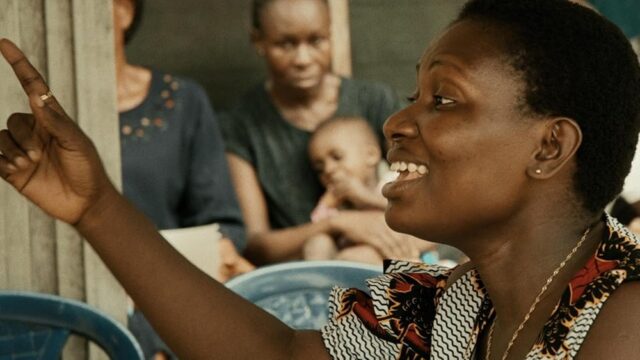
Crucially, Dyrvik shares the screenplay credit with Bassey and three younger poets: Barinedum Mbee, Ukpono Bassey and Odudu-Abasi Asuquo. “Hope is a Word was written many times over, and Nnimmo, Barinedum, Ukpono and Odudu were a part of every step,” she explains. Their poems were not merely illustrative material; the filmmakers chose to hold on the poets during readings rather than cut away to images that might impose another interpretation.
This collaboration also changed the story she thought she was making. Dyrvik had envisaged large political rallies recalling those associated with Saro-Wiwa. Instead, Barinedum and Ukpono wanted to create their own workshops, opening smaller spaces in which others could speak. “My idealistic expectations met with the realities of Nnimmo, Barinedum, Ukpono and Odudu,” she says. The participants also viewed successive edits and challenged what they saw.
The father-son relationship between Nnimmo and Ukpono gives that generational shift a personal form. Ukpono, already writing music, began drawing on his father’s poetry for rap, while developing his own approach to activism through The Young Environmentalist Network. “He didn’t just reproduce them, he made them his own,” Dyrvik says. Admiration for a parent’s work comes with the pressure to live up to it, but also the need to find an independent voice.
For Barinedum, an Ogoni poet and expectant parent, the environmental crisis is inseparable from the everyday. She describes disappearing fish, plants and food sources, and worries about what her children might never know. “Food is culture,” Dyrvik stresses. Pollution threatens not only health and livelihoods but a community’s relationship with its land and its identity. The director says Barinedum was initially reluctant to share such personal writing; building trust meant discussing the project openly and allowing her thoughts to develop on her own terms.
That ethic extended to the camera. Dyrvik and cinematographers Anita Jonsterhaug Vedå and Allen Onyige sought to remain close to their subjects rather than turn oil-damaged landscapes into spectacle. “It was very important for us to avoid exoticising the place or sensationalising the issue,” she says. During workshops, the crew became part of the process rather than pretending to be invisible. “Our idea was that the camera, just like the audiences that might eventually come with it, was a listener.”
The soundtrack follows the same principle. Working with sound designer Yngve Leidulv Sætre, the team foregrounded spoken rhythms, rap, ambient noise and the performers’ own music, using additional musical accompaniment sparingly. Poetry delivered in Ogoni languages or Pidgin also retains its original written form on screen, an attempt to preserve the texture of words that cannot be reduced to translation.
Even so, deciding how much context to include proved difficult. During IDFA Project Space’s 2025 rough-cut programme, editor Federico Neri and Dyrvik worked with Niels Pagh Andersen, who encouraged them to return to the people at the centre of the film. Explanatory scenes were sacrificed for what the director describes as “a leap towards simply trusting the emotional response of the audience.” The lengthy production was supported by the Norwegian Film Institute, Western Norway Film Fund and Fritt Ord, with partners Smau, Nigeria’s Zuri24 Media and Italy’s Ginko Film working across the three countries.
The film does not suggest that poems can repair pipelines or reverse environmental damage. “I didn’t want to leave the audience with an illusion of a happy ending for the Niger Delta when the situation is still as disastrous as it is,” Dyrvik insists. What poetry can offer, she has come to believe, is “a tool for personal liberation, connection, and ultimately resistance.”
That conviction is shaping its life beyond festivals. After a Nigerian premiere in Lagos in October, a Port Harcourt screening is planned for 27 November, with community members and activists among the guests. The team is also developing workshops and screenings in Nigeria and Europe, including collaborations with Amnesty International UK and other organisations. The ambition, Dyrvik says, is to amplify the poets’ work while generating pressure on oil companies and governments. Rather than offering a promise that change is imminent, Hope Is a Word asks what it takes to keep speaking when it is not.