Oscar-shortlisted Julia Loktev’s family left the Soviet Union in 1978. “That was a time when you really couldn’t go back,” says the director of My Undesirable Friends: Part II — Exile, which has been screening this week in IDFA.
Sold by Cinetic, the film is the follow-up to the award-winning My Undesirable Friends Part 1 (2024). It follows the young journalists from Russia’s last independent television channel, TV Rain, forced to flee Russia, just as Loktev’s family did almost half a century ago.
As the family were building a new life in the west, Julia wasn’t, as a child, able to watch Russian-language cartoons on YouTube, and there was, as yet, no internet through which to communicate. “There were only letters and phone calls that you had to order a week in advance,” she remembers how hard it was to stay in touch with loved ones back in Russia.
In her new film, her protagonists are facing a similar predicament. They’re a long way from home. Anna Nemzer, her co-director and the former editor in chief of TV Rain, is the age Loktev’s parents were when they left Russia. Nemzer is now based in London. Valeria Ratnikova, one of the station’s star young presenters and now located in Amsterdam, is in her mid-20s.
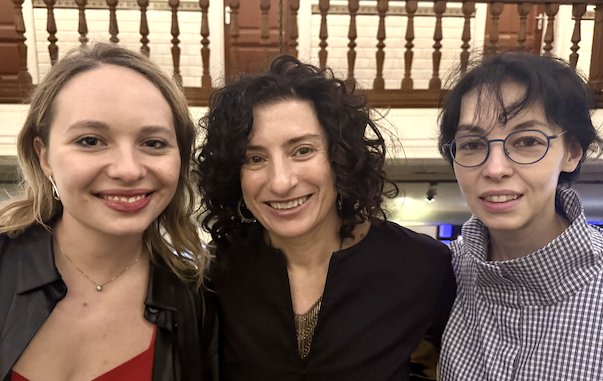
At IDFA last weekend, all three spoke to Business Doc Europe, about Loktev’s epic but very intimate chronicle of their lives.
Early in Part II – Exile, Ratnikova is shown arriving in Istanbul having just fled Russia. She is not even entirely sure where she is going to stay. Loktev is also there, filming her during an especially raw moment as she checks into an Istanbul hostel with some colleagues. “I had no idea who Valeria was when I met her. All I knew was the camera wanted to film her,” Loktev recalls this first encounter.
“Actually, I really didn’t care who would film me at that moment. I just really wanted to be around people,” Ratnikova says. “We had just left the country. We felt really abandoned by our own motherland. I was feeling very lonely. For me, each person around me who was friendly, I was totally open to this person – and Julia was nice. She understood Russian. She could joke. She understood our situation. I was just glad someone was near me.”
Nemzer and Loktev had first spoken about a possible film project in the summer of 2021. Even before the full-scale invasion of Ukraine, Nemzer knew the political situation was getting worse. Journalists were being threatened and designated as ‘foreign agents’ by their own state. It seemed worth recording – “horrible, but interesting at the same time and definitely a historical moment,” Nemzer recalls. That’s how My Undesirable Friends began.
Loktev had started filming with her iPhone and they realised that maybe they didn’t need a cinematographer after all. With no cumbersome equipment to hold her back, the Russian/American director was immediately able to put herself in the centre of events. Her protagonists trusted her from the outset.
“Julia is very good at making friends. She comes and you are totally charmed,” Ratnikova describes the filmmaker’s uncanny ability to make people to warm to her wherever she goes.
The new film has many heavy moments – but we also see Ratnikova in her kitchen discussing dating and the pros and cons of Tinder relationships.
As the new documentary also shows, the TV Rain journalists in exile are criticised by Ukrainians. Despite the sacrifices they themselves have made and their courageous reporting, they are still attacked.
“I expected this. From the very first moment of the war, I just felt so huge a shame for what my country is doing,” Ratnikova strikes a philosophical note. Ukrainians “sitting under bombs,” she points out, don’t have time for trying to distinguish between good and bad Russians.
In the documentary, Loktev deftly interweaves the personal and the political. At one stage, Nemzer has to work out what will happen to her daughter’s pet chinchilla when they leave Moscow. In the event, the pet got out too, joining the family first in Georgia and then in the US. Sadly, though, the chinchilla died around a year ago. “It was heart-breaking because he was a very decent person,” Nemzer pays tribute to the much-loved family rodent who lived in more countries than he could ever have anticipated. “The pain is still very fresh.”
TV Rain is now based in the Netherlands. Nemzer is less directly involved as she is working on another project, but is still well placed to observe how the channel’s work has changed.
“There is a major difference in how you work inside your country and how you work outside your country, but still focused on what is going on in Russia and in Ukraine I think my colleagues did something incredible, something that I wasn’t sure was possible at all. Russian independent journalism has survived as an institution,” Nemzer marvels at her colleagues’ resilience. “The vast majority of Russian independent journalists left their country and survived not only as separate media outlets but as a huge community.”
News gathering has obviously become far more complex. Anyone in Russia who gives the station an interview or shares a link to a TV Rain may be accused of a criminal offence. Nonetheless, the journalists have found ingenious ways to get around the restrictions and have also managed to establish contacts with members of the Russian military.
“It just serves this incredibly important role, to have access to information that the propaganda channels aren’t telling – that you do have access from people who look and sound like you, and are telling the truth,” Loktev says of the role the channel plays in Russia.
Are Nemzer and Ratnikova at all optimistic they will be able to return to Russia any time soon? “With Putin in power, no,” they both say. They have criminal charges facing them as a result of their reporting. They’re still regarded as foreign agents.
Post-Putin, there may still be dangers unless there is a “total” regime change and the draconian new laws criminalising journalists and activists are overturned. Nemzer points out that the two wars in Chechnya lasted for 15 years, and it’s conceivable the conflict in Ukraine could drag out over a similar time frame.
How are the duo coping with the existential angst of exile? Ask them if they feel that intense nostalgia and longing that Russian writers like Solzhenitsyn and Brodsky expressed in their work and they parry the question.
“Longing…and logistics,” Loktev intervenes, describing how exile was once memorably described by Libyan-British author, Hisham Matar.
“We definitely became a huge part of this tradition of Russian immigration,” Nemzer agrees. “All those books you read in your childhood, you start reading them with quite another optics…but there is a huge difference. They were all leaving their country knowing they would be welcome in exile. They had their share of suffering, money problems and losing their identity and so on – but still they were the good guys. No-one appointed them as responsible for the Bolshevik revolution. They were victims and managed to escape it. We, on the other hand, are in quite a different situation because we are responsible for what happened in our country and we feel responsible. This defines and designs this type of immigration.”
“I am totally with my mind there, I am not here,” Ratnikova, who was only 22 when she left, expresses her very strong feeling that she will return to Russia sooner or later.