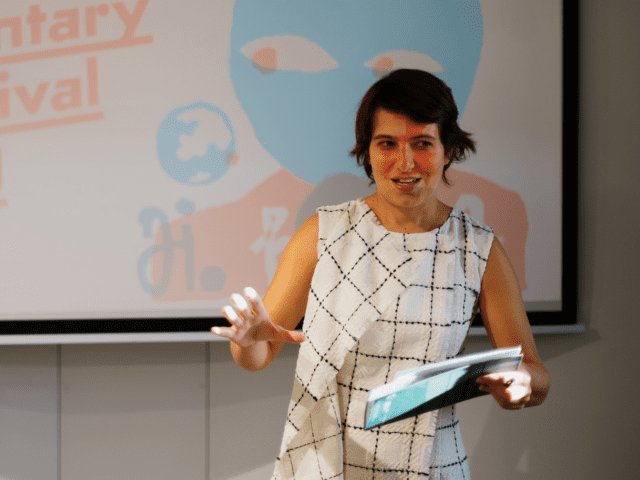
Andrea Slovakova (Pic: Ji.hlava IDFF)
Is there still room for experimental in the field of non-fiction? You bet there is, academic, programmer and filmmaker Andrea Slovakova tells Business Doc Europe on the eve of a truly experimental Ji.hlava 2020.
Andrea Slovakova mulls over the question and answers in two ways, after underlining experimental’s continuing relevance in an age when we are flooded with a lot commercial content working with the newest and most inventive technologies and techniques. This has, she reminds Business Doc Europe, been an historical function of experimental and avant-garde artists, to zip forth across hitherto unchartered waters, with commercial interests and concerns following in their wake.
“Firstly there is this function of reflecting the medium and including self-reflective processes in the works,” Slovakova responds, citing filmmaker/programmer/visual artist Jacques Perconte’s Before the Collapse of Mont Blanc, whose international premiere is in 2020 Fascinations section. The director is a technophile who works with Codecs and compression mechanisms, and whose depiction of the decaying French mountain is reflected in the digital disintegration of the image on the screen.
“He embodies the qualities of the medium into the work itself,” she adds. “He invents and creates his own tools, the purpose of which are to impact his topics into the way we use the medium.”
Slovakova reminds us that there are still traditionalists who aren’t so digitally oriented and remain loyal to old-fashioned film stock as they seek mediums to manipulate. “They still really love this medium, they have a nostalgia for it and work with it. These are conventional avant-garde processes.”
But then she points to another film that online audiences must check out in 2020, Czech Zbyněk Baladrán’s 6-minute Catastrophe.
The film is a conceptual work based on the theatre play of the same name by Samuel Beckett, written in 1982 and dedicated to Václav Havel who was in jail at the time. “It has this political layer, but what interests the director is of course the medium and the manipulative potential of the digital image,” says Slovakova. “So he inputs some data and the algorithm created images that look very persuasively like photographs that can be used in evidence within the context of the play. So there is the fictional level, this level of a refence with reality and this level of the manipulative potential of the medium.”
Before the Collapse of Mont Blanc is one of 19 films playing in the Fascinations competition section, which its itself presented alongside several other sections that screen cutting-edge avant-garde works. There is a competition for Czech experimental films (where Catastrophe is to be found) which includes student work, a retrospective on the Czech underground (untold/unseen until now), another on the Polish avant-garde working in the late 20th Century and a section on gardens and their depiction by experimental filmmakers.
Slovakova articulates another aspect of the Ji.hlava offer, the examination of experimental as a thriving, if at times haphazard, industry. Over the past six years the festival has hosted a conference to mull over the distribution and presentation of experimental works for cinema and gallery exploitation. This year’s conference is presented on October 28 and the morning of October 29.
“Over these past 10 or 15 years you can observe strong change in the way the moving image is used by fine artists and aimed for gallery distribution or presentation…how they absorb and exploit much of the cinema conventions. So a really big part of experimental cinema is being created for this different kind of perception that is in galleries, not in the black box of cinema,” Slovakova underlines. But to some degree that is where comparison ends.
“Each year, each panel meets the people who are from classical cinema distribution and who are from the galleries. And we compare the curatorship models. We are comparing the production and organisational strategies and we are comparing the legal and economic aspects – and they are really two completely different worlds, especially because the main economic and production mechanisms, and the whole mindset, are really different.”
“We
found out in recent years that while the financial policies for cinema distribution or festival presentation are stable, and [they offer] a list of prices, for the galleries it’s a circus. You almost have no rules… You cannot say that if the work is 10 mins and [the installation] is for one month that it is usual or customary to offer certain prices, absolutely not. It is totally ad hoc. It can be 100 euros, or it can be 10,000 euros.”
This year’s Fascinations Conference comprises a series of 5-minute presentations by leading Czech and international distributors, festivals and galleries before three top-level panels address topics of contemporary relevance, with online at its core. Speakers include Eye Experimental’s Edith van der Heijde, Josh Siegel (curator, Department of Film, MoMA, USA) and Koyo Yamashita (director of Image Forum, Japan).
Ji.hlava stresses that it was the first platform to enable “systematic presentation’ of Czech experimental films (notably works referring to reality and including documentary features), at the same time continuously focusing on Eastern European cinema. The year on year on conference further emphasises the festival’s dedication not only to promoting Czech and European films internationally but to facilitate collaboration between Czech experimental filmmakers and distributors, galleries and festivals and similar institutions that are active abroad.