Heart-breaking, severe, revolutionary. Using simple but effective composition, Zhao Dayong’s story of one man’s resistance against property developers, screening in Opus Bonum competition, creates a raw atmosphere which never shies away from the harsh realities that many societies have to experience within China today.
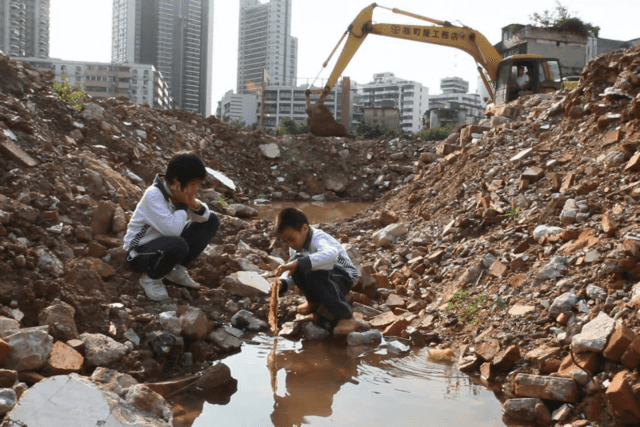
Located in the century-old village of Yangji, in Guangzhou, the documentary focuses on one family’s, and specifically father Li Qizhong’s, fight against the ‘hungry’ property developers who, working alongside the Chinese government, attempt to demolish the homes of the villagers, enabling modern developers to cash in on the property boom.
Director Zhao Dayong, who was a painter before becoming a filmmaker in 2004, makes both feature films and documentaries, with works selected for major international film festivals (One Says No is also selected for IDFA 2020). He began documenting the villagers’ struggles in 2010 after the ‘nail house’ phenomenon became widespread throughout communities in China. (The term refers to a home whose owner refuses to accept compensation from a property developer for its demolition, hence it remains in situ as developments grow up around it).
Many of the owners of these nail houses, it seems, have no choice but to helplessly accept the unfair conditions imposed by the government, and are forced to leave the homes that have been a part of their family for generations. The impact is often considerable, with some villagers ending up homeless, suffering from trauma and even turning to suicide as a result of the immoral treatment they receive from the authorities.
Our first view of the residents rebelling against the police is presented powerfully, accompanied by equally dramatic non-diegetic music. Filmed throughout with hand-held cameras and mobiles, we continually see crowds protesting against the demolitions, some having to be wrestled away and calmed down, while others continue to painfully watch on.
When it becomes clear that the destruction will not stop, with the homes of many torn down and a demolition notice posted outside protagonist’s Li Qizhong’s home, he takes matters into his own hands, barricades every floor and vows never to leave. Radical action is his primary response, and he is adamant that as long as he is standing, so will his home.
Originally an area densely covered with buildings, Yangji soon resembles yet another construction site, with the people in power seemingly overlooking the villagers’ safety and well-being in an effort to make room for new development projects. No matter how much the people of Yangji plead for a fair deal, it seems to always fall on deaf ears. As Qizhong expresses, ‘they just ignore you outright.’
Li Qizhong is a rebellious character, who will meet violence with violence and has no intention of surrendering to the property developers or, as he repeatedly calls them, the ‘thugs’. His willingness to fight against the ‘attack’ is evident through his weapons stockpile, as well as the explosives he has set all over the building, so that in his words, the ‘traitorous enemies don’t make it out alive.’
Despite all the chaos, Dayong beautifully blends natural scenes that display the family’s genuine intimacy, whether it’s the joy of a playfight, or creating shadow effects with their hands against the well-lit wall. The family’s spirit seems to easily withstand the demolitions surrounding them.
It’s in these scenes where you can see the director’s sense of warmth and attachment to his subjects, along with the frequent observations of Qizhong’s son who, using an old camera, wanders around the house taking pictures of objects he finds.
When Qizhong witnesses the ‘thugs’ cut off the water and electricity during the middle of the night, he soon realises the dangers that his family will inevitably go through, living with no water and candles as their only source of illumination in the evenings. And so he eventually allows his wife and children to move away, thereby becoming the building’s only guardian.
Following this, the ‘enemy’ seizes the chance to negotiate terms with Qizhong, guaranteeing that they won’t touch his house if he comes out, as well as promising him a ‘resettlement home’ and ‘standard compensation’. However, the time has long passed for either Qizhong or us, as viewers, to assume that these deceitful tactics are in any way believable.
The importance of this documentary cannot be underestimated in its examination of the total control the Chinese authorities has over its people. The choice of bold subject matter serves to both illustrate and challenge the imbalance of power between corporations and the people, with thousands of lives forgotten and the subsequent impact on many societies throughout the country.
It’s inspiring to see an individual in Li Qizhong, courageous enough to fight against the establishment with his back against the wall, determined that he will ‘repay their savagery with savagery’, as well as a director in Dayong who is not afraid to test the boundaries, and show the darker sides of an individual’s character when on a mission for justice.
Director: Zhao Dayong
Producer: Rikun Zhu, Georg Prokop
Photography: Qizhong Li, Xueqi Wei, Dayong Zhao
Editing: Dayong Zhao
Music: Fanqiong Zhu