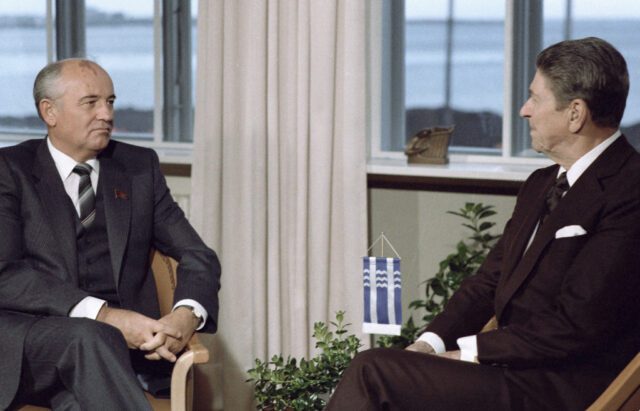
Could the war in Ukraine have been avoided, asks Irish/Romanian filmmaker Irina Maldea in her 120/90 mins project Moscow Nights, selected for AJB DOC Industry. Yes, she suggests, had the world taken greater heed of Mikhail Gorbachev and his philosophy of ‘New Thinking’ in the early 1990s.
The ending of the Cold War, a result of Gorbachev’s new openness, was of enormous global significance, and seemed a sign of peaceful times ahead. But Gorbachev was ousted, and “a chance for long-term peace was lost forever in the pursuit of short-term gain,” Maldea stresses.
“Our documentary is made entirely of archive, without interviews or narrated voiceover. We feel that this is increasingly the kind of film that is necessary in our era of fake news, a film that today’s audience is looking for, in that it allows them to make up their own mind about the events that they see on the screen,” Maldea tells Business Doc Europe. “Of course, this will only work if [we] the filmmakers are dedicated to fairness and objectivity, and this is something in which we pride ourselves, and this is enhanced by the public funding model we have in Europe.”
“This is so important right now, as truth takes second place to propaganda in much of the media, and in the unregulated excesses of social media,” she adds. “We are in an era of massive change in the political and military world order, bringing certainties of the post- Cold War international order to an end. I grew up in Romania, under communism, so I have already seen the bi-polar world of the Cold War change to a unipolar world. Unfortunately the peace dividend was abused, and we now find ourselves in a more militaristic world.”
Produced by Brendan Culleton of Akajava Films, the documentary is budgeted at €676,252 with €212,584 still to be raised. Currently in post-production, the project has a mooted release date of March 2024.
Maldea lists some of the hurdles she and Culleton have had to overcome so far. “Probably the main hurdle at the beginning was that commissioning editors could not envisage a film without a voice-over or interviews. They kept asking ‘but how will the audience know what’s going on, they don’t’ remember those times etc, etc’. Gradually we were able to explain that there is in fact a narration, but it comes from the archives themselves, it’s just not narrated by an actor.”
“Making an archive-based film is challenging because of one simple fact: clearing film archives is just too expensive,” the director stresses of another hurdle. “Many of the best film archives are owned by big corporations who are charging €10,000 per minute, never mind the fees for screeners. This means that a large part of the history of the world, OUR history, is owned by somebody who limits access to it. This to me seems anti-democratic and unfair.”
The director further expresses her amazement at a lazy media that “constantly relays the same, often misleading, clips and soundbites, and also how historians don’t use film archives as historical documents. They prefer the written record, even when the event was filmed and we can look the speaker right in the eye; it’s a completely different experience.”
The filmmakers were also determined to portray some of the female protagonists from the period who have historically been sidelined. “Ignored for years by serious historians, they feature heavily in our film. Barbara Bush comes across as a very human straight-talking woman who you would like to have sitting beside you at a boring dinner. We even developed a sneaking sympathy for Nancy Reagan, watching the persecution she underwent by a very hostile press corps, although there are plenty of cringe-worthy moments as well.”
Maldea assesses her chosen medium, and the advantages it confers in the accurate chronicling of history. “Not least, it adds to the pool of knowledge in the world, through presenting little known archives that will now be part of the public record. We believe very much in film archives as historical records, especially when the record is so hotly debated.”
For a brief period at the beginning of the 1990s ongoing global rapprochement seemed a possibility, and we had every right to feel a little more optimistic about our collective future. But that was a mere fleeting moment. Hostilities resumed, as did the desire for aggressive land-grab empire building, as we see today.
“When the war in Ukraine started, unfortunately, the whole story became much more relevant,” Maldea stresses. “It made the speeches of Reagan and Gorbachev much more poignant. It is difficult to listen without emotion to the US President stating “Mr. General Secretary, we have dared to hope, and our hopes have been rewarded”. As indeed they had, for a brief period.”