

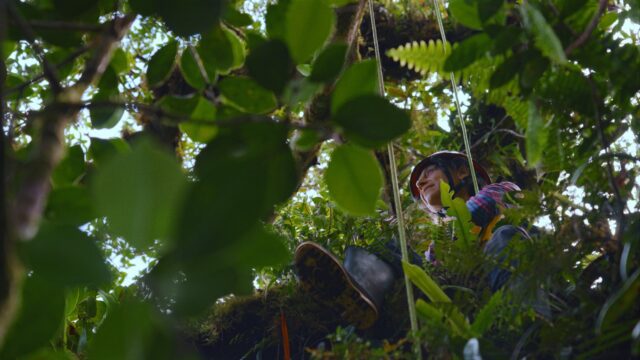
In July 2015 biology professor Nalini Nadkarni was conducting tree research high in the “three-dimensional volume” of Washington’s Olympic Peninsula forest when her rope snapped and she fell fifty feet. She spent two months in hospital and underwent numerous operations, and for a while it was doubtful if she would ever walk again. She also suffered a “super identity crisis” during which she questioned her own sanity and intellect.
Nadkarni made a full recovery, both physically and psychologically, and she regained full confidence in her abilities. Nevertheless, she began to reflect on her life, or more significantly her three lives. For decades she was a brilliant academic and advocate for the ecology, before she entered a “third state” after her rope broke.
But perhaps the most challenging of the lives she sought to come to terms with was her childhood. Nalini was the daughter of an Indian father and a “Brooklyn/Jewish” mother within a family where boys were considered superior (indeed her parents were expecting her to be a boy). It was also a childhood in which she suffered sexual abuse by her father, a secret that she was cajoled into keeping secret from the rest of her family.
The one reliable things in her life at that point were the maple trees she climbed and which offered no “harsh words,” nor had any “expectations.”
For director Andrew Nadkarni, all this was a total revelation when making his film. “When I started interviewing Nalini, we started talking about where some of this drive to achieve and this need to perform perfection [professionally] came from,” he says. “We were looking into these childhood experiences and she shared with me this personal journal…that touched on the sexual abuse and some other ripple effects of that childhood trauma. So I asked her if we could talk about that and she said ‘yes’…I’m really grateful and I find it very inspiring and brave that she was willing to be vulnerable in that way and maybe make other people feel less alone if they’ve dealt with something similar.”
Not that Nalini reveals overt signs of her disturbing past. She is the most enthusiastic, supportive, fun and sparky of subjects, a woman who inspires devotion from her students. “As we show in the film, Nalini is not defined by her trauma. She’s had these joyful and amazing experiences in life…so [it was important] to balance the trauma and the lightness.” She is also somewhat of technophile, having designed a “master-caster” rope climbing mechanism to scale the enormous trees.
Director Nadkarni explains the regular use of tree as metaphor in his film. “Nalini’s youngest child Ricky came up with this wonderful sort of visual that I really liked,” he recalls. “If you think of Nalini as a tree, sometimes for the tree to prosper you have to dig in…and shine light on those wounded roots in order to give them air and space and time to heal. And that will allow the crown of the tree to prosper,” the director explains.
“Another metaphor [of] Nalini that I really loved is that trees show in their body language the experiences, the disturbances that they’ve had. If they were struck by lightning, you see the scar in their bark and it lives with them. The bark grows back around that scar, but it’s always there,” Nadkarni equates to the emotional scars that humans bear, and which become hidden over time.
Between Earth and Sky has won a handful of prominent awards in 2023, including Best Short at the Big Sky Doc Fest, where it world-premiered. The film is currently streaming on POV and PBS, and is a Vimeo Staff Pick. Response across all audiences has been highly positive, such as the 2023 Sheffield DocFest public who joined the Nadkarnis in a poetry writing session beneath the city’s trees, or youths within US detention centres who shared with Nalini their own experiences of trauma (and marvelled at her explanation of her climbing techniques).
Despite the vertiginous heights, director Nadkarni didn’t shy away from scaling the trees himself to experience the “three-dimensional volume” of the forest and to sit above the vast arborial canopy. One moving scene depicts Nalini sitting on a branch above him, more than 200 feet above the forest floor. “I was sitting there and seeing her in her element alone…and she was just at peace in her favourite tree on this branch. So I got my favourite shot of the film, which is looking up at Nalini through the leaves, just sitting there at peace.”





