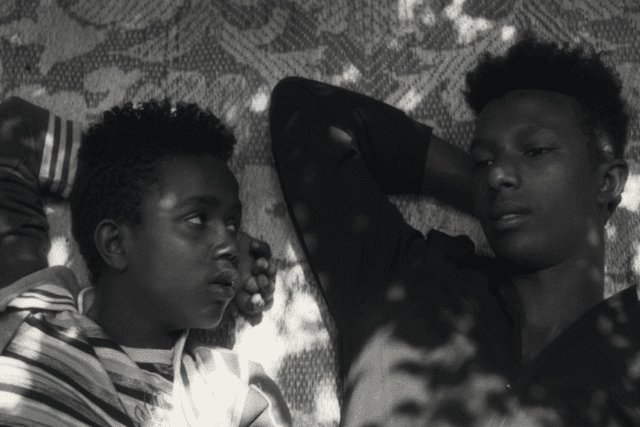
A delightfully immersive and engrossing examination of a country set over a 10-year period, Jessica Beshir’s rightly acclaimed Faya Dayi offers up an enthralling portrait of Ethiopia, blending lyrical moments with reflection on myth and spirituality and told with a refreshingly gritty honesty.
Beshir was a teenager when she and her family left Ethiopia to escape political unrest, settling in Mexico and eventually the US. But over te course of a decade she regularly returned to her home country as a filmmaker, shooting black and white footage and crafting a rich and engrossing film debut.
By its very nature, it is a film of vignettes and varied themes, though at its heart are notions of memory, tradition, family and an underlying appreciation of place and landscape. There is also an off-kilter aspect at the core of the film when it comes to dealing with the farming of khat, a plant whose leaves are chewed for their psychoactive effect and which has gradually displaced coffee as the land’s cash crop given that it is less dependent on rain.
The title Faya Dayi comes from a hymn sung by Oromo farmers as they harvest khat, with the film following the plant’s route from the fields and into the sheds where it is sorted, cleaned and placed into bundles before eventually reaching the night markets. For the workers it is a cycle that has taken place across generations of families, always set against a backdrop of civil unrest and various political regimes.
Ethiopian legend has it that khat was discovered by Sufi Imams in search of eternity. Inspired by this myth, the film is a spiritual journey into the highlands of Harar immersed in the rituals of the profitable leaf that Sufi Muslims chewed for religious meditations.
Through the prism of the khat trade, Faya Dayi weaves a tapestry of intimate stories of people caught between violent government repression, leaf-induced fantasies and treacherous journeys beyond their borders, and offers a glimpse into the dreams of the youth who long for a better life.
Mohammed, one of the film’s central characters discusses the concept of emigration – he talks with an older man who had headed to Tunisia at one stage – but for many within the region the line between working with khat and using is often a very thin one. Mohammed’s mother looked to leave, but his father is “losing it with khat.”
The film is rich with beautifully observed black-and-white imagery, with the sound design nicely complementing the striking visuals. It is gently paced and self-aware at times, but it is also engrossing and clearly made with insight and compassion, with Beshir clearly at ease in the environment and with those whom she films and observes.
It is a documentary that reflects on the dreams of youth, the perils of addiction and the delicate links between tradition and memory, all tied together with a sense of understated warmth and often poetic imagery.
Ethiopia-US-Qatar, 2021, 120mins
Dir/scr Jessica Beshir
Production Merkhana Films, XTR, Neon Heart Productions, Flies Collective
International sales Cinetic Media
Producer/cinematography Jessica Beshir
Editors Jeanne Applegate, Dustin Waldman
Music William Basinski, Adrian Aniol, Mehandis Geleto, Kaethe Hostetter