The production company behind Fiona Tan’s art film Dearest Fiona is called Antithesis Films. That’s an interesting name. Let’s use that as a starting point.
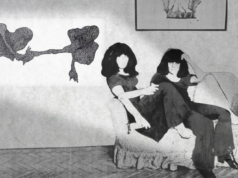
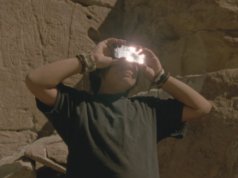
Dearest Fiona strikingly consists of two very different elements – thesis and antithesis, one could suppose. There are the scenes and shots taken from documentaries from the archives of the Eye Filmmuseum in Amsterdam, black-and-white, silent, often tinted, sometimes beautifully hand-painted, made roughly between 1900 and 1930. Quite a few of them shot by well-known early Dutch filmmaker Willy Mullens.
And then there is the voice-over of an actor (Ian Henderson), reading passages from letters that Tan’s father sent her from Brisbane, Australia, after she had left for Amsterdam to study art. The actor’s voice is pleasant and emotive – it comes across more like a performed theatre text than simply letters read out loud.
Now, what do these two have to do with each other? In my mind, the video and the audio never came together.
I can watch these early films for hours on end; I find them endlessly fascinating. And without having seen the raw material, just looking at the selected shots, I assume Fiona Tan (who represented the Netherlands at the 2009 Venice Biennale and whose work is collected by the Tate Modern, the New York Guggenheim, the Stedelijk Museum in Amsterdam and the Centre Pompidou) has probably chosen especially beautiful and engaging moments.
Many of these shots are of people working, in the fields, in the factories, at the docks. Often one or two (or more) look into the camera, instantly connecting with the viewer, erasing the century that separates us – the effect is especially strong with children and their uninhibited curiosity. The realistic sound effects that were added to these silent films do much to bring them to life. But apart from that, showing this material is in itself nothing extraordinary – many of these old films can be watched at Eye’s website.
Then there are the letters. In the selected texts, Fiona Tan’s father often jumps from international politics to local events to family news or tales of their dog. This disjointedness has a certain charm, but as the people (and animals) in his letters are unknown to me and his mentions of world events remain very brief, as if he somehow thought Fiona Tan had no access to newspapers and should at least get the headlines, there is very little here that offers any real insight or food for thought.
But of course, neither do the films. Is it then that I’m simply more visually oriented? Or is it that the letters are too recent to hold much historical interest for me? I remember the late 1980s well, and I even remember sending letters to Australia around that time, when my older brother spent a year down under. Whatever it may be, there is not much in those letters that’s surprising to me. It all seems rather mundane.
Just like the films, you could say. Which would then be a link between the two: everyday life in the 1900s to 1920s and in the 1980s. But that is simply too vague, too general. There are a handful of more direct, more specific correspondences between image and text. For example, there is a moment when the father talks about birds and there are also birds in the scene. But these moments are so rare that they feel coincidental and even if they aren’t – they are just birds and birds. What does that add up to? Birds.
Dearest Fiona is an art film, with an exceptional narrative construction. My first question when an art project doesn’t work for me is usually: am I missing something? Therefore, let’s go back to that name, Antithesis Films. Thesis, antithesis, synthesis. That sums up my question about Dearest Fiona: there are two colliding forces, the audio and the video – how is the film more than the sum of these parts? What does it add up to? What is the synthesis that was, presumably, intended?
We could ask which one is the antithesis, the video or the audio? In other words, which came first? Since the letters are personal and the films take a long time to dig up in the archives, I assumed the project started with the letters. Turns out I was wrong. Tan was first commissioned by the Eye Filmmuseum in Amsterdam to make a new work, based on their archives, for the major exhibition of her work at the institute in 2022.
It premiered as Footsteps and although I didn’t see it then, it seems to be – in essence if not in its entirety – the same work. There is a lengthy description of Footsteps on Tan’s website which is identical to the description in Dearest Fiona’s press kit. Their trailers are the same, too, and nothing in the reviews or interviews I’ve read suggests any significant differences. Therefore, I’m assuming I can refer to what has been written about Footsteps.
Tan went into the archives without a clear goal, she explained in interviews about Footsteps. No search terms, no key words. She wanted to be surprised. She wasn’t so much looking, as finding. She trusted that when she found something, she would know. During that time – when the pandemic reigned – she was, like so many people, cleaning out her house and she found these old letters her father had sent her and she started reading them. Again, she found something, without looking for anything in particular.
And then it was a question of editing. Putting these two disparate elements together in the hope of – again – finding something. To be touched by something. To see the magic happen. It took seven months before (in Tan’s words) the edited material finally began to “fly”. When asked in an interview, she wouldn’t or couldn’t exactly say what she meant by ‘flying’. She also stressed that, like most artists, she didn’t want to tell the audience what to think. Quite rightly. The audience has the right to find its own interpretation.
She did explain that she reduced the number of specific connections between sound and image once she felt she was on the right track. Moments like the one with the birds, I suppose. She deliberately created fewer of those clear connections and more empty space for the audience to fill in for themselves.
She also said she had forgotten about all those major world events that had happened during that period, when she started studying in Amsterdam, from the Fall of the Wall to the Tiananmen Square Massacre. This might explain, at least in part, why those letters didn’t work for me – these historical events didn’t surprise me at all. I remember them very well, and I also regularly come across them as reference points in contemporary news articles. However, if another viewer is also ‘struck with wonder’ by this recollection, as Tan herself was, it may well give them a different experience of the film as a whole.
In an article on the Eye website, writer Lauren du Graf takes another view of the film, analysing it solely from the perspective of migration. It’s true that Fiona Tan, like her father, was born in Indonesia and that their correspondence, between Australia and Amsterdam, echoes their being geographically uprooted. And it’s interesting that her father acquired knowledge about the Netherlands because of its colonial occupation of Indonesia – without, I later learned, ever having set foot there himself. He even uses a few Dutch words in his letters (‘it’s not a difficult language’, he writes). In Graf’s view, the old Dutch documentaries, with their wooden shoes and windmills, find their meaning in the romanticising of an idealised history, excluding migrants from their nationalistic idea of community.
It’s an interesting read, and it does combine the two narrative elements of Dearest Fiona, but I find this migrant lens reductive. It excludes many other ways to look at Tan’s film – poetic, economic and climatological ones, to name a few. Both the films and the letters touch on many different issues, not just ones related to the migrant experience. Briefly, most of the time, but still. The fact that Fiona Tan has a migrant background should not reduce or prejudge the ways in which we interpret her work. Nor is there anything in the press material or interviews to suggest such an intention on the part of the artist.
My impression is different. I feel I’m in the presence of an artist who is reaching for something ineffable. Something that is less politically motivated than humanistic and philosophical. With Dearest Fiona, she has created a space, a very lightly dressed, almost empty space, between two historical periods – three, if we include our own – and between the personal tone of her father’s letters and the more universal aspect of an overview of life in a specific time and place – in this case, the Netherlands at the beginning of the last century – in the hope that within this space, the audience might sense a similar resonance to the one she experienced and enter a similar state of being.
Dearest Fiona feels like an invitation. An invitation to freely ‘fly’ within that space. Unfortunately, I never got off the ground. But I have great sympathy for the attempt and appreciate the invite.
The Netherlands, 2023, 100 minutes
Director Fiona Tan
Production Antithesis Films
Producer Fiona Tan
Script Fiona Tan
Editing Nathalie Alonso Casale
Sound Hugo Dijkstal
With Ian Henderson (voice)