The first thing to note about Rithy Panh’s Everything Will Be OK is that you will have never seen anything quite like it. And that in itself should be enough to make you want to experience this latest work by Cambodia’s leading arthouse filmmaker.
Very roughly, Everything Will Be OK could easily be described as ‘Animal Farm meets Planet of the Apes meets the totalitarian regimes of the twentieth century’. It is an essayistic approach, a form of speculative non-fiction, in which animals in the near future will have taken over the role of totalitarian tyrants that we, as humans, have so far reserved for ourselves.
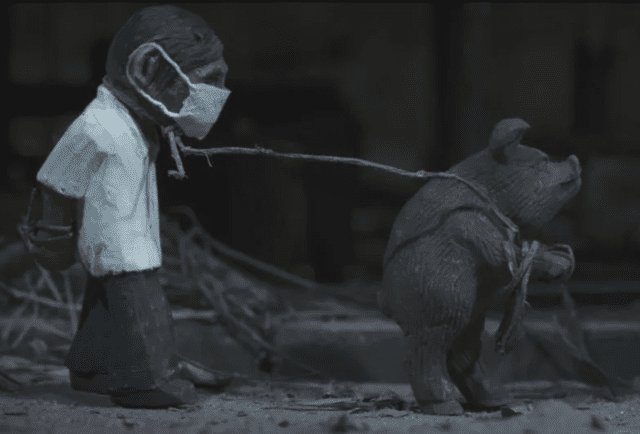
Stylistically, the film follows in the footsteps of Rithy Panh’s best-known work, The Missing Picture (2013) – the first Cambodian production ever to be Oscar-nominated as Best Foreign Language Film. In Everything Will Be OK, Panh again uses the little clay figurines with which, in The Missing Picture, he recreated his memories of the Khmer Rouge, a genocidal regime which had managed to keep most of its crimes from being caught on camera. In Everything Will Be OK, these same little clay people and animals, shot with lots of close-ups and shallow focus within elaborate sets, bring to life a fantastical and as-yet unseen future. It is almost unbelievable, how alive these immobile figures seem to be, appearing as vulnerable, hesitant individuals in a world that cannot – or could not – be filmed.
Borni in 1964, Rithy Panh lost his family to the horrors of the Khmer Rouge dictatorship and fled Cambodia in 1979, ending up in Paris. He became the foremost cinematic chronicler of the Khmer Rouge, creating a cinematic record of a regime which strongly resisted being filmed. Panh often mixes fiction and non-fiction techniques, whatever helps to tell the stories that need to be told, from a docudrama like Bophana: A Cambodian Tragedy (1996) to the on-camera reenactments by former Khmer Rouge prison guards in the heart-wrenching S-21: The Khmer Rouge Killing Machine (2003).
In Everything Will Be OK, Panh takes this hybrid approach to the next level. Documentary archive footage and fiction features are merged on the screens upon which the animals – led, as in George Orwell’s ‘Animal Farm’, by a pig – study human behaviour. It’s a futuristic setting which Panh uses to confront the past and present. Seen by a pig, all totalitarian states seem alike. On the screens, Pol Pot is joined by Stalin, Hitler and Mao; the animals copying their gestures, flag waving and methods of oppression. But there are also references to Stanley Kubrick’s 2001: A Space Odyssey (1968), when a black monolith rises in the desert; and to Fritz Lang’s Metropolis (1927), whose downtrodden masses appear throughout Panh’s film. Meanwhile the title ‘Everything Will Be OK’ is taken from a T-shirt worn during the Myanmar anti-coup protests by a teenager who was subsequently killed by the junta’s security forces.
Panh compresses a century of repressive and violent dictatorships – portrayed in fiction and non-fiction, in reportage and re-enactment – into a mind-boggling and gruesome glimpse of a future in which humanity is all but lost. But Panh doesn’t even stop there. After having the animals in Everything Will Be OK study shocking historical footage of people being executed, shot through the head and dumped into ditches, he presents them with bloody scenes from intensive factory farming, where livestock are mechanically and ruthlessly abused. So that, once in control, the animals are not only copying the way they have seen humans treat other humans, but also avenging the horrors inflected on their kin.
Panh, whose previous films have not only documented the Khmer Rouge but also critiqued modern capitalist Cambodia, points to the Covid-19 epidemic by giving some of his figurines mouth masks, and adds yet another layer by commenting on the many screens that aid the animals in controlling the masses. It’s no coincidence that Everything Will Be OK starts in an empty cinema hall. Here, not just the picture is missing, but even the audience. With its omnipresent screens, Everything Will Be OK at first seems like the opposite of The Missing Picture. But in effect, the message is similar: it’s the absence of art, of cinema, having been replaced by hundreds of little screens with commodified imagery, state surveillance and computerised facial recognition, as another kind of dictatorial oppression. Just as the Khmer Rouge eradicated any kind of artistic, free-thinking expression. But by removing art, the voice-over reminds us, you only sow hate.
The French voice-over is the only real issue I have with Everything Will Be OK. The literary, poetically inclined texts are often hard to follow. The general themes are clear enough, but I got lost in the specifics. Especially when the poetic musings are combined with fast-paced split-screen montage sequences (reminiscent of Panh’s Irradiated, which won the Berlinale Documentary Award in 2020). The fact that only one voice recites both monologues and dialogues in a rather monotone manner, does not help.
On the other hand, it also has a kind of mesmerising effect, mixed with the overwhelming sound design, which combines the haunting musical patterns of composer Marc Marder with historical soundbites (of Russian or German or a distorted version of The Internationale) and the almost continuous grunting and growling of the animals into a nightmarish whole.
Ultimately, as an essay on totalitarianism, Everything Will Be OK is more of an experience than an analysis. It wants to make us feel something, maybe even partly subconsciously. Rithy Panh has said he enjoys the parables of Jean de la Fontaine. And that is what this is: a parable of human folly. Imagined by someone who, through his own horrific experience, knows totalitarianism when he sees it, and who, through his mastery of the art of cinema, can share some of those feelings with us.
France / Cambodia, 2022, 98 minutes
Director Rithy Panh
Production CDP
Producer Catherine Dussart
Script Rithy Panh, Agnès Sénémaud
Cinematography Rithy Panh, Prum Mesa
Editing Rithy Panh
Production design Sarit Mang
Sound Eric Tisserand
Music Marc Marder
With Rebecca Marder (voice)