

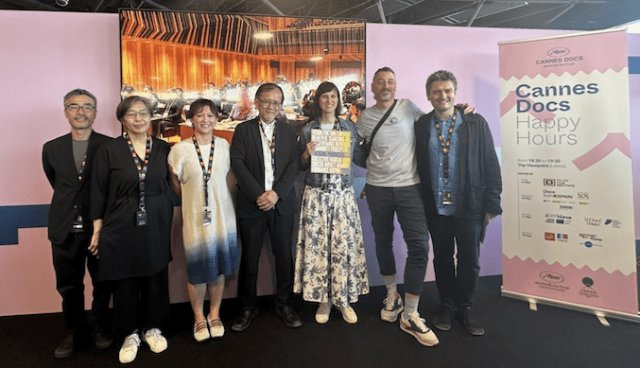
Before the May 17 Ji.hlava IDFF/J-Docs Hub reception at Cannes Marché, Yamagata IDFF’s Asako Fujioka (second from left, above) sat down with BDE to discuss the new J-DocsHub initiative, whose goal is to create “a structured pathway for Japanese documentary makers to engage with the global market, develop internationally competitive projects, and build long-term partnerships with overseas producers, broadcasters, and distributors.”
The J-DocsHub international documentary talent development program is run by Tokyo Docs and supported by the Japan Creator Support Fund, established within the Japan Arts Council. Fujioka sits on the steering committee, while Oscar-nominated director/editor Ema Ryan Yamazaki (Instruments of a Beating Heart) is a member the initiative’s advisory committee.
Fujioka tells BDE how J-DocsHub is looking to plug a structural gap between strong Japanese content and weak international access. While Japanese docs are generally admired for their compelling storytelling, distinctive perspectives, and high production quality, their presence in the international market remains limited. One of the main reasons is the lack of a systematic framework to support their international development.
The J-DocsHub programme focuses on practical skills such as pitching, financing, and international strategy, and networking to connect participants to global markets, festivals, and decision-makers. Hub staff will look to support project development through mentorship and continuous feedback.
The programme’s five-year trajectory starts with training, via participation in international festivals and pitching markets, eventually enabling participants to move step by step from learning to real-world international engagement.
Fujioka argues that, over past years, funding for docs has fallen between the cracks of support offered by the Japanese Ministry of Trade & Industry and the Ministry of Culture, and hence finance of the documentary sector has been “fragmented.”
“It [was] like a hot potato,” she tells BDE. “But belatedly, the government, the ministries, are consolidating their efforts, and they think that sending creative documentary content and talent to the world is one of the assets of their strategy.”
“Finally, now we have a slate of programmes,” she adds. “We have a training programme in Japan and are trying to outreach with our international colleagues to see where we can send our filmmakers, where we can train, how we can collaborate.”
In 2026/27, Japan will also be the Guest country of Ji.hlava IDFF’s Emerging Producers programme, when a Japanese producer will receive educational, networking and promotional support alongside 17 European counterparts. The names of all participants will be announced during Sarajevo FF/Cinelink.
“Eventually we would love to co-produce. We would have Japanese filmmakers to learn more about the partnerships that they can gain from co-producing with foreign countries,” Fujioka further tells BDE.
“I think that stories from Japan have been very few in the creative documentary world,” she adds. “And this is a way to incubate internationally-minded documentary filmmakers from Japan. It would definitely benefit the broadcasters or any kind of producers, or exhibitors of film festivals of the world. They will have higher quality films, and they will be able to see different stories from Japan that are not the stereotyped outside gaze of foreigners to Japan.”
“For a long time, Japanese filmmakers think that they will finish their masterpiece and then sell it to the film festivals, or something like that. But the reality of the industry right now is not like that. You have to get in early. You have to get to know the people. It’s a really an ecosystem that takes time for the filmmakers to grow their films in. And I think this initiative will help them do that. And that it will lead to better films and to better collaborations,” Fujioka signs off.





