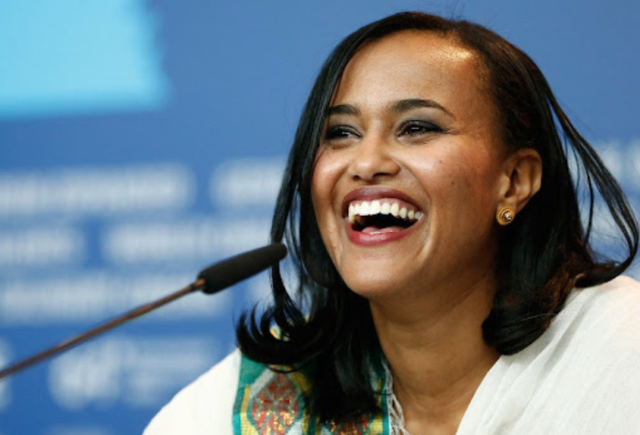
How can the film industry – and in particular documentary makers – move beyond empathy? How can they fight their prejudices and deal with their emotions? How fresh (or outdated) is the concept of impact? These were some of the questions tackled during Mehret Mandefro’s Cannes Docs keynote speech on Doc Day, May 23.
Mandefro is an Emmy-nominated producer, writer, director and co-founder of various organisations at the intersection of social impact and media in the US, Ethiopia, and across Africa at large.
First, Mandefro asked the audience to identify the first images and stories that come to mind when thinking about the African continent. Some attendees provided answers like ‘the African map’, ‘lack of food’, ‘the Rift valley’, ‘a particular place where I stood’, ‘the image of a Masai’, ‘Nelson Mandela’, ‘elephant poaching’ and ‘a dead body on a street.’
Next, Mandefro asked whether they thought about Africa as the fastest growing economy in the world, or Addis Ababa as its fastest growing city, or even about the continent’s fabulous museums, amusement parks, contemporary architecture or Johannesburg, Africa’s most culturally vibrant city.
She also told the audience that the most educated immigrant group in the US are Nigerians, and explained how Africa’s audiovisual industry is booming, currently employing 5 million people and generating $5 billion in revenues, with the potential to top 20 million workers and $20 billion in revenues, according to a recent UNESCO report.
“There’s quite a contrast between this image and some of the stories and images you have shared. That’s what I want to talk about today, and in particular growth.” She said. “Whether you look at economic metrics, cultural indicators, demographics… Africa represents all kinds of growth right now.”
“But the images…that circulate about that place are still different, there’s a gap there. And what’s that gap? Why is it [so]? Even though there’s plenty of evidence of that modern, bursting growth, it seems we can’t change that story…”
“Storytelling obviously has a lot to do with it. Storytelling in its best forms – fiction or docs – is supposed to lessen that gap, but often in the continent [of Africa] and other places around the world it doesn’t do that,” said Mandefro.
She highlighted how this tendency is present even more in documentaries. This doesn’t necessarily imply the makers’ bad intentions but the presence of “a structural problem,” she underlined.
She invited the audience to think about the films that get financed and why, also about their makers, the festival selection committees and the juries that will vote on these films. “Financing makes it hard to tell nuanced stories from the inside. At almost every juncture, it seems you’re disconnected from this idea of growth. […] I started thinking about these issues out of necessity,” she said.
Then she spoke about how the concept of impact needs to be redefined, even though it’s been widely discussed and used as a principle for funding decisions. Referring to a study commissioned by the Ford Foundation, Mandefro warns how some organisations often ask for impact evaluation for both fiction and documentary, “especially in countries where authoritarian structures will kill you [for the work undertaken on impact campaigns]… There’s serious consequences with your life.”
During her research, she interviewed over 40 storytellers – many of whom were from the Global South – and familiarised herself with the traumatic experiences they had. Some wanted to tell “a story about changing the world,” but they ended up doing harm both to themselves and others. Mandefro questioned how the whole development and production ecosystem can change so that these traumatic experiences can be eliminated. “Can we ‘impact’ impact?” she asked.
“So many stories tend to be about issues. The idea is that, usually, you want to disrupt the order. What happens often is that you end up maintaining it,” she added. Mandefro cited an article about the evolution of impact published by Filmmaker Magazine last August (https://filmmakermagazine.com/116071-the-evolution-of-documentary-impact/ In it, filmmakers claim they need to talk about “the impact of the industry, making the industry [itself] the target of the impact [campaign].”
“When you start to unpack, what they really ask for is an evolution of what impact filmmaking is and what would that look like,” said Mandefro.
She later mentioned a concept she stumbled upon reading Brené Brown’s book ‘The Atlas of Heart.’ “I highly recommend it for all storytellers, [since] what we do is about emotions. […] When I read it, it instantly made sense of many dynamics we are living in the documentary community.”
In this book, Brown explores the concept of ‘near enemies,’ labelled as ‘states of mind that feel similar but come from a different place.’ Mandefro explained how far enemies, instead, tend to be “super-opposite” – for example, the far enemy of compassion is cruelty, whilst its closest one is pity.
“Compassion is [about] openness, an expression of kindness rooted in a common humanity. Pity, on the other hand, sets up the separation, a space between ourselves and others. Whereas compassion is kind of sharing…when you pity someone, there’s actually nothing worse than being pitied…”
“On the surface, the near enemies of the emotions might look, experience and even [feel] like connecting us, but ultimately they drive us to disconnect from ourselves,” she said.
Mandefro argued that classical works including Greek tragedies define pity as “one of the most profound ways to move an audience.” Recent researches show, however, that this actually fuels disconnection. Makers often act “in the name of changing the world,” but the structures and cultural support in place lead them towards opposite directions.
But how can we go beyond empathy? Mandefro suggested a few ideas to put into practice. Some of these tips include “asking the right questions within your organisations,” paying attention to the juries and selection committees’ opinions (often biased and focusing on very specific POVs), realising that often empathy “goes wrong” when “we use stories to confirm what we know about the world or what we think we know about the world,” and encouraging festival discussions about these topics so that these forums can make informed decisions.
Finally, she touched upon Brown’s definition of empathy, conceived as “just about knowing a feeling.” “If you’ve ever experienced love, joy, pain, sorrow, that’s what it is about.”
“Empathy is connecting to a feeling and saying ‘you’re not alone’ and leaving it right there, not falling into your own feelings…it’s different from saying: ‘I know what it’s like walking in other people’s shoes.’”
In asserting such sentiments, Mandefro warns we might be “assuming things we don’t understand or know, and often there’s an implicit judgment in it.” She suggested that we refrain from using such sentences, in order to “suspend” judgement on others.