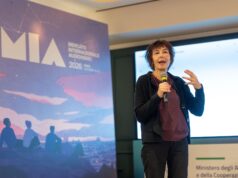
On May 20, the Cannes Docs hosted a conversation titled ‘The (market) value of creative documentaries.’ The talk was moderated by Documentary Association of Europe (DAE) co-director Brigid O’Shea, and saw the participation of Visions du Réel’s artistic director Emilie Bujès, the Museum Of The Moving Image’s Associate Curator of Film Edo Choi, and Grasshopper Film’s founder Ryan Krivoshey.
O’Shea first criticised the highly pessimistic narrative around creative documentaries being impossible to distribute, the supposed struggle to engage audiences and how they allegedly suffer under the influence of streamers. She then introduced the elephant in the room, namely the “real value” of creative documentaries, and how to find new ways to make them impactful and profitable outside of the traditional theatrical and linear TV circuits.
After introductions, Museum Of The Moving Image’s Choi spoke about his curatorial work which is mostly handled by himself and another colleague, occasionally with the help of some external consultants. “Overall, it’s pretty intimate. We’re not a submission festival. We don’t have a platform to do that, we’re very small. We do a lot of research on international festivals’ line-ups such as that of Visions du Réel. What is special to me about it is that we personally believe in what we’re showing. It’s coming from that, and not from other calculations larger festivals may have.”
Bujès later touched upon her work for the Nyon-based event. “One of the particularities of Visions du Réel is that it takes place in a small town in Switzerland. It’s pretty absurd doing it in this small town […] But it’s really easy to meet people and to create the festival. The festival becomes the whole town.”
The core of her work is about “expanding things cinematically and in terms of cinemagoers,” as well as “contributing to make non-fiction and documentary less of a ghetto” and “discovering new people and films.”
“We got 3,000 submissions this year and we create our selection out of these. We host about 80-90 world premieres, [because our festival] is really about launching new films. There’s always this issue of world premieres, and it can be painful. I’d be happy to programme something that is already out there, but it’s important to give room to new films. […] It’s really about creating an atmosphere, a context that is fertile for everyone,” she further explains.
Krivoshey spoke about his work for Grasshopper Film and zoomed in the launch of Projectr, a streaming platform whose catalogue has been compiled in co-operation with public libraries and educational institutions across North America. Eligible residents can access to roughly 1,000 films for free.
O’Shea then asked panelists to address the defining both of creative documentaries and experimental films.
Choi answered how he tends “to keep an open mind to what a creative documentary, or [what] an author-driven documentary is…I look for films that retain the spirit of interdependent cinema not necessarily resembling what this was in the past.”
Krivoshey underscored how the terms “hybrid” and “experimental” are now more widely accepted. “We released Sweetgrass [in 2009] and it was seen as radical and experimental back then. […] Now that film is hardly viewed as experimental. Once it was a taboo word, but that has considerably changed these days, and I think it’s positive.”
Bujès doesn’t use the word “experimental,” because it tends to scare away the general audience. The festival strategy is to “let people enter through one door” and then push them towards a direction they wouldn’t expect to take. “Our role is to fight for people to be aware that these films at least exist, and then allow them to understand they’re not boring, not scary, there are lots of preconceived ideas, [since] they are different from we’re used to watch.” Bujès applies the same balance within her industry programming strategies, selecting projects that are more “understandable,” with some that are more challenging, “maybe a bit too artsy” for a general audience, but still worth giving them a chance.
On the topic of challenging festival premieres as “the pinnacle of a creative doc’s distribution,” Krivoshey admitted this model doesn’t work as it should, since “most of the time this [model] works against the benefits of the filmmakers.”
“Certain films premiere at certain festivals just to get a certain logo or laurel, but if you’re overlooked and the press is focused on the big, Oscars-baited premieres, it’ll be much more difficult to gain a foothold in the distribution landscape,” he said, adding that the US theatrical landscape for documentaries is navigating difficult waters, but there are still many other avenues available for distribution, including event screenings and community screenings.
On the same topic, Choi explained that a “big fish” title doesn’t necessarily benefit either his event or the film itself, as the film teams may have too high expectations. “We’re more and more trying to find the right moment, [when] the team is very enthusiastic about coming to us and, of course, we’re enthusiastic about their work [too].” Krivoshey agreed, adding that being honest about the realistic potential of the film is indeed essential, so this aspect needs always to be discussed with the producers beforehand, he said.
The panel was rounded off by a Q&A session. One of the attendees asked whether Krivoshey’s team themselves create and provide supplementary material and study guides to accompany the films of their Projectr catalogue along their non-theatrical distribution path. Krivoshey answered that the materials are written by his team in close co-operation with the projects’ directors and producers, citing one of their titles, Steve James’ The Interrupters. In detail, the documentary gained great traction through a number of screenings taking place in working groups, community centres and prisons around the country. The project has been so impactful that the study of the film has been included in the study curricula of some schools and university faculties.