In Swedish director Carl Olsson’s Vintersaga, selected for Dox:Award and sold by CAT&Docs, we meet a cast of 55 ordinary folk who do and say ordinary things across 24 scenes.
They were cast for their very ordinariness, and were asked not to go beyond the realms of the ordinary in the dialogues that they share. There is no discernible narrative (director Olsson admits to disliking drama in all its artificiality), no tension, disputes, intrigue or resolutions (although there is one pretty graphic sex scene, presented in all of its perfunctory ordinariness). And the people, in the main, remain in the frame, as requested by the director.
Yet what makes Vintersaga extraordinary is the manner it is presented and the processes that Olsson follows. It is a work of balance and control, and it plays to the rhythms and cadence of the 24-stanza song which spawned, or at least influenced, its very production. The mise-en-scène is formal, rigid, unwavering, even when the static camera is mounted on a moving vehicle. It is a winter song and therefore most of it is shot at night or in the failing light. And unlike just about any other documentary we are encouraged to watch, we rarely get to know the names of the protagonists, and we would do well to recognize them again on the street.
But over the course of 82 minutes we get to know and even like these folk, despite their being plucked from, and returned to, a place of general anonymity. They remain in the consciousness, despite their ordinariness. And therefore the whole work is infused with a satisfying sense of melancholy, as well as a dollop of humour, and a huge dose of humanity.
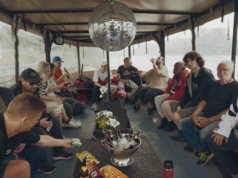
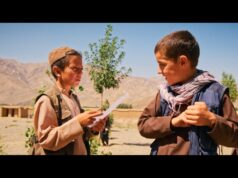
So what do we see? We see two bird watchers setting up for the day beside coastal rocks. A woman kick-sledges along a snowy road. Two adolescent girls in a car discuss make-up. Two men indulge in mildly drunken camaraderie in a pub. A middle-aged couple (maybe they are having a fling, maybe they are long-married) talk flirtatiously at a bar (later they have sex before Olsson’s static camera). A car gyrates noisily within a dockyard compound, its tyres throwing up plumes of smoke. Two Muslin brothers discuss fraternal disharmony outside the bakery where they work. A royalist MC leads a group of formal diners in a toast to the king. Five or six likely lads walk along a tunnel singing football songs. Two manual workers in a cabin discuss stock market activity. A young and beautiful couple discuss marriage while jacking up heroin in a stairwell. And so on…All very ordinary.
“It’s always a balance or a dance,” director Olsson tells BDE of the directing that entails such an approach. “How much can I can push the language, push the setting, without disturbing this very fragile authenticity?” The director doesn’t refer to working in a ‘genre’, rather he works to a ‘method.’ And it is a method that requires time to allow ordinary folk to relax and to forget that the camera is in ‘play’ mode. “Then I kind of trust that there’s always going to be something in that scene, that is going to be human and interesting in some way, and something that is recognizable.”
Olsson was inspired by the song Vintersaga, written by Ted Ström in 1984. What intrigued the director was the song’s fragmentary structure, “and how that could be stronger than a narrative,” he underlines. There’s no “explanation” given or “conclusion” drawn within the song. “It is strong because I, as an audience or listener, have to put the dots together myself…[Ström] lays the power of interpretation over to the audience.”
“So I want to do the same thing in film. I hope this film can be read at many different levels. That the right of interpretation, the right to draw conclusions is with the audience,” Olsson adds.
There is, in the film, that sense of dark humour for which the Nordics are renowned, maybe a characteristic that derives from the long winters, the cold, the paucity of light, the elongated passing of time. And the flipside of this is a tendency towards melancholia, which Olsson very much acknowledges in the film.
“Apart from being a somewhat self-defining part of Scandinavian mentality, melancholy is a multifaceted term as it embraces feelings that are in fact contradictory,” he writes in his Vintersaga notes. “There is sadness, but also a kind of romantic beauty. A memory of a deceased friend can be painful, but at the same time we do not want to let it go. Melancholy as a concept has complexity enough to generate diverse interpretations, which makes it interesting to work with in an artistic context.”