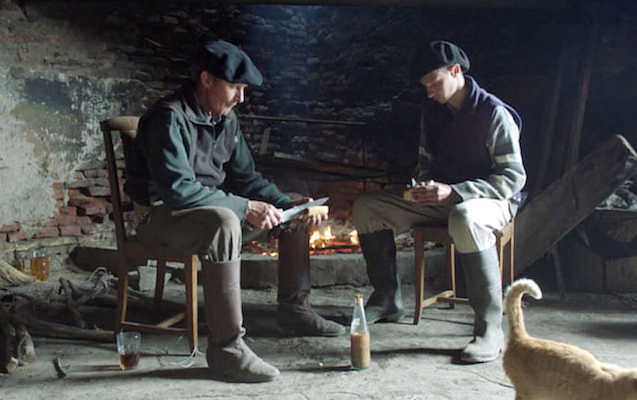
Juan Alvaro Hein’s Oriente is a western documentary revolving around fatherhood and identity experienced through three Danish-Argentinian gauchos. Gustavo is 52 years old and has spent his life working with horses in the pampas. In the eponymous town, the man lives with his son Leandro and he is in charge of a large farm known as ‘El Rincón.’
We also meet Pitu, now 25 and the 12th brother of 13 siblings. He has been an orphan since he was 12 and has been fostered in different homes, away from his brothers and sisters.
The story of Gustavo, Leandro and Pitu was pitched at this year’s CPH:DOX as part of the Forum pitch presentations held on March 19.
The project is a Danish-Argentinian co-production courtesy of Sidsel Lønvig Siersted (best known for her producing credit on IDFA 2022 winner Apolonia, Apolonia) for Copenhagen-based firm Good Company Films, and Buenos Aires-based outfit Cactus Cine LCC. Hein is a visual artist and filmmaker whose body of work spans documentary, photography and conceptual art, now developing his first feature doc. His previous credits include the shorts Water and Blood (2020), The Kiss (2016) and The Killing of a Danish Swan (2012).
The director began working on the project while reflecting on his own Danish-Argentinian “hybrid identity.” “Through some friends I’ve heard about this little town south of Buenos Aires called Oriente, full of people of Danish descent. I went down there to discover the community. What I found out was something else. These people are of Danish descent, of course, but I’ve also discovered something different, something about [their own] relationships – those between men, fathers and sons, men and nature, tradition and modern life,” said Hein, adding how the gaucho culture is gradually fading away.
Next, he introduced the two protagonists featured in the trailer. The first is the aforementioned Gustavo, who controls his huge plot of land extended over 700 hectares. He oversees seven people and 120 horses. The second is his youngest son, 32-year-old Leandro. Meanwhile, we get to know the notorious “virus from the West” that is threatening the farm’s horses by attacking their nervous system and, as a consequence, the gaucho “way of life.” Moreover, we find out that at some point Gustavo is forced to sell his horses as he needs money to save the ranch.
After showing the trailer, Hein moved on to introducing the other protagonist of the doc, Pitu, whose real name is Luis Palmas. He is about to become a father, and he forms “a special bond” with veteran Gustavo. Hein bills his film as “a simple but significant story of human connection” depicting “the downfall of nature and [of a] culture.”
“In this story, these three men are taking centre stage because they are all forced to rethink their lives.”
In his director’s notes, Hein aims to use “the cinematic experience to stir emotions and perspectives by inviting the audiences to reflect on their own connections with the natural world and fellow human beings.”
“We plan to wrap shooting this summer, with delivery planned in early 2025. We’ve all rights available, and we’re looking for production, funds, pre-sales, distribution partners as well as sales agents,” added Lønvig Siersted at the end of the session.
The panellists warmly welcomed the project, praising in particular its solid concept, its emotional and lyrical potential as well as the first images shown in the trailer. When asked by one of the panellists whether he is planning to encapsulate the socio-political dimension of gaucho life in his work, Hein replies: “Yes, absolutely it’s a theme we can’t escape from but it is for me [something that should stay] much more in the background, because what is happening here [in this film] needs to focus on this microcosm, these dynamics, and these characters.”