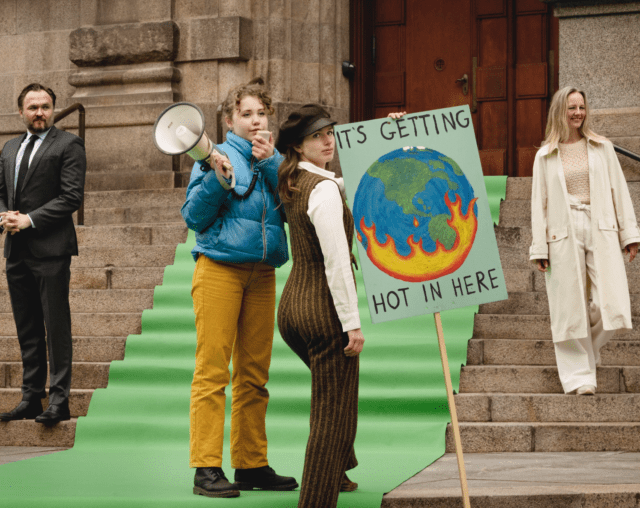
The conflict between politics and public protest provides the enthralling backdrop for the emotional rollercoaster ride that has been the creation of the Danish climate law that promises the reduction of the country’s C02 emissions by 70% before 2030. Phie Ambo’s powerful new film, which opens this year’s CPH:DOX, follows a period of action and change as seen from the viewpoint of both politicians and activists.
The film veers between being inspiring and insightful to depressing and challenging, but also reflects the general acknowledgement that climate change is real, that things have to change and that politicians – even those as open, ethical and supportive as some of those living in Denmark – have to respond to public opinion and anger.
Remarkable (and astutely deployed) access to the Danish corridors of power is the key driver of Ambo’s film. Yes, there is judicious and appropriate on-screen balance provided by the young campaigners who have been so vital to the Danish protests, with the thoughtful and passionate views and activities of two young climate activists Esther Kjeldahl and Selma de Montgomery front and centre. But the spine of the film is the work of climate minister Dan Jørgensen and the former chair of the climate committee Ida Auken who work to bring real political change to Denmark.
In 2019, thousands of Danish children and youths took to the streets. They stayed away from school to demonstrate for the climate. They mobilised their schoolmates, parents and grandparents, and demanded action. When elections were called later the same year, it was clear that green climate policies attracted voters, so suddenly the climate was at the top of the political agenda. New Prime Minister Mette Frederiksen responded to the protests and promised change.
But core to matters has been whether politicians, citizens and industry would be able to unite to make Denmark a green pioneer? Or will the election promises and green ambitions crumble when the new climate law goes face to face with political and industrial reality?
With access both to political wranglings behind the scenes and the battle waged by young activists on the streets, Phie Ambo’s doc charts a fascinating period. Dan Jørgensen and Ida Auken are on the same page, but political will and green ambition as ever make uneasy bedfellows. Yet as the film follows them through a series of meetings, their desire for real change helps forge a shared agenda with other political parties, with the debate around Denmark’s North Sea oil and gas reserves the real elephant in the room, especially given the binding contracts with mining companies are in place until 2052.
The film’s halfway point sees the landmark agreement in February 2020, with Jørgensen commenting that “we have the world’s strongest climate deal…we have eight parties with 167 mandates, which means it is a binding agreement.”
But what should have been a grand départ soon started to stutter. In April that year, as Covid started to have an impact around the world, Ida Auken stated that she was ill with stress, and so her charismatic personality was a loss to meetings. In June 2020 Prime Minister Mette Frederiksen made a speech saying: “If we decide on a path to be 70%, based solely on the technological tools we know, the consequences will be too great. We will lose Danish companies, lose Danish jobs.”
This quickly provoked response on the streets, with the young climate change activists blocking roads, angrily responding in the media and staging a loud protest in October that year as Parliament was re-opened, with the Government eventually acknowledging commitment to the climate plan, announcing energy islands in the North Sea and deciding to stop gas and oil exploration after 2050. The end of the film also sees a brief interview (at Christmas) with Ida Auken who appears relaxed and generally positive about the future.
The film is, naturally, very much a snapshot of a turbulent period. The fickle world of politics changes all the time but meaningful change tends to move slowly. Carbon taxes remain a major issue in the country and in February 2021 the Danish Council on Climate Council found it unlikely that Frederiksen’s government will achieve the target of a 70% reduction of greenhouse gases by 2030.
Nevertheless, the activist young people of Denmark will continue to fight…
Denmark, 2021, 98mins
Dir/cinematography Phie Ambo
Production Hansen & Pedersen, Viola Lucia Film
Producer Malene Flindt Pedersen
Editor Mads Michael Olsen
Music Johan Caroe