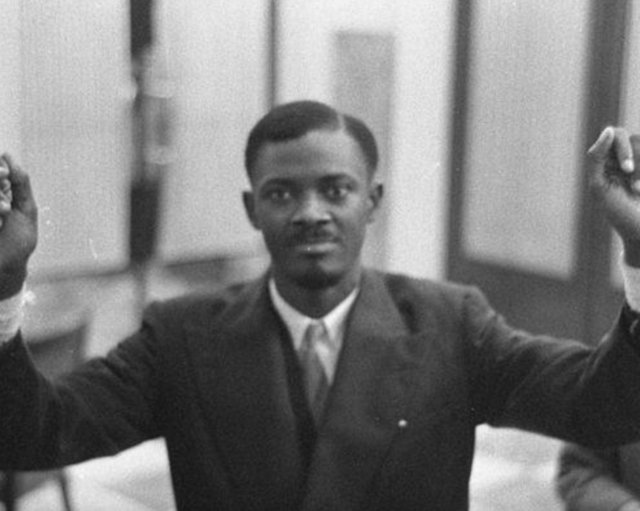
Director Johann Grimonprez and producers Daan Milius and Emmy Oost pitched their new project that fuses the promise of African decolonization in the 1960s, the rise of the US civil rights movement and the State Department’s mobilization of ‘jazz ambassadors’ for propaganda purposes.
“This film is about the promise of decolonization, the hope of the non-aligned movement and the dream of self-determination,” Belgian producer Daan Milius (zap-o-matik) told the international online audience during his CPH:FORUM presentation of Soundtrack to a coup d’état this week.
The film covers the period of instability after the 1961 murder of Congolese PM Patrice Lumumba, the rise of Pan Africanism and the US State Department’s response to international criticism of its race policies at home by forcing diplomacy through jazz.
“It is also about the multinational corporations working hand-in-glove with the privatized military industrial complex to smother this very dream [of self-determination],” Milius added.
The West, seeing the danger of losing access to lucrative ‘colonial riches’, were perturbed by the emerging Pan African movement that Lumumba personified. “Washington, exploiting the hiatus left by the crumbling colonial empires, cooked up a paranoid cold-war narrative to smother the African dream of sovereignty,” the film’s production notes read.
Director Johann Grimonprez added: “The film is as much about the political earthquake in the United Nations in September 1960, when 16 African countries including Congo were admitted to the General Assembly.” This caused a major shift in the balance of power whereby the African and Asian majority together with the Eastern Bloc “was actually calling the shots,” which was deemed a threat by the Western countries.
“Another [aspect of the project] is that the situation in the Congo in 1960 was the Ground Zero, and it was kind of the template for what is still going on today,” Grimonprez continued. “The corporations dictated very much what the situation would be in the Congo. And so what’s going on today in the Congo is not very different. It’s still the same corporations, with the aid of private armies, holding on to what is actually going on in the Congo. And so… this dream of self-determination was completely smothered in something that is very similar today.”
And so to jazz. “A third layer [in the film] is the connection to music, and the music in this sense becomes a protagonist, because what is going on in the Congo was sort of an inspiration for the civil rights movement and specifically to what was going on in jazz,” says producer Milius.
Racist US policies in the 1960 in the face of global interest in the civil rights movement determined that the Eisenhower administration felt compelled to act, and so turned to the likes of Louis Armstrong, who was sent to the Congo as a Jazz Ambassador “as a diversion.”
“It was a response to Soviet leader Nikita Khrushchev’s allegations of hypocrisy [by] the US,” Milius told BDE. “While there were many civil rights scandals in the US Khrushchev basically said, ‘you preach democracy worldwide, but keep on lynching black people in your own country.’”
Other musicians that were roped in as jazz ambassadors included Nina Simone, Duke Ellington, Dizzy Gillespie and Melba Liston, all of whom faced the painful dilemma of defending a country (the US) whose record on civil rights, as evidenced by its policies of segregation, was indefensible.
“[They] were sent out to those (so-called) friction zones to, in a way, sell the diplomacy and try to re-conquer the atmosphere of the non-aligned countries,” Milius added.
Co-producer Emmy Oost for Belgian production company Cassette for timescapes explained how the production is looking for international co-pro partners, TV partners and sales agents. The running time is 150 mins with an expected release date of February 2023. The total budget is €826k with €185k in place.